Positionen asks whether contemporary music is liberated or reshaped by the media environment. Including articles on AI and composition and ‘schweigen’/silence as performance.


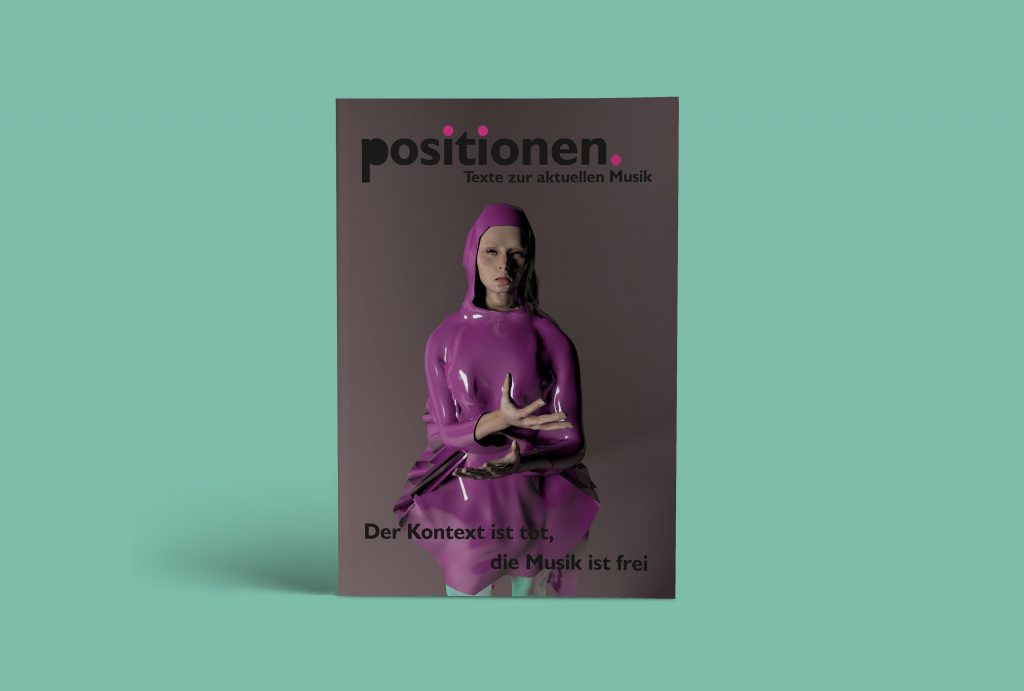 Positionen re-evaluates contemporary music’s apparent freedom from context, asking whether it is liberated or reshaped by the media environment.
AI: Composer Genoël von Lilienstern examines artificial intelligence’s impact on recent music production. AI’s musical advancements are set against its shortfalls and questions are raised regarding its overall efficiency, quality and hidden cheap labour. Lilienstern recognizes AI’s success in emulating punk, hardcore and heavy metal but questions its capacity to create something entirely new.
‘Perhaps mankind will eventually harness the high-levels of energy consumption required to get an extremely complex AI model up and running. Or, perhaps, when it does become possible, we would rather deal with completely different issues – pure survival, for example.’
 Silence: Nina Guo considers Schweigen – German for ‘being silent’ – as mode of action or non-performance. Some musicians choose not to perform in support of others, as was the case during the 1980s anti-Apartheid protests. Others do so to highlight their own plight, for example the Orquestra Sinfônica Brasiliera, whose members striked against the introduction of individual performance evaluations and threatened dismissals. But non-performers need an audience, Guo argues: ‘For disruption to work, there must be witnesses with thwarted expectations.’ Schweigen ‘becomes the ultimate freedom when artistic expression turns into a commodity.’
 Future music: Composer Alexander Schubert and graphic artist Pedro González Fernández have created an avatar named Av3ry that combines natural language processing, algorithmic composition, data crawling and machine learning. Av3ry chats to its audience, composes music and writes poems based on user-specified criteria. Might this be the context-free future of music in the making? Readers are invited to send Telegram messages and respond to the personalized songs received.
More articles from Positionen in Eurozine; Positionen’s website
Published 31 March 2020
Original in English
Contributed by Positionen © Eurozine
PDF/PRINT
Invest in insight!
After over 20 years of publishing for free, Eurozine needs your support to get through an exceptionally lean year.
Become a Patron and get exciting perks for your help!


Want to hear a human voice?
Listen and subscribe wherever
you get your podcasts.
Newsletter
Subscribe to know what’s worth thinking about.


Related Articles

Whether an Ivy League academic or a Patriot Front white nationalist, Curtis Yarvin will find your position too democratic. The once obscure blogger’s brand of postliberalism calls for a political system reboot popular with MAGA and Big Tech leaders. But does his eccentric mix of elitist, pseudo-religious and computational thought reflect chaos more than his desired order?

What should European politicians be focusing on in the forthcoming year? Europe needs to adjust to an increasingly multipolar world order, under pressure from US retrenchment and threatened military withdrawal, Russian cyber and trench warfare, and China’s technological dominance.