


Let our political imaginations soar
Blätter für deutsche und internationale Politik 10/2025
Gaza and the age of impunity; Islamism and leftwing anti-Zionism; dead-ends of Staatsräson; illiberal rap.
The German government’s decision to reinstate national service has hit resistance. Young activists, aligning climate protection and peace, are turning to pacifist groups. Ex-conscripts, now elderly, embody lessons of the nation’s past. Will following the lead of Scandinavian and Baltic countries, prioritizing civil defence, shift public opinion?
On the morning in which the German parliament voted in late 2025 to reinstate military service, protests spilled into the streets outside the Bundestag and across the country. The decision, unthinkable just a few years earlier, marked a sharp break with a political culture long defined by military restraint and the post-war mantra of ‘never again’. As lawmakers debated inside, chants and placards echoed for hours outside, underscoring how, more than 80 years after the fall of the Nazi regime, Germany remains deeply, and uniquely, unsettled about the use of force.
In Berlin, more than 3,000 young people joined what organizers called a ‘school strike against conscription’, marching behind handmade signs and chanting, ‘We don’t want to spend half a year of our lives in barracks, be trained in drill and obedience, and learn how to kill.’ The mood was disciplined and earnest – closer to a climate rally than a Cold War-era anti-war march. For many participants, the choreography of protest felt familiar, repurposed for a new political moment.
Yannick Kiesel recognized it immediately. A long-time environmental activist and 32-year-old geography graduate, he once urged students to skip school for Fridays for Future. Now, alarmed by what he sees as an accelerating militarization of German society, he has joined the German Peace Society–United War Resisters, or DFG-VK, a historic pillar of German pacifism.
During the Cold War, the DFG-VK helped guide a generation of young Germans through a constitutional provision that exists almost nowhere else: the right to refuse military service on moral grounds. West Germany enshrined that right in its Basic Law as a direct response to National Socialism and the crimes of the Wehrmacht – a safeguard intended to ensure the state could never again compel individuals to kill in its name. Over time, conscientious objection had evolved from a legal clause into a socially anchored movement, supported by churches, unions, student groups and, later, the Green Party.
After reunification and decades of relative peace, climate activism had eclipsed the peace movement as the dominant cause among younger Germans. But as the war in Ukraine reshaped Europe’s security order, fuelling debates over rebuilding Germany’s depleted armed forces, the DFG-VK had seen a surge of interest. On that December day, Kiesel urged protesters to reclaim what he says many see as a distinctly German constitutional right – and to reject the new law.
‘For me, it’s the same thing,’ he said, standing beneath banners reading ‘The youth are not cannon fodder.’ ‘This is Fridays for Future – applied to peace. Climate protection and peace belong together. Without peace, there is no climate justice.’ Kiesel views the legislation not as a pragmatic security measure but as a symbolic breach of a post-war taboo, and, he argues, a step towards compulsory service in an army he considers underfunded, outdated and morally compromised. Rearmament, he said, reflects misplaced priorities in a country where social inequality is growing and funding for education, youth programmes and social services is under strain. Young people, he added, are being told they must ‘do something for Germany’.
‘No,’ Kiesel said. ‘I won’t defend my country, because I don’t know what there is left to defend.’
The mass protests against the return of military service were not just a reaction to a single law. They exposed a deeper fault line in Germany – one rooted in its post-war history and German society’s unresolved relationship with military force now colliding with a rapidly deteriorating security environment in Europe. Russia’s full-scale invasion of Ukraine has forced Germany into a reckoning that would have seemed implausible only a few years ago. Warnings from political leaders and security analysts that Moscow could attack another European country before the end of the decade have pushed Berlin into its most ambitious rearmament effort since the Cold War – a shift former Chancellor Olaf Scholz labelled a Zeitenwende, or change of era, when he announced a 100-billion-euro investment in the armed forces days after the Russian invasion of Ukraine.
At the centre of the effort is the Wehrdienst-Modernisierungsgesetz, or Military Service Modernization Act – a law that marks Germany’s most significant move towards rebuilding military manpower since conscription was suspended in 2011. The legislation establishes a new framework for military service, focused on a volunteer-first model with mandatory questionnaires and health assessments for 18-year-olds, while allowing the parliament to activate a needs-based form of conscription (Bedarfswehrpflicht) if volunteer numbers fall short.
The goal is to identify potential recruits more efficiently and reverse a steady erosion of personnel that has left the German military, the Bundeswehr, short-staffed and overstretched. With incentives including higher pay, free driver’s licences and bonuses for longer service, the government hopes to raise troop levels from roughly 180,000 towards the NATO target of 260,000 by the early 2030s, while expanding the reserve force from about 50,000 to 200,000.
The law, passed only after months of one of the most acrimonious national debates in recent memory, represents a difficult compromise. It is far more cautious than Chancellor Friedrich Merz had suggested months earlier. Standing alongside NATO’s Supreme Allied Commander Europe, General Alexus Grynkewich, Merz spoke of turning the Bundeswehr into Europe’s strongest conventional army. The legislation, however, stops short of reinstating a full draft, but it explicitly requires lawmakers to revisit compulsory service if too few volunteers step forward.
Even so, the government has struggled to explain to a largely pacifist society – particularly younger Germans – what it is that Germans should be prepared to defend, trying to convince them that defence should once again be understood as a shared civic responsibility, rather than the task of a professional minority. Critics on the left, including many members of the Social Democratic Party, had seen military service as a symbolic breach of a post-war taboo, warning that it risks sliding towards conscription without first addressing why the Bundeswehr remains unattractive to many young people. Most conservatives had argued that mandatory service is the only realistic way to build a force capable of meeting Germany’s obligations. Supporters of the compromise say a volunteer-first approach buys time to rebuild recruitment systems, housing, training facilities and infrastructure dismantled after the draft was suspended.
Public opinion reflects the tension at the heart of the Zeitenwende. Rising threats and allied expectations have pushed Germany towards a more assertive defence posture, even as a deeply ingrained culture of military restraint continues to shape attitudes at home. Polls show that while support for higher defence spending has increased, only 38 per cent of Germans say they would be willing to take up arms to defend the country.
Yet, by German standards, the shift is historic. For Roland Bösker, a long-time reservist, the law is less about troop numbers than about changing mentality – an attempt to break what he calls Germany’s long-standing ‘friendly indifference’ towards the Bundeswehr, the assumption that ‘somebody, somehow protected freedom and peace’.
Generations raised on peace and the imperative of ‘never again’, he said, never had to confront the question of military service directly. By forcing that question into the open, the new law ‘makes people think’, Bösker said. ‘And in Germany, that alone is already a turning point.’
Michael Harsch, an associate professor of national security at the Eisenhower School of the US National Defense University, sees the legislation as the latest step in a long and uneasy evolution – from an army designed to limit power to one expected to anchor Europe’s defence in a major land conflict, and from a society shaped by pacifism to one being asked to confront war as a lived possibility. The stakes, he said, are high. NATO’s Eastern Flank measures readiness in months, not decades. As Poland and other frontline states accelerate rearmament, Europe’s strategic centre of gravity is shifting eastward and Germany’s window to close its capability gaps is narrowing.
‘If successful,’ Harsch said, ‘Germany may complete its long journey from a country that associates power with guilt to one that understands power as responsibility in a changing geopolitical environment.’
The unease surrounding Germany’s defence debate runs deep and is rooted in history. For years after the Second World War, the very idea of a German army was morally fraught. The Wehrmacht had been dissolved, the country lay in ruins, and a reckoning with Nazism left not only physical devastation but a profound moral collapse. Militarism and nationalism had led to catastrophe. Rearmament was not merely controversial – it was taboo.
Out of that reckoning emerged a strategic culture of self-limitation, later called Kultur der Zurückhaltung – a culture of restraint, infused with a distinctly German pacifism. Avoiding the use of force was seen not as weakness but as responsibility. Power was something to be distrusted, tightly bound, and constantly justified.
During the Cold War, West Germany fielded one of NATO’s largest and most capable forces, peaking at more than 500,000 active troops and spending up to three per cent of GDP on defence. Yet it rarely deployed soldiers abroad. Military power was accepted as a necessity, not embraced as a tool of statecraft. At the same time, resistance began to take shape, especially in the 1970s and early 1980s, when the legacy of Nazism, the Cold War, rearmament and a rebellious younger generation collided. Peace and conscientious objection became central political issues. For many young Germans, the new state appeared morally unconvincing when it once again began recruiting soldiers.
The German Peace Society–United War Resisters built directly on this sentiment: conscientious objection was framed as an individual consequence of collective guilt. Peace groups argued that rearmament would make Germany a target. After 1945, the right to conscientious objection had ultimately been recognized as part of freedom of conscience and enshrined in the constitution, giving German pacifism a distinctive quality.
Russia’s full-scale invasion of Ukraine shattered assumptions overnight. Days later, Chancellor Olaf Scholz announced the Zeitenwende backed by 100 billion euros to modernize the Bundeswehr and meet NATO spending targets. The rhetoric was historic. The reality was sobering. Ammunition stocks were low, while major systems were unserviceable. The army’s chief reportedly described that the Bundeswehr was ‘more or less naked’. Defence Minister Boris Pistorius sharpened the message: Germany had to become kriegstüchtig – ready for war – not just militarily, but socially and mentally.
Spending rose rapidly. By 2024, Germany met NATO’s two per cent benchmark and became the second-largest military donor to Ukraine after the United States. But recruitment lagged, readiness targets slipped and the culture of restraint – embedded in society and Scholz’s own party – proved stubborn. Scholz’s coalition collapsed later that year. When Friedrich Merz took office in May 2025, Germany was still halfway through its defence reckoning. The Bundeswehr remained undersized and partially operational, even as pressure mounted from Washington and NATO’s Eastern Flank. Merz vowed to build Europe’s strongest conventional force.
His first move was fiscal. He loosened Germany’s constitutionally anchored debt brake – a milestone in a debt-averse country – clearing the way for a 500-billion-euro defence and infrastructure fund. Berlin signalled that nearly one trillion euros could be mobilized over a decade. Merz pledged to meet NATO’s five per cent benchmark by 2035. ‘Whatever it takes,’ he said.
Money, however, did not buy societal buy-in. Although an increasing number of Germans acknowledge the threat posed by Russia, few say they would take up arms themselves. In a recent poll, just 16 per cent said they would ‘definitely’ defend the country, while another 22 per cent said they ‘probably’ would. A large Bundeswehr survey showed similar results, particularly among young men. Support for defence spending is broad but support for personal obligation is not.
That tension erupted this past June, when senior Social Democrats published a controversial Friedenspapier – a ‘peace paper’ – outlining an alternative vision for Germany’s security policy. The paper stopped short of rejecting support for Ukraine but criticized what its authors described as a headlong rush into militarization, urging diplomacy, arms control, and eventual dialogue with Russia. The backlash was swift. Critics accused the authors of naïveté and Cold War nostalgia. Analysts, however, saw it as evidence of how deeply pacifism remains embedded in German political culture.
At the offices of the German Peace Society–United War Resisters, the phone rings more often than ever. ‘We actually have many older people who refused service in the 1960s, 70s and 80s,’ said Yannick Kiesel. ‘They’re coming back now and want advice. They bring their experiences with them – as if they somehow senses their stories would be needed again.’
Most calls, however, come from families. ‘Mothers, grandparents who are worried. We get calls from grandmothers calling on behalf of their grandchildren – 13, 14 years old,’ Kiesel said. ‘They can only apply for conscientious objection at 17 and a half, but the fear is already there.’ Kiesel describes a paradoxical situation: a peace movement shaped by two poles: the old, who speak from experience, and the young, who act out of uncertainty. ‘The middle is missing,’ he said. ‘The generation that grew up in peace never felt the need to actively stand up for peace.’
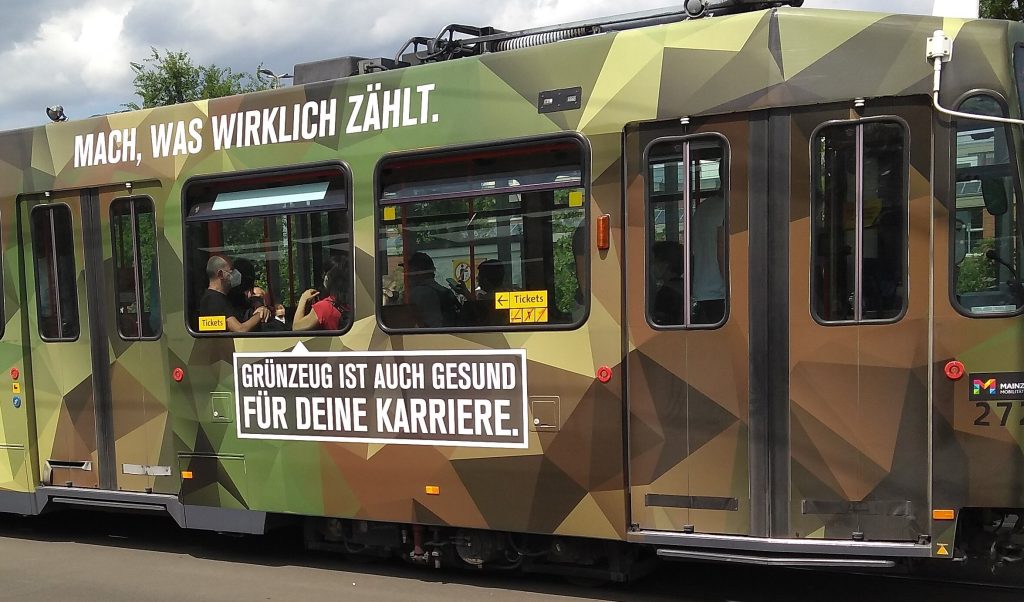
Recruitment advert, Germany. Image by Al-Lind-Smith via Wikimedia Commons
At the same time, the Bundeswehr is recruiting more aggressively than ever, with posters, YouTube series, influencers, and around 100 uniformed recruiters visiting schools. ‘And still they can’t make it work,’ Kiesel said. ‘Because the army is not an attractive employer. The moment you have to hold a rifle and shoot at someone who looks human, the romance is over.’
For him, the political narrative that Germany is defending ‘our freedom’ in Ukraine falls short. ‘People in Ukraine are dying because they are defending their own country, not our freedom,’ he said. ‘That’s a fallacy politicians keep returning to.’
The new military service law is meant to bridge the widening gap between Germany’s defence ambitions and public willingness to serve — and in doing so, it has ignited one of the country’s fiercest debates over security in decades. In mid-January 2026, the defence minister sought to project momentum. The Bundeswehr, he said, had reached its highest personnel level in more than a decade. ‘We have the best recruitment results since the suspension of conscription,’ Pistorius told reporters. ‘Young people are increasingly willing to contribute to Germany’s external security.’
Yet beyond official optimism, much of German society remains undecided about what that contribution should look like or whether it should be expected at all. That hesitation has fuelled a broader debate over the meaning of defence, one that has moved beyond parliamentary committees and military briefings into classrooms, protests, conference halls, and conversations like the one Yannick Kiesel helped spark outside the Bundestag.
‘Civil defence is not only about soldiers and weapons,’ Florian Constantin Feyerabend of the Konrad Adenauer Foundation told a packed audience at a recent conference at Berlin’s Nordic embassies, held just days before student protests erupted against the new service law. ‘It’s about everyday citizens – preparedness, volunteering, resilience.’
The event, titled ‘Civil Defence and Societal Resilience – Lessons from Russia’s War of Aggression and the Nordic-Baltic States’, was part of a growing effort to shift Germany’s defence debate from troop numbers and hardware to the resilience of society itself. Germany may have grown accustomed to peace, Feyerabend warned, but Moscow is waging a hybrid war that targets societies as much as armies.
‘Resilience is not optional,’ he said. ‘Ukraine shows it is essential for survival.’ The Nordic and Baltic states, he added, offer models Germany has barely begun to absorb — approaches that fuse military readiness with social cohesion, trust, and a deeply rooted security culture.
In Finland, Sweden, and the Baltics, defence is treated as a societal project. Civilian preparedness, crisis communication, and resistance to disinformation are core elements of national security. The experience of Russian occupation – or proximity to it – has made defence existential. Citizens are trained to respond to emergencies, protect infrastructure, and support the state in crisis, reducing the burden on overstretched militaries.
Germany, by contrast, dismantled much of its civil-defence infrastructure after the Cold War, betting that peace was permanent. ‘In Ukraine, resilience isn’t something the state hands down,’ Oksana Huss, a Ukrainian political scientist now at the University of Duisburg, Germany, told the audience that evening. ‘It’s built horizontally.’ After the 2014 Revolution of Dignity, she explained, local self-organization rewrote the social contract, networks that later kept towns functioning during Russia’s full-scale invasion. ‘In Germany,’ she added, ‘many still expect the state to handle everything. In a real crisis, that won’t work.’
Changing that mindset will take time. ‘The will to defend is there,’ Feyerabend said at a workshop titled Resilient by 2030: Is German Society Ready for Defense? ‘Now political leadership and society have to turn that will into real capability – including in the information space.’ He warned that Germany must move from a full-service state mentality toward shared responsibility, strengthening cognitive resilience against disinformation without tipping into panic.
For Roland Bösker, the tension is personal – and generational. Fresh out of high school in 1989, he decided to do military service and later trained as a reserve officer. When he proudly showed his uniform to his grandfather, the reaction was brutal. The older man had fought at Stalingrad, lost a leg, and carried shrapnel in his body for life. ‘He said, ‘Son, you’re an idiot. I lost my leg in a bloody war – why the hell do you want to be a soldier?’’
Bösker’s response came from the wars that were unfolding in the Balkans. ‘In Bosnia, innocent people were being slaughtered,’ he recalled. Turning away was not an option. After completing his service, he trained as a reserve officer, serving in places that include NATO’s Enhanced Forward Presence in Lithuania after Russia annexed Crimea, working alongside Baltic and Nordic forces for whom defence and societal resilience are existential realities, not abstractions.
For his grandfather, military service was inseparable from loss and guilt. Bösker insists his aim is not conquest but protection. One person may defend with a weapon; another in the fire brigade, civil defence, emergency relief, or elderly care. All contribute to resilience.
‘The Zeitenwende is not a decision,’ Bösker said. ‘It is a process – a societal process. What matters is not uniformity, but participation.’
He speaks openly about scenarios: NATO’s operational plan for Germany, the movement of hundreds of thousands of troops towards the Baltic states in a crisis, civilian hospitals treating the wounded, and bottlenecks affecting everyday life. Germany dismantled much of its civil-defence infrastructure after the Cold War, betting that peace was permanent.
Deterrence, he said, is not created through silence, but through preparedness. ‘The greater this awareness is,’ Bösker said, ‘the more resilient society becomes – and the less likely war is’.
While that awareness has not reached everyone, it is growing. In the end, Bösker said, the decisive question is not how many young people join the Bundeswehr, but that they are forced to confront the question at all. The Zeitenwende is not over. It has just begun.
Published 11 March 2026
Original in English
First published by New Eastern Europe 1-2/2026
Contributed by New Eastern Europe © Isabelle de Pommereau / New Eastern Europe / Eurozine
PDF/PRINT
After over 20 years of publishing for free, Eurozine needs your support to get through an exceptionally lean year.
Become a Patron and get exciting perks for your help!


Want to hear a human voice?
Listen and subscribe wherever
you get your podcasts.
Subscribe to know what’s worth thinking about.
Gaza and the age of impunity; Islamism and leftwing anti-Zionism; dead-ends of Staatsräson; illiberal rap.

Veganism is rising in countries with the most meat-heavy diets, especially amongst the young. How did this change come about? Standard Time dives deep into the meat-free diet and how an agricultural transition could benefit farmers.