
Clenched fists don’t make political theatre
Dialogi 3–4/2020
The Slovene journal talks to a theatre director taking political theatre beyond anticapitalist clichés; thoughts on the walkout as effective critique; and a debate on ‘punditocracy’.
War writing and the breakdown of the ability to narrate; defending democracy versus defending territory; Hollywood and 9/11; Charlotte Delbo’s theatre of survival.
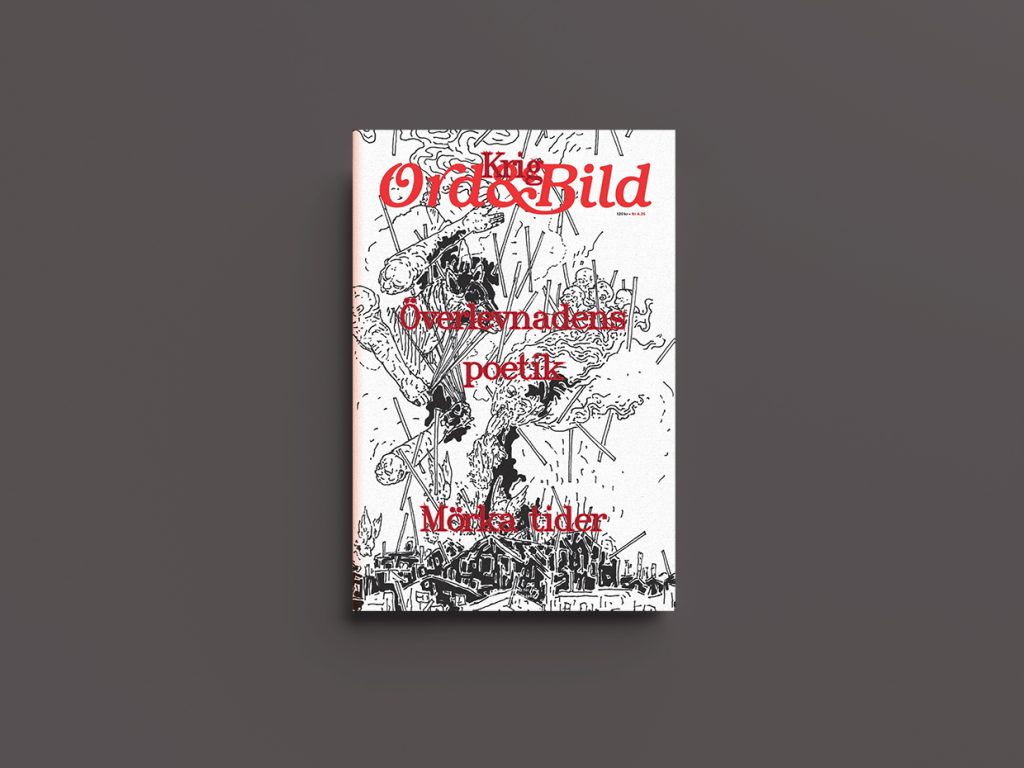
With war again a headline across all our screens, the thematic headlines on the cover of the latest issue of Ord & Bild read like a premonition, and possibly a fragmentary guidebook: ‘War – The Poetics of Survival – Dark Times’. Behind these red titles we can see the Syrian artist Muhammad Ali’s black and white drawing of exploded arms and debris. Ali’s cover is followed by pages of more of his images without words, only movement, chaos, distinct human forms, the logic of which are hard to make out.
Glimmering like coins reflecting in the dark pool of our times, the essays include reflections on the relationship between war and literature, Sweden’s entry into NATO, and explorations of the way that art and reality are inexorably intertwined, both as fascist sloganeering and as anti-fascist life writing.
Mattias Hagberg traces a long arc of western literature – beginning with The Iliad and ending with Pynchon and DeLillo – crafted in the shadow of war. While The Iliad provides a catalogue of cruelty and hate, in Stendhal’s account of the Napoleonic wars ‘it is as though a vulnerable power has come loose in the text’. The breakdown of the ability to narrate war, Hagberg writes, becomes even more acute with the mechanized wars of the twentieth century and their modernist and postmodernist literary reckonings.
Following the media theorist Friedrich Kittler, Hagberg calls Alexander Kluge’s WWII novel Air Raid (1964) an overlooked literary masterpiece of the twentieth century. It is a gathering of documents, fragments and information, which may just be the task of literature today: ‘to collect the debris that war is now spreading across the world’. Hagberg’s essay ends with a fragmentary news item from last year: ‘Sweden buys air defence systems for nine billion crowns’.
Rolf Almström reflects on the situation in Sweden since its rapid entry into NATO. The Swedish military claims that it is defending democracy and freedom, but what it is really defending is territory. It is up to the country’s citizens to defend democracy and freedom, Almström argues. But this has become more difficult with changes to Sweden’s constitution that outlaw speech or actions that can damage Sweden’s relationship with another state or international organization.
According to commentators, Swedish preparedness for war has been damaged by too much peace; but Almström makes clear that preparing for war brings its own damage – not to mention the damage caused by modern war itself, which always includes sexual violence and staggering civilian casualties.
Saga Cavallin reflects on the way that the 9/11 turned fiction into reality. Hollywood, she writes, had already blown-up hundreds of skyscrapers in Manhattan, in effect preparing us for the inevitable. The death drive of such fantasies is pornographic and erotic, according to Cavallin. She quotes the radical feminist theorist Andrea Dworkin: ‘Porn is the theory and rape is the practice.’ Terrorism, in this case, is the rape of people and architecture.
Cavallin is fascinated by the film Taxi Driver, reflecting on how the movie inspired John Hinkley Jr. to attempt to assassinate Ronald Reagan in a vain attempt to get closer to Jodie Foster, whose picture he carried in his pocket. Reagan was supposedly aware of his own image as more significant than anything he said. We also see Cavallin standing in October 2024 on 5th Avenue amidst tourist shops selling t-shirts of Trump with a bloody ear and the quote ‘Never Surrender!’ and t-shirts of Harris and I HEART NY. These t-shirts reveal a self-awareness about turning politics into images, into memes, which Cavallin finds unsettling.
Kristina Hagström-Ståhl also writes about the relationship between fiction and reality, this time in relation to the French writer and dramatist Charlotte Delbo, the member of the Resistance whose memoirs of Auschwitz, though less well known than those of Primo Levi, Jean Améry or Elie Wiesel, have been highly influential.
Hagström-Ståhl explores the significance of Delbo’s brief stay in Sweden after being rescued from the Ravensbrück concentration camp by the Swedish Red Cross’s famous White Busses. Delbo made her way to Stockholm and to Agne Beijer, who had discovered Drottningholms Slottsteater’s 18th century wooden stage machinery. Delbo mentions viewing the set for Orpheus, the very same scenery that Hagström-Ståhl sees in a 2025 production of the play.
Eurydice’s journey to the underworld seems picturesque in comparison to Delbo’s journey through the concentration camps. Yet it is precisely through the theatre, according to Hagström-Ståhl, that Delbo was able to make her haunting experiences come to life. Indeed, she argues, we should understand Delbo’s writing as a response to Adorno’s claim that it is impossible to write poetry after Auschwitz. Delbo shows how ‘artistic representation is both inadequate and the only means by which we can do justice to experience’. Experience, in this account, must be poetically worked through if we are to make sense of it. It is also with the help of her fantasy that Delbo survived the concentration camps.
Review by Joel Duncan
Published 5 March 2026
Original in English
First published by Eurozine
© Eurozine
PDF/PRINT
After over 20 years of publishing for free, Eurozine needs your support to get through an exceptionally lean year.
Become a Patron and get exciting perks for your help!


Want to hear a human voice?
Listen and subscribe wherever
you get your podcasts.
Subscribe to know what’s worth thinking about.


The Slovene journal talks to a theatre director taking political theatre beyond anticapitalist clichés; thoughts on the walkout as effective critique; and a debate on ‘punditocracy’.

Celebrated playwright and theatre director Matthias Lilienthal talks about the past, present and future of what he calls the ‘theatrical mode of production’, the new forms it might bring about, and the new audiences attending radical theatre productions.