


On the border between Poland and Belarus, the Forest has become the subject of a humanitarian crisis. An artist’s report, based on meetings with activists and refugees, charts this contested space. Poetry honours those lost in transit.
We live in a world where the borders between one language and another, between reality and non-reality, between the human and the non-human, are being denied. As a reminder of difference and an openness to encounter, translation can be an antidote to the nihilism of borderlessness. [Slovenian version added]
The 33rd European Meeting of Cultural Journals took place from 7–9 November 2025 in Nova Gorica, the Slovenian city joined with the Italian city of Gorizia. Taking its lead from Nova Gorica’s multilingual identity, the conference returned to an idea at the core of the Eurozine project: translation as means for the formation of a transnational public sphere. What follows is an edited transcript of the conference keynote, given by the historian of ideas Marci Shore – ed.
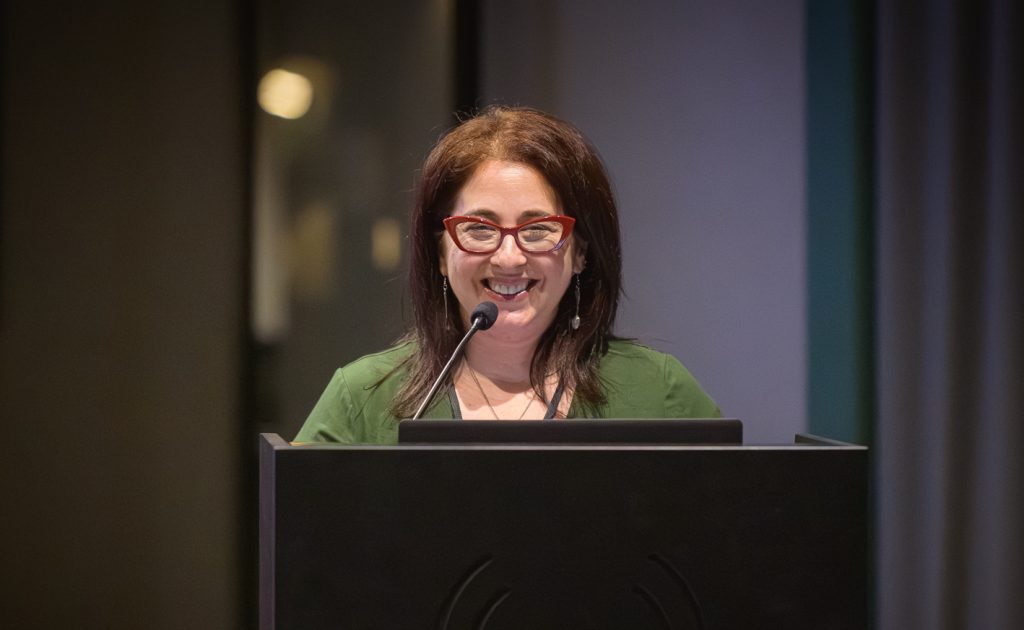
Marci Shore gives the keynote at the 33rd European Meeting of Cultural Journals. Image copyright: Jernej Humar, Razpotja/Eurozine
When Eurozine was founded in the 1990s, the present world was unimaginable. A cheerful optimism then prevailed in western intellectual circles: the wicked witch was dead and we were all going to live happily ever after. But as Stephen Holmes and Ivan Krastev write in their book The Light that Failed, with respect to a bright democratic future, many in the West ‘confused the absence of obstacles with the presence of preconditions’. They believed that once communist authority was overthrown, ‘liberal democracy would pop out like toast from a toaster’.
This liberal optimism came tinged with a triumphalist condescension. A predominant assumption held that the East was going to ‘catch up’, that ‘the West’ had already figured out the correct way of doing things, and now everyone just had to follow its lead. Holmes and Krastev question whether this kind of ‘copycat’ liberalism had been inherently humiliating. Perhaps even the best-intentioned western advisors had failed to conceal their sense of superiority over those expected to imitate them. ‘Westerners,’ write Holmes and Krastev, ‘ended up visiting post-communist nations in the way tourists visit primates at the zoo. They were fascinated only by what was missing: no opposable thumbs, say, or no rule of law’.
Eurozine came into this environment with the idea of a de-hierarchization of Europe; of a mutually enriching pluralism and a restoration of cosmopolitanism; of multipolarity and openness to one another as way of rectifying an East-West imbalance; of intellectual integration as an antidote to triumphalist condescension.
Some of this may have been the kind of nostalgia we see in Stefan Zweig’s memoir Die Welt von Gestern. In it he recalls the period before the First World War as an age of innocence, when it was possible to travel without a passport. Those ‘who once knew a world of individual freedom, know and can give testimony that Europe once, without a care, enjoyed its kaleidoscopic play of colour,’ Zweig wrote. Milan Kundera evoked this Habsburg nostalgia, a nostalgia for pluralism, in his 1984 essay ‘The Kidnapped West, or the Tragedy of Central Europe’. The Central Europe Kundera described ‘longed to be a condensed version of Europe itself in all its cultural variety, a small arch-European Europe, a reduced model of Europe made up of nations conceived according to one rule: the greatest variety within the smallest space.’
The end of the Cold War brought a feeling that we could return to that cosmopolitanism content, now in post-imperialist form. This, for me, was the ethos of Eurozine: a post-imperialist cosmopolitan, a non-condescending pluralism. And translation was the means for this. Translation was activism.
What is translation? The Ukrainian translator and psychoanalyst Jurko Prochasko once said, in an interview he gave in German, Alles ist Übertragung – ‘everything is translation’. The German word is broader than ‘translation’ in English, encompassing the whole sense of what can be conveyed, passed on, communicated. All human communication is, in this sense, translation.
Translation means channelling the Other. It has a dybbuk-like quality. There are moments when it’s a vacation from oneself, a respite which at once stretches the possibilities of one’s own voice. As an act of radical empathy, translation is a natural extension of what I do as a historian: I try to write in such a way that readers can make an imaginative leap into times and places where they themselves were not, and into the lives of people who they themselves are not. Can experience be translated? To write history is a leap of faith that in some way experience can be translated, even if the translation is never wholly consummated.
In an essay titled ‘The reason of borders or a border reason?’, based on a speech given at the 16th Meeting of Cultural Journals in Belgrade in 2003, the Germanist and translator António Sousa Ribeiro writes: ‘Potentially, any situation where we try to relate meaningfully to difference can be described as a translational situation. In this sense, translation points to how different languages, different cultures, different political contexts, can be put into contact in such a way as to provide for mutual intelligibility, without having to sacrifice difference in the interest of blind assimilation.’
Sousa Ribeiro explores Mikhail Bakhtin’s idea that culture happens on the borders. He quotes Bakhtin as saying that, ‘in the realm of culture there is no inner territory: it is situated entirely on the borders, there are borders passing everywhere, through each of its components … Every cultural act takes place, essentially, on the borders.’
Borders can divide and separate. They can be used for self-definition by opposing oneself to whom one is not. They can be used for exclusion. But they are also spaces of encounter. They are places in-between. Sousa Ribeiro describes translation as a third space, the point of contact between the same and the Other.
Borders are the settings for dramas. I think of the many encounters that have shaped the history of ideas: when Marx met Engels, when Roman Jakobson met Claude Lévi-Strauss, when Václav Havel met Adam Michnik. This last meeting came about on the top of the Śnieżka/Sněžka mountain on the Polish-Czechoslovak border. The conversation on that mountain became the impetus for Havel’s essay, ‘The Power of the Powerless’, arguably the most important text produced in dissident literature between ’68 and ’89.
My interest in borders is also connected to my interest in the avant-garde: my first book was about Polish futurist poets. The radical cosmopolitanism of the interwar avant-garde was an aggressive internationalism. Empires had fallen; it was no longer possible to travel without a passport. There was a recognition that national borders now existed; and crossing them was now something to be done deliberately, with force, as an act of transgression.
The avant-garde poets’ rejection of national borders belonged to their revolt against anything that dared to limit or confine. One of my favourite archival discoveries was a letter held in the Moscow literary archives written by Aleksander Wat, Anatol Stern and Bruno Jasieński, all around twenty years old at the time, to Vladimir Mayakovsky in 1921. The letter began, ‘the Polish futurists, establishing relations with futurists of all countries, send fraternal greetings to the Russian futurists’ and went on to solicit contributions for ‘the first large international journal-newspaper devoted to universal futurist poetry in all languages’.1
The avant-garde harboured a brazen desire to burn through boundaries. The Yiddish avant-gardist Peretz Markish wrote in 1919, ‘I don’t know, whether I am at home/Or abroad – I am no one’s, my own master,/ Without beginning and without end.’ The poets believed in the materiality of language; the idea that the word could be severed from the thing it represents brought a dizzying liberation. They vaulted from literature as representation to literature as transformation. Aleksander Wat explained that ‘the joy came from the fundamental collapse, that there was now room for everything, that everything was doable … You see, that slogan, the idea of words being liberated, that words were things and you could do whatever you liked with them, that was an enormous revolution in literature.’
The Ukrainian futurist poet Mykhail Semenko wrote, Я почуваю себе без меж – ‘I feel myself without limits’. Semenko led a Ukrainian avant-garde group calling themselves ‘panfuturists’. They produced manifestos not only in Ukrainian, but also in French, English and German and published a trilingual journal in Russian, Ukrainian and Yiddish. They integrated Esperanto. ‘We must follow the road of universal creative objectives and not stew in our own juice,’ Semenko declared. ‘We must rid ourselves of provincialism.’ He titled an article, ‘Reflections about Why Ukrainian Nationalism Is Bad for Ukrainian Culture, or, Why Internationalism Is Good for It.’
The avant-garde’s rebellion was a utopianism of borderlessness. And the poets, caught up in the thrill of a free fall, leapt into an abyss. The short version of what happened is that it ended up very, very badly for all of them.
I want to think now about the difference between the effacing of borders and the crossing of borders. What does it mean to dissolve a border? To dwell on a border? To move across a border? Border crossing is something that is active. It’s active the way that translation is active. It’s most often conscious. You know when you’re crossing.
Translation is an encounter with the Other who is on the other side of a border. Emmanuel Levinas was preoccupied with the idea of the l’Autre. He wanted to move the grounding point of both epistemology and ethics from the relationship between subject and object to the relationship between one subject and another subject – or to what he called the face-to-face. For Levinas, the encounter with the Other was an encounter with radical alterity. The Other is on the other side of a border that can never be made to disappear. To use a word Hegel liked, the Other is jenseits, on the other side, wholly transcendent.
For Levinas, the Other ‘also means the free one. Over him I have no power (je ne peux pouvoir). He escapes my grasp by an essential dimension.’ The Other can never be assimilated and absorbed into a totality with the I. There is no possible Aufhebung; no sublation into synthesis. The Other remains beyond. And from this beyond, the Other beckons to us. For Levinas, desire is precisely desire for this radical alterity. It is a relationship, Levinas says, whose positivity comes from remoteness, from separation, from the hunger of not possessing.
The Other not only tempts us, but also calls us to responsibility. ‘The Other,’ Levinas writes, ‘wrenches me from my hypostasis, from the here, at the heart of being or the centre of the world where, privileged, and in this sense primordial, I posit myself … I see myself from the other’s vantage point; I expose myself to the other; I have to render account.’
Józef Tischner – the Polish Catholic theologian and Levinasian – asked what sort of experience permitted good and evil, joy and despair, to appear in our lives. He answered that this occurs when we encounter another person. ‘I emphasize the word “encounter” – spotkanie’ Tischner says. ‘An encounter is something more than an ordinary “coming in contact” with another, seeing or hearing another. An encounter is an event. It initiates a drama, the course of which cannot be foreseen.’
I want to suggest that all human drama is encounter, and that all human communication is translation.
Now I’ll tell a story. It’s a slightly involved story, in which Tischner plays a role. It begins just before the First World War, when Edmund Husserl was teaching in Göttingen and gathering a circle of phenomenology students around him. One of the young philosophers who went to study with Husserl was Edith Stein, a German Jew from an Orthodox family in Prussian Breslau. Stein had lost faith in God and was looking to pursue truth through pure philosophy. Another of the young philosophers was Roman Ingarden, a Polish student who, frustrated with his studies in Austrian Lemberg, was also looking to pursue truth through pure philosophy.
When WWI broke out, Stein responded with fanatical German patriotism. She volunteered as a nurse and was sent to work at a hospital in Moravia. Ingarden tried to join Józef Piłsudski’s Polish Legions to fight for an independent Poland, but was turned away because of a heart condition. At a certain point, Stein returned home on furlough. While waiting to be recalled, she followed Husserl to the University of Freiburg, where he had taken up a chair of philosophy. There she wrote her dissertation on the problem of Einfühlung, empathy. Having been denied the chance to fight for Poland, Ingarden, too, went to Freiburg to continue his studies. He and Stein were the only students there of Husserl’s original circle; many of the others were fighting for Germany.
Ingarden and Stein became very close. She fell in love with him. Not a native German speaker, Ingarden could only publish in German if she edited his work for him. She was insecure about his feelings for her, but also condescending about his German. Although she tried via her methodology of Einfühlung and her study of the Polish language, she was unable to understand his Polishness, which still somehow seemed lesser than her Germanness.
When in autumn 1918 it became clear that Germany would lose the war, Stein was devastated. She set off for Breslau to be with her mother, inviting Ingarden to spend Christmas with her. But when she arrived home, she found Silesian Breslau ensconced in violent animosity between Germans and Poles. And seeing this, Stein – who had no doubt that Silesia must belong to Germany – uninvited Ingarden, telling him that although he would be safe in her home, she feared she could not entirely protect him from the sentiments towards Poles in her city.
In response, Ingarden was silent. Stein wrote to him again and again, her letters increasingly desperate. Finally, in September 1919, he sent her a letter telling her that he had married a Polish woman. Stein replied the same day, asking him to burn all of her letters and to forget everything that had passed between them.
Some time later Stein converted to Catholicism. When the Nazis came to power, she entered a Carmelite convent. She invited Ingarden, all those years later, to her Einkleidungsfest, when she took her vows and received the veil. He declined. Afterwards she sent him a photograph taken at the ceremony, so that he could ‘see how she looked as a bride’ – the bride of Christ.
After the outbreak of the Second World War, the nuns sent Stein to a convent across the border in the Netherlands, hoping that she would be safe there. She was not. The Gestapo came for her in 1942. She was murdered as a Jew in Auschwitz.
Jump to the 1960s, when Józef Tischner was the graduate student of Roman Ingarden, writing a dissertation about Husserl. Another of Tischner’s teachers was Karol Wojtyła, then the Archbishop of Kraków. Ingarden spoke to them both about the work of Edith Stein and the fact that she had been a phenomenologist, before turning to the philosophy of Thomas Aquinas. Her late work, written in the convent, drew upon Thomism without abandoning phenomenology.
Wojtyła, whose own work also synthesized Thomism and phenomenology, was intrigued. Ingarden was the only one in Poland who had known Stein personally. Moreover, no one in Poland had read her work; there was only a single copy of her dissertation in the whole country. Wojtyła asked Ingarden if he would hold a private seminar. Ingarden agreed; and Wojtyła was enthralled both by Edith Stein’s philosophy and by her personal history. Some quarter-century after her death in Auschwitz, the Polish priest arguably fell in love with the Jewish philosopher-turned-Catholic nun.
Around a decade after Ingarden introduced him to her, Wojtyła became Pope John Paul II. In 1987 he beatified, and then in 1998 canonized Edith Stein. In a sense, her sainthood was a consolation prize for Ingarden’s having left her to marry a Polish woman.

Detail of Johann Brunner’s bust of Edith Stein bust in Walhalla, Regensburg. Image: Johann Brunner / Source: Wikipedia Commons
A drama of encounter story to illustrate Tischner’s point. Now I want to return to the idea of borders. The openness to the drama of encounter implies a preservation of difference, an interaction with limits and engagement with boundaries. The avant-garde’s aspiration to limitlessness was utopian. Like most utopian strivings, it contained a dystopian implication. Transparency is a dialectic of the utopian and the dystopian.
I see signs of this dystopianism in our present world. I’ll begin with the English language, which is both privileged and impoverished by its hegemony. American monolingualism is not only a linguistic, but also an imaginative deficiency. When you grow up code switching between two languages, you can theoretically imagine a third or a fourth. But if the world has only ever existed in one language, the second is unimaginable. I sense that for most Americans, things that happen in other languages across borders are not quite real.
In his 2003 essay, Sousa Ribeiro wrote that ‘one possible definition for hegemonic globalization is that of a globalization without translation, which … amounts to the process through which a hegemonic country is in the position to promote its own localisms in the form of the universal or the global’. I see this problem of English hegemony as globalization without translation. I also see it as a flattening, a deterioration into an artificially generated English.
Artificial intelligence provides us with a fantasy of transparency, in which everything is instantaneous. I fear that there is a loss of understanding of translation as something that involves activity. And I worry that the idea that the boundary between languages can be obliterated has something in common with the idea that the boundary between the human and the nonhuman, between reality and unreality, can also be effaced.
I recently listened to a clip of Mark Zuckerberg explaining how the average person has three friends, whereas demand is on the order of 15. He goes on to offer us chatbots, AI-generated friends, who can fill in for the missing 12. The offer is not a joke.
In a review of Peter Pomerantsev’s book Nothing is True and Everything is Possible (2014), about the postmodern neo-fascism that developed in Russia, Jurko Prochasko described this world of post-truth:
This is when a bracingly narcissistic, and therefore megalomanic and arrogant, conviction of the superiority of one’s own massive manipulative intellect over a sort of limitlessly plastic, pliable substance of reality… emerges from the skulls of its creators, the black demiurges, and spills over into different arenas of the mind and the media. It is the infinitely extended megalomania of a certain very specific conception of the producers of reality, who, having lost a sense of reality, are convinced that any given social or discursive reality can be constructed, transformed, induced, or discarded at will, replaced by a different one.
Prochasko went on to describe truth as a limit. When there is no such thing as empirical reality, the world is boundary-less; and, as he pointed out, this refusal to recognize truth as a limit ‘never ends well’.2
Death is also a limit. Today we find ourselves in a world run by oligarchs who don’t believe in death. Putin was recently caught on a hot mic talking to Xi about how, with the help of science, it would soon be possible to achieve immortality. This was not just the fantasy of a single tyrant. Peter Thiel, the evil genius, or at least the financial begetter of J.D. Vance, is obsessed with the Antichrist. He has arranged to have his body cryonically preserved in anticipation of resurrection. Elon Musk believes that we are living in what is only a simulation, and in any case is planning to go to Mars.
I remember an incident several years ago, at a Festschrift conference for one of my former graduate advisors, Hans Ulrich Gumbrecht, a brilliant philologist and Heidegger expert. At one point there was a discussion about Heidegger’s idea of Sein-zum-Tode – being-towards-death. One of Gumbrecht’s current students, a Stanford undergraduate double majoring in computer science and the humanities, stood up and said: ‘You know, I don’t understand this whole discussion. I live in Silicon Valley. I, for one, don’t anticipate I am ever going to die. Death is just one more problem we are working on a technological solution for.’ And he was not being merely performative. Like Zuckerberg, he was speaking completely seriously.
I’ve started to play with this idea that, paradoxically, the denial of death is nihilistic. And that there is some kind of relationship between post-truth, the denial of death, and this artificially generated language that aspires to vanish all borders. I was talking at some point to an IT expert who was trying to explain cryptocurrency to me. The wonderful thing about it is that it’s frictionless, he said. Virtuality is frictionless.
But translation should not be frictionless. It should remind us of difference. We should be playing off that encounter with difference, distinguishing one voice from another voice, taking pleasure in polyphony. Translation should not be a blowing up of borders, but a creative act of bridge building. The tension of avoiding both imperialist hegemony and nationalist exclusivity, of creating an inclusivity that neither levels nor fetishizes otherness, should be part of the activity that is translation. The friction is essential.
Translation needs to preserve that element of what the Russian formalist Viktor Shklovsky called ostranenie – ‘defamiliarization’ or ‘estrangement’ – poetic writing that disorients us and thereby allows us to see something anew. The language is a little bit off, a little bit strange, and that strangeness shakes us out of our habituation, out of the way in which we sleepwalk through life.
Translation has to operate in that space between transparency and opacity. If everything is opaque, there is no possibility for translation. If everything is transparent, we are in a totalitarian dystopia. An analogy would be the way that Sartre rejected both Freud’s idea of the opacity of the unconscious, and Husserl’s idea of the transparency of the transcendental ego. Sartre said: no, consciousness is neither opaque nor transparent. Consciousness is translucent. It is this in-between, where things are neither completely clear nor completely dark. This is the space of translation.
I want to conclude with Jan Patočka, the Czech philosopher who was Husserl’s last student, and his idea of ‘negative Platonism’. Patočka was looking at Plato’s idea of the chorismos – the gap between the real and the ideal. Patočka’s move was to say that the chorismos, the gap itself, was the space of freedom. The gap is where there is an endeavouring that is not possession, a searching that can never be consummated – this is the space of our responsibility and our freedom.
Translation for me takes on this negative Platonism, this being drawn to the Other without a demand for transparent possession, without a design to eclipse all distance; with a hope for intimacy that is always invasive and always a risk, and with a possibility for misunderstanding, which is part of any attempt at understanding.
There are ways in which these misunderstandings and mistranslations are just as creative and productive as anything that appears to more closely approach transparency. Arguably all of French existentialism is based on a mistranslation of Heidegger’s Dasein as réalité–humaine, which takes a Cartesian turn Heidegger himself never intended. But that does not nullify French existentialism and all it inspired.
At the 2020 funeral of John Lewis, one of the great American civil rights activists, the ninety-one-year-old African American Methodist pastor James M. Lawson read Czesław Miłosz’s poem ‘Meaning’ (Sens). In introducing the poem, Lawson completely mispronounced Miłosz’s name. And I loved that moment, because it was about Lawson reaching for something from a very different part of the world, from a very different tradition – one that was not his own, but that spoke to him. He found things in that poem that were perhaps not what Polish readers of the original would have found, but that were no less meaningful. And he found those in translation.
Translation is what Karl Jaspers would describe as a Grenzsituation, a ‘border-situation’, which pushes us to ask the questions for which we do not have answers. For Jaspers and others, there is something about that Grenzsituation that is epistemologically privileged. For my favourite philosopher, Lev Shestov, it is in that realm on the edges, where reason alone is inadequate, that we find ourselves forced to push further and deeper.
I’ve been in dialogue about this idea of the Grenzsituation with my philosopher friends in Kyiv, Volodymyr Yermelenko and Tetyana Ogarkova, who have just published a book in Ukrainian titled Життя на межі – ‘Life at the edge’. They make a very strong argument, which they themselves embody, that it is this edge, this limit, this border, where all is precarious and all is at risk, that is the origin of thinking.
See Marci Shore, Caviar and Ashes, New Haven and London 2006, 20.
See also Marci Shore, ‘A pre-history of post-truth, East and West’, in Eurozine, https://www.eurozine.com/a-pre-history-of-post-truth-east-and-west/
Published 2 December 2025
Original in English
First published by Eurozine (English original); Razpotja (Slovenian version); Kultūros barai 12/2025 (Lithuanian version)
© Marci Shore / Eurozine
PDF/PRINT
After over 20 years of publishing for free, Eurozine needs your support to get through an exceptionally lean year.
Become a Patron and get exciting perks for your help!


Want to hear a human voice?
Listen and subscribe wherever
you get your podcasts.
Subscribe to know what’s worth thinking about.


On the border between Poland and Belarus, the Forest has become the subject of a humanitarian crisis. An artist’s report, based on meetings with activists and refugees, charts this contested space. Poetry honours those lost in transit.

How disenchantment with government has fuelled necropolitics; statue mania in the age of empire; and a conversation about censorship, self-censorship and Palestine.