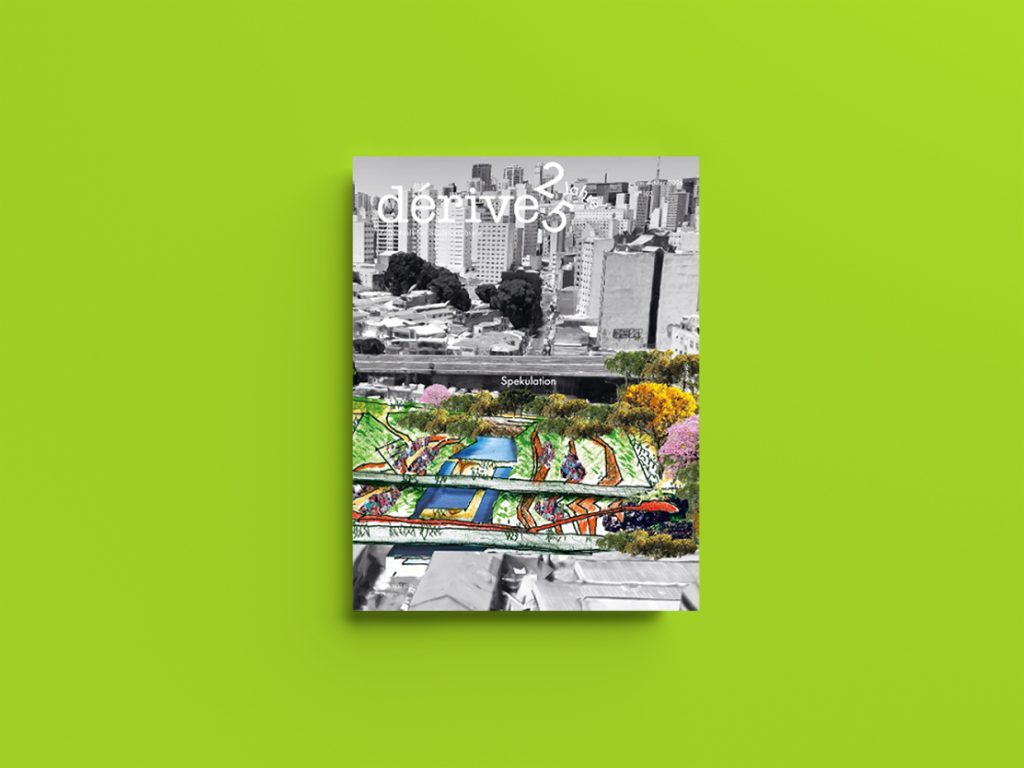
The field of speculative urbanism usually deals with how urban environments are impacted by the financialization and commodification of late capitalism. Yet as Frank Müller and Anke Schwarz explain in their introduction to the current issue of the Austrian journal dérive, speculative urbanism is also rich with possibility for ‘diverse types of aspirational imagination’.
If cities are arenas where competing visions of the future collide, then speculation can be used as a tool for imagining alternative futures that challenge the commodification of human life and the natural world. Speculation in this non-financial sense can be seen as ‘a transformatory practice and method of research in and on urban spaces’.
Speculation is not inherently emancipatory, however: authoritarian and reactionary political movements also rely on speculative visions of the future. What distinguishes emancipatory speculation is its willingness to question existing power structures and ‘expand the space of possibilities’. Rather than promising technological salvation or utopian certainty, it highlights ‘contemporary and historically embedded inequalities, dependencies, and constellations of power’ and asks what conditions might allow fairer urban futures to emerge.
Used to imagine more inclusive and less oppressive urban environments, speculation becomes ‘the source and instrument of a collective, intersubjective and intergenerational practice of care’. This kind of speculation is inherently geographical because of its orientation towards the material world. The quest to ‘design tangible urban utopias that give everyone the chance of a liveable life’ requires the ability to ‘think with the earth’, always conscious of the relationship between the conceptual and the material. Speculation is thus both a theoretical approach and a practical method of critical urban research: a way of linking imagination, political struggle, and the material transformation of cities.
Collaborative mapping
Laura Kemmer, Ana Luiza Nobre and David Sperling explore how speculative cartography can rediscover suppressed urban histories and inspire community resistance to real-estate speculation.
Urban development destroys ecological systems and cultural memory, they write. ‘Rivers are channelled into straight paths or buried to create space for buildings and capital flows’, while local communities and histories disappear from the landscape. The Saracura River, which once flowed through São Paulo’s Bixiga neighbourhood, now runs beneath layers of concrete infrastructure and is largely absent from official maps and planning documents.
To counter this erasure, the Ground Atlas team organized a ‘collaborative mapping project’ inspired partly by the discovery of archaeological artefacts from a historically documented but previously unlocated quilombo (a community of former slaves) during the construction of a new metro station. Researchers, artists, activists, Indigenous representatives and local residents produced a digital map composed of letters addressed to the hidden river, linking stories, images, and objects to sites across the neighbourhood.
In one letter, a fictional Hydrolinguistic Research Group presents a translation of the river’s ‘sound frequencies’ into Baniwa, an Indigenous language, and then into Portuguese. The speculative element is essential: ‘It shifts the framework of scientific authority and opens a space for thinking of water not just as a resource, but as a speaking, expressive medium’. Another letter is written from the perspective of a quilombo resident, using archaeological finds as a ‘scientific foundation for an act of fabulation’. By filling the gaps in official archives with speculative narratives, the map highlights voices and relationships normally excluded from urban planning.
Berlin
No sooner had the Berlin Wall fallen than investors started eyeing the real estate along its course ‘with the aim of rapidly transforming socialist land into capitalist structures’. Christoph Sommer traces how planning procedures, political debate and civic activism shaped the eventual decision to conserve the historic Checkpoint Charlie site for public use.
Various plans were mooted over the years, most recently a large-scale commercial development comprising shops, hotels and a small museum to be leased by the developer to the state. The idea that the state itself could acquire the land and use it for a museum and memorial was dismissed as unfeasible, with a public-private partnership seen as the only possibility. But the project triggered strong opposition from historians, heritage experts, activists, and local initiatives, who feared the development’s dense buildings and commercial nature would erase the site’s historical significance.
Belying ‘the often-justified criticism that communicative planning benefits wealthy, articulate actors and neutralizes counter-hegemonic potential through integration’, planning procedures intended to gather expert feedback unexpectedly became spaces of political resistance. Participatory formats allowed critics to form alliances and legitimized their concerns, leading to the formation of a powerful ‘counter-public to the investment project’.
Eventually, the project’s opponents were successful. Instead of a fully privatized development, parts of the land were designated for public purposes, including a memorial and educational site. The outcome ‘shows that participation is not, as is often and rightly criticized, doomed to legitimize preconceived intentions’.
Solarpunk
For decades, popular visions of the future city have been dominated by the imagery of cyberpunk: towering skyscrapers, neon-lit streets and corporate power. Against this aesthetic, solarpunk developed as a greener, more utopian vision of the future. However it too has been co-opted by ‘neoliberal capital and mainstreamed to greenwash everything from authoritarian regimes to yoghurt companies’, writes Anja Lind. The Gaza Riviera proposal exemplifies how even ‘fantasies of colonial dispossession cannot afford to decentre ecology’.
But ‘solarpunk practitioners actively resist these depictions, satirize this greenwashing, and forward new, vibrant and critical post-capitalist speculations’. Recent solarpunk novels are united not by a coherent, conveniently packaged aesthetic, but by their radical communalism. A recurring motif is the creation of intentional communities that experiment with new forms of urban life, such as settlements built from salvaged materials.
Unlike the ‘monumentally greened smart architecture’ promoted by corporate urbanism, solarpunk emphasizes slower, more communal forms of life: shared spaces, local food systems and participatory governance. ‘The solarpunk city is built out of the abundance of shared goods, decommodification, and social justice, not out of extracted, colonized bodies’, Lind writes.
This kind of science fictional speculation is more than just entertainment. By offering ‘a radically different consensus of the future city’, solarpunk helps us imagine alternative ways to arrange our communities in an age of climate crisis and social fragmentation. As we wonder how to work our way out of crisis, ‘SF has never been more timely, speculation never more important to address’.
Review by Cadenza Academic Translations