Austria
The Institute for Human Sciences / Institut für die Wissenschaften vom Menschen (IWM) is an independent institute for advanced study in the humanities and social sciences. Since its foundation in 1982, it has hosted more than 1500 scholars, journalists and translators from all over the world. Many of the Institute’s Permanent and Visiting Fellows are regular contributors to Eurozine or its focal points The World in Pieces and Ukraine in European Dialogue (see below).
Website: www.iwm.at
X (formerly known as Twitter): https://x.com/iwm_vienna
Youtube: https://www.youtube.com/channel/UCIwFQ_iRX8w8D0NKJo41Ihw

When NATO intervened in the Yugoslav wars on 24 March 1999, depleted uranium weaponry punctured Serbian targets across the region, leaving permanent contamination behind. Populists, whose victim narrative gained ground, now position nuclear as the solution to energy dependency. But how can public fear and security be one and the same?

Whether an Ivy League academic or a Patriot Front white nationalist, Curtis Yarvin will find your position too democratic. The once obscure blogger’s brand of postliberalism calls for a political system reboot popular with MAGA and Big Tech leaders. But does his eccentric mix of elitist, pseudo-religious and computational thought reflect chaos more than his desired order?

What should European politicians be focusing on in the forthcoming year? Europe needs to adjust to an increasingly multipolar world order, under pressure from US retrenchment and threatened military withdrawal, Russian cyber and trench warfare, and China’s technological dominance.

Democracy in the US is under threat from within. Racial nationalism – a throwback to unresolved tensions from the American Civil War – has found new impetus under Trump, forcing civic nationalism into a corner. Will the immutable longevity of the American Constitution be its paradoxical undoing? And how might the US recover from its emerging dictatorship?

Inspired by a lecture that Clifford Geertz delivered in 1995 at the Institute for Human Sciences in Vienna, this focal point engages with ‘deep diversity’, ‘a sense of dispersion, of particularity, of complexity and of uncenteredness’ rather than unified world order. It follows the launch of a research programme of the same name at the institute in January 2023.
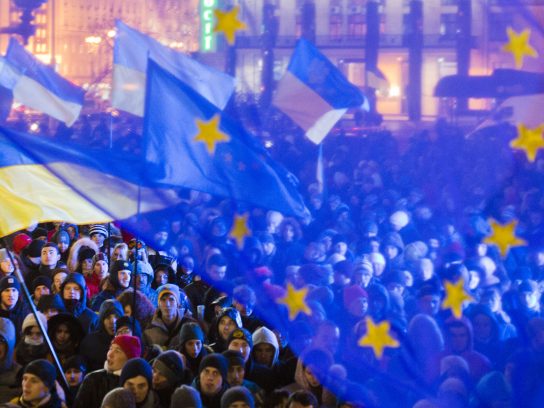
Post-revolutionary Ukrainian society displays a unique mix of hope, enthusiasm, social creativity, collective trauma of war, radicalism and disillusionment. With the Maidan becoming history, the focal point ‘Ukraine in European Dialogue’ explores the new challenges facing the young democracy, its place in Europe, and the lessons it might offer for the future of the European project.