


Narrative Apocalypse
Mittelweg 36 2/2026
End-times narratives and the end of narrative: storytelling as story-selling; zombie fiction for Derrideans; resisting teleology.
The writer and feminist Slavenka Drakulić will be remembered for the moral wisdom and humanity running throughout her work, writes her friend and former Eurozine editor Carl Henrik Fredriksson.
Slavenka Drakulić’s integrity was unshakeable. When she described a conflict, a society or a human predicament, she was not simply an authoritative observer, but a moral compass.
The Croatian writer’s influence on generations of readers, writers, journalists, feminists – on women and men across the world – can scarcely be overestimated. Communism and post-communism, war and post-war, crime and justice, altruistic goodness and banal evil, feminism and backlash, love and sexual violence, health and illness: she helped us to understand all of this. Not through some grand narrative or all-encompassing analysis, but through a meticulous and empathetic focus on the details: on tampons or toilet paper, a designer bracelet or the hard, cold floor beside a bed in the Covid ward. And on people.
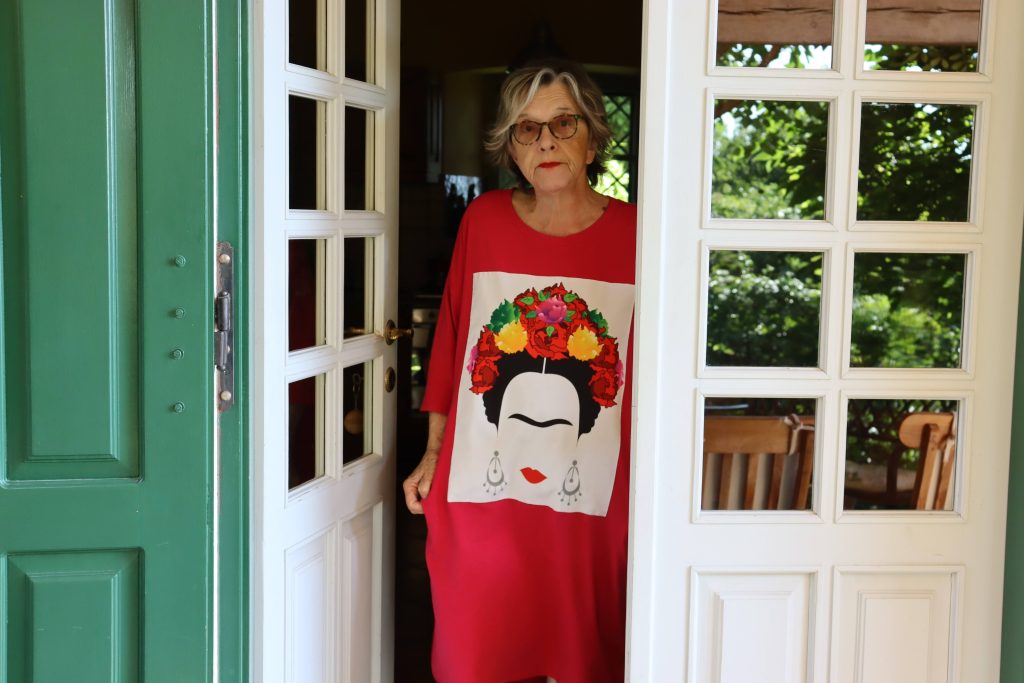
Slavenka Drakulic in her summer house in Sovinjak. © CHeFred
In Kyiv in 2014, just after the Euromaidan had forced the pro-Russian Viktor Yanukovych to flee to Moscow, but before a new president had been elected, Slavenka Drakulić was there to take part in a meeting between leading international and Ukrainian intellectuals. At one of the city’s universities, she spoke about the bridge in Mostar, about Srebrenica and about the victims of nationalism in her old Yugoslavia, where a European war had raged not so long ago. The hall was packed to bursting with young Ukrainians, mainly women. They hung on her every word.
‘When you can no longer remember the names of the dead,’ she said, ‘that is when you know that the war has begun.’
And it felt as though all of us who were there at that very moment understood precisely that. That the war had begun. The names of those who had died on the streets around Maidan – ‘the Heavenly Hundred’ – were still on everyone’s lips. But the ‘little green men’ were already in Crimea, and in the Donbas people were dying – people whose names hardly anyone knew.
For Slavenka, however, the situation in Ukraine proved to be a difficult test. Her solidarity with the victims of Russia’s war of aggression was strong and unwavering. She stressed the need to document Russian war crimes and pointed to how the international tribunal in The Hague contributed not only to establishing justice but also the truth about the crimes committed in the lands of the former Yugoslavia. Yet she also struggled to fully grasp a situation in which the line between crude nationalism and nation-building was not always clear-cut. For her, nationalism was the greatest enemy; it was this – together with patriarchy – that she had fought throughout her life as a writer.She herself became one of chauvinism’s foremost targets. In 1992, towards the end of the fiercest part of the war in Croatia, she and four other writers and journalists were branded as enemies of the state and literally denounced as ‘witches’. As a result of this attack, Slavenka Drakulić could no longer live or work in her homeland and sought refuge in Sweden. There, under Arne Ruth’s editorship, she became one of Dagens Nyheter’s most important writers. Several of her articles on the wars in the Balkans and the break-up of Yugoslavia were first published in DN.
During these years, she also wrote the books that established her international reputation: How We Survived Communism and Even Laughed, Café Europa and Balkan Express. This was later followed by the revealing and courageous They Would Never Hurt a Fly, about war criminals on trial in The Hague. In 2005, that book earned her one of the continent’s most prestigious literary prizes, the Leipzig Book Award for European Understanding.
The 2026 recipient of the same prize, the Bosnian-Croatian author Miljenko Jergović, once compared Slavenka Drakulić’s attempt in her work to explain her home region to uninterested westerners to translating the classics of German idealism into the language of a Croatian farmer, only the other way round. In other words, effectively impossible. Yet Slavenka Drakulić succeeded in her task, because she wrote without bitterness, sentimentality or stereotypes.
What was to be her final book, however, was not a work of non-fiction, but one in a long line of novels and short story collections (of which the two about Frida Kahlo and Mileva Einstein are among the most widely read). It is titled Zašto nisam naučila kuhati (‘Why I never learned to cook’) and was published in Croatia a couple of weeks ago. It is a tragicomic collection of stories, all of which take their cue from the traditional embroideries hung in Balkan kitchens, which, for example, urge Croatian housewives to be thrifty and stay close to the hob, for then they might even be treated to an occasional trip to the cinema. Classic Slavenka Drakulić: hard-hitting feminism, with a keen eye for the details of everyday life. (And as everyone who had the privilege of sitting in Slavenka’s kitchen knows: she was a god-gifted cook…)
Despite two kidney transplants – about which she wrote two books – and several decades on cortisone and immunosuppressants, the news of Slavenka Drakulić’s passing came as a surprise. She died on Saturday at her home in Sovinjak, Croatia. She was 76 years old and is survived by her husband, the Swedish author and journalist Richard Swartz, and by her daughter, the writer Rujana Jeger.
An abridged version of this text was published in Swedish in Expressen on 24 June 2026.
Published 24 June 2026
Original in English
First published by Eurozine (English version); Expressen (Swedish version)
© Carl Henrik Fredriksson
PDF/PRINT
After over 20 years of publishing for free, Eurozine needs your support to get through an exceptionally lean year.
Become a Patron and get exciting perks for your help!


Want to hear a human voice?
Listen and subscribe wherever
you get your podcasts.
Subscribe to know what’s worth thinking about.

End-times narratives and the end of narrative: storytelling as story-selling; zombie fiction for Derrideans; resisting teleology.

Since 2020’s ‘revolution with a female face’, Lukashenka has ramped up his neo-Soviet family policy while continuing to persecute women disobedient to his regime.