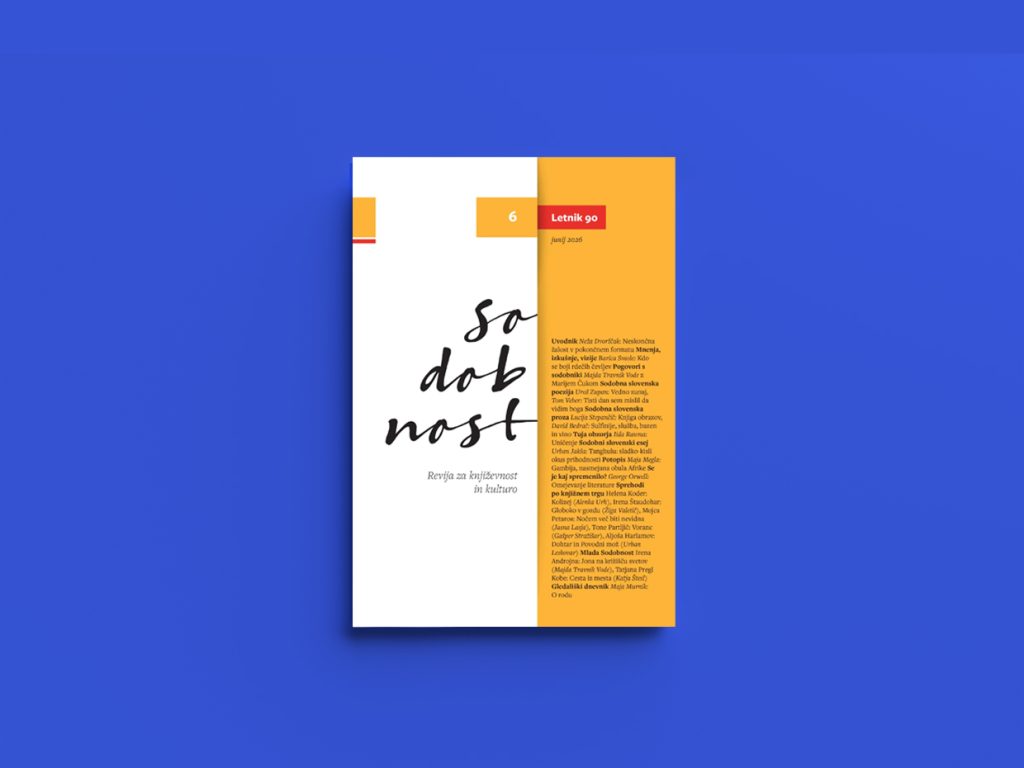
In her editorial to the current issue of the Slovenian journal Sodobnost, Neža Dvorščak offers a thought-provoking take on compassion in the digital age, where the suffering of others can be accessed on demand. Echoing Hamlet’s ‘pale cast of thought’, Dvorščak argues that excessive awareness breeds emotional numbness and compassion fatigue, as suffering loses its status as an event and becomes ‘content’.
Dvorščak explores the consequences of this endless exposure. Each voice may be genuine and deserving of attention, yet through sheer volume it dissolves into background noise. It is also a question of form: the strange montage of subject matter served up by social media feeds. ‘War and face serum are not made equivalent in meaning, yet they appear within the same stream, the same composition of attention, subject to the same mechanisms of scrolling, swiping and fleeting pauses.’
How might art cut through the din? Not by playing into the ruthless logic of algorithms, but by creating a space in which suffering can recover duration, tangible form and weight. Drawing on Greek tragedy, especially the chorus, Dvorščak imagines art as ‘a laboratory of attention’ capable of ‘reconstructing the conditions under which pain can once again become an experience rather than merely information’.
Multilingualism in Slovenia
In conversation with Majda Travnik Vode, poet, novelist and playwright Marij Čuk talks about literature, identity and the history of Slovenia’s minority community in Italy. Čuk tells how history contrived that, though he and his two siblings were born under the same roof, his brother was registered as born in Italy, his sister in Yugoslavia and he himself in the short- Free Territory of Trieste. His memories of childhood in the village of Dolina are threaded with history: Fascist attempts to Italianize the region, the Tito–Stalin split and the ideological schisms that threatened to tear the local community apart.
For Čuk, language, art and culture are the glue that holds minority communities together. ‘Language defines our identity; it is through language that I know who I am.’ He is therefore appalled by what he sees as the linguistic indifference of central Slovenia today. Now president of the Slovene Writers’ Association, Čuk wishes to bring ‘more periphery into the centre, and more centre to the periphery’, advocating a unified Slovene cultural space whose branches extend far beyond the central trunk of Slovenia proper. He hopes the Association will become a model for Slovene society: a place where diverse viewpoints coexist and where culture helps write new chapters instead of remaining mired in old conflicts.
Green futures in China
Along with travel mishaps and ‘mangled Mandarin’, Urban Jakša punctuates his travelogue through eastern China with reflections on its development model, which seems to herald a technological future at once dazzling and daunting – sweet and sour like tanghulu, the glossy skewers of candied hawthorn berries he buys from a street stall.
Ningbo feels like he is stepping into the future, where cash is obsolete and the mobile phone is king. Washed up in Ningbo as an internet-less ‘tech castaway’, he scrambles to buy a SIM card, only to find himself surrendering his personal information at every turn – a ‘Faustian bargain’ he is forced to accept.
The sleek bullet train to Shanghai prompts comparisons with European railway infrastructure. Over the past twenty years, China has built 48,000 kilometres of high-speed railway from scratch, while Slovenia spent years debating the cost of a single line, the drugi tir or ‘second track’.
While China is clearly leading the way in electric vehicles and public transport, Jakša ponders the price paid for such breakneck progress. As uninterrupted cityscape flashes past, his thinking returns to the European model of development: the green belts checking urban sprawl, the leafy shade and birdsong afforded by conservation trails. ‘This European soft power seemed to me more enduring and more solid than all the concrete pillars I had seen that afternoon.’
Alighting in Shanghai, a glittering showcase of the very best of ‘Made in China’, Jakša realizes that the green transition is not a matter of technology, but a question of choosing who we are, where we are headed and how we would like to live. ‘Although the train to a green future is running late, we must not miss it. And we must make sure we board the right one.’
Conversations in The Gambia
Maja Megla recounts a journey to The Gambia, unaware when she books the trip that the country has become a destination for ‘romance tourism’. At her secluded resort she is repeatedly approached by curious young men until a resort watchman, Lamin, becomes her companion and guide. ‘His presence had a magical effect. No men approached.’ What follows is less a holiday romance than a meeting of cultures. In the course of long walks, card games and endless conversations, Megla and Lamin compare their attitudes to sex, marriage, religion and family.
Beneath the warmth and easy smiles, however, Megla uncovers harsher realities. Invited to celebrate the birth of the cook Koita’s child, she is troubled by the exclusion of women from the festivities. She also learns about the prevalence, despite its legal prohibition, of female genital mutilation. A local physician, Dr Sulejman – who treats her after a severe bout of food poisoning – describes the devastating health consequences of the practice while explaining his own tireless grassroots work to educate young people about sexual health.
Yet the lasting impression is one of extraordinary generosity. Strangers give her gifts, the resort staff treat her ‘like family’ and saying goodbye is heart-wrenching. Had her suitcase not already been safely stowed on the plane, she would have run straight back for a few more days of that ‘paradisiacal acceptance, warmth and love’.
Review by Cadenza Academic Translations