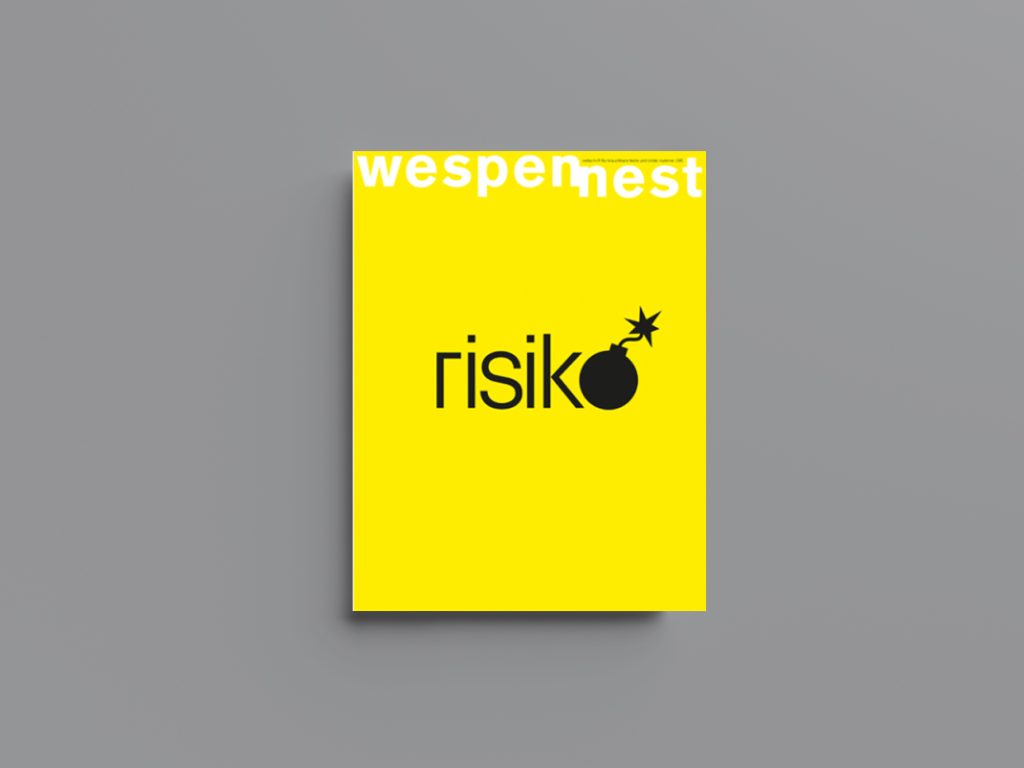
The new issue of Wespennest discusses risk from all possible angles: war, sport, theatre, car accidents, love… One topic is missing, however, warns editor Andrea Roedig: financial markets. For that, see the previous issue on bankruptcy!
Any discussion of risk must start – though by no means end – with Ulrich Beck, as sociologist Emanuel Deutschmann explains. In Risk Society (1986), Beck famously argued that the twentieth century marked a transition to a new form of modernity, one characterised by incalculable risks. The effects of pollution, the arms race and nuclear energy were impossible to accurately predict, so that populations were kept in a state of fear and insecurity. Science offered no help; on the contrary, it merely administered, if not exacerbated, this state with its arbitrary exposure limits and toleration of the poisoning of humankind and the planet.
Forty years later, Deutschmann claims, we no longer live in a risk society, but in a society of exponentiality. The threats we face are far from incalculable – there is solid data on the destruction of planetary ecosystems, for instance. This data points to exponential growth, allowing us to calculate with some precision where the world is heading if we continue down the path of fossil capitalism. The problem is the refusal of governments to perform these calculations and integrate the results into policy.
Rather than incalculable risk, we are now faced with uncalculated risk. This omission occurs out of helplessness as well as intentionally, according to what the author calls ‘the rules of the game in unfettered market-based systems’. This calculated non-calculation wilfully destroys a predictability that is at our fingertips.
Manufacturing uncertainty
How can objective threats be identified in times of escalating conflict? The political scientist and disarmament activist Mary Kaldor, whose forthcoming book is entitled Experimental Junctures, talks to Sarah Waring and Andrea Zederbauer about security strategies, war economics, commercial warfare, pacifism, neutrality and the risks of nuclear war.
‘[Beck] describes climate change, terrorism and new wars as global manufactured uncertainty. Trump, Putin and other right-wing leaders, meanwhile, are positing the imagined risks of the past within a national framework. Everything they’re doing is making situations worse, because they’re not addressing the transnational, technically manufactured type of risk that we really are facing. They’re trying to control the perception of risk, which they see as coming from a combination of external threats and migrants, other ethnicities.’
Read the full interview in English and German in Eurozine.
Leftist survivalism
Predictions of the end of the world can be found in nearly all cultures – and many cultures have indeed come to an end as a result of colonialism and capitalist exploitation. What makes our historical moment unique, writes Victor Kössl, is the scientific basis for anticipating climate collapse on a global scale.
Most of us in industrialised democracies tacitly accept that what we have come to take for granted is being put at risk for the sake of convenience and profit: a temperate climate, a reliable food supply, health care, rule of law. Kössl identifies three different strategies underlying this acceptance: the refusers, who think the threat is being exaggerated; the hopeful, who think that technology, the market, or governments will implement solutions in time to prevent it; and the deniers, who can’t find the time or energy in their daily lives to face what they know is coming.
Then there are those who have translated their fear into action. When generations of political activists have not been able to prevent collapse, the only rational response is to find ways to survive it in mutual solidarity. Unlike rightwing preppers, leftist survivalists are not focussed on hoarding for and arming their clans, but on building structures of collective care and responsibility. This involves acquiring hands-on skills for growing food and building shelter or creating spaces of refuge for those who can’t do it themselves.
Luxury or liberation?
Angela von Rahden writes a fictional dialogue in the afterworld between Anne Dufourmantelle, the French philosopher and psychoanalyst, and Günther Anders, the German–Austrian philosopher. In their philosophical and at times combative conversation, each tries to convince the other of their views on risk. Dufourmantelle celebrates risk as the possibility of individual liberation in an overprotective society, in which everything is ensured and nothing unexpected happens. Risk, she insists, creates unpredictable events that allow us to break out of our comfortable prisons.
For Anders, who had to flee Hitler in 1933, this argument could only have come from a bored bourgeoisie that has never experienced real risk and therefore craves adventure. The migrants trying to make it across the Mediterranean today would be grateful for less risk. For them, risk is not an opportunity but the threat of annihilation.
Dufourmantelle counters that individuals will wake up from their passive state only if they learn to embrace all of life, including its dangers. ‘When we dare to leave the well-trodden path, we open ourselves up to … metamorphoses.’ Only as a result of such personal transformations will people disengage from the consumerist und technology-dependent trajectory that is leading to annihilation and that so worries Anders.
No risk, no love
Friederike Gösweiner introduces the existential risk of love by way of the tight-rope walker Philippe Petit, who in his balancing acts without a safety net – such as between the two World Trade Center towers – had to overcome the physiological effects of his fear: sweaty palms, goosebumps, a racing heart. These are the same physiological effects brought on by falling in love. Why so?
Love, specifically sexual love, is just as risky for our sense of self. We seek love in order to overcome our loneliness and sense of incompleteness. The sexual act with another person allows us to temporarily forget our separateness, to physically manifest our union with the beloved in the form of a new human being.
And yet we continually fall back into our loneliness, are disappointed, our hearts are broken. When we seek confirmation of our own value in the other, their behaviour can always devalue us in the form of betrayal, abandonment, disregard.
Historically, the most powerful strategy to protect against this risk has been marriage. Rejection of marriage’s patriarchal oppression and the liberation of sex from procreation has brought about a competing model, polyamory. Here the individual’s value does not derive from exclusivity; sex no longer means anything as it does in monogamy. The individual is responsible for their own sense of completeness, which in practice often proves elusive.
Gösweiner concludes that the risk of sexual love ‘cannot be held at bay by a concept. Love remains a balancing act over the abyss … Anyone who loves, will be hurt.’
Review by Millay Hyatt