


For the second year, Ukraine’s collective consciousness is exhuming mass graves and burying children killed by Russian missiles. While just beyond Ukraine’s borders, the world of the transcendent reigns.
Russia’s full-scale invasion of Ukraine is entering its fifth year. With peace negotiations at a standstill, traumatized communities face a tough question: What does it mean to memorialize a war when its end is nowhere in sight? War crime survivors from Yahidne are actively engaging in how their mass confinement is remembered.
‘We are all waiting for the war to end’, says Valerii Polhui. The resident of Yahidne, a small village in Ukraine’s northern Chernihiv region, is calm and collected. He has mastered a sense of control over what happened to him, his family and neighbours in the spring of 2022 when Russian troops confined 368 people to the basement of the local school. Almost all members of the village community, including pensioners and children, were held there for 27 days as human shields, while Russian forces set up their headquarters in the school building above. Ten people died in the basement under inhumane conditions.
Sitting in a circle with Valerii and other survivors of the mass confinement, we have a different task than over three years ago. As journalists from Public Interest Journalism Lab, a Ukrainian NGO that co-founded The Reckoning Project and has been documenting war crimes since early 2022, we were among the first to report on the occupation in Yahidne. Now we’ve convened a meeting with village residents to understand how survivors see the preservation of memory from one of the most horrific mass war crimes committed by Russian forces. This gathering is the chance for neighbours to meet and express their thoughts and feelings; there’s no place left in the village where they can ordinarily gather, discuss and remember together.
Only 90-minutes drive from Kyiv, Yahidne has become a frequent destination for foreign journalists and international delegations, who come to see the consequences of Russian crimes firsthand. The residents of Yahidne have become unwitting guides, telling visitors the story of the crime committed against them. The door from the school basement, where villagers marked the days they were confined, has even been taken to New York for an exhibition held just 100 metres from the UN headquarters.
Yahidne is such a small village that it has no formally appointed spokesperson. Valerii, a local council member in his early forties who assumed responsibility for communicating with Russian soldiers in 2022, speaks more openly and directly than many of the others. After several hours, with careful moderation, the group of pensioners, students and former teachers gradually begin to articulate their understanding of what happened. Although silent at first, many residents want to speak out.
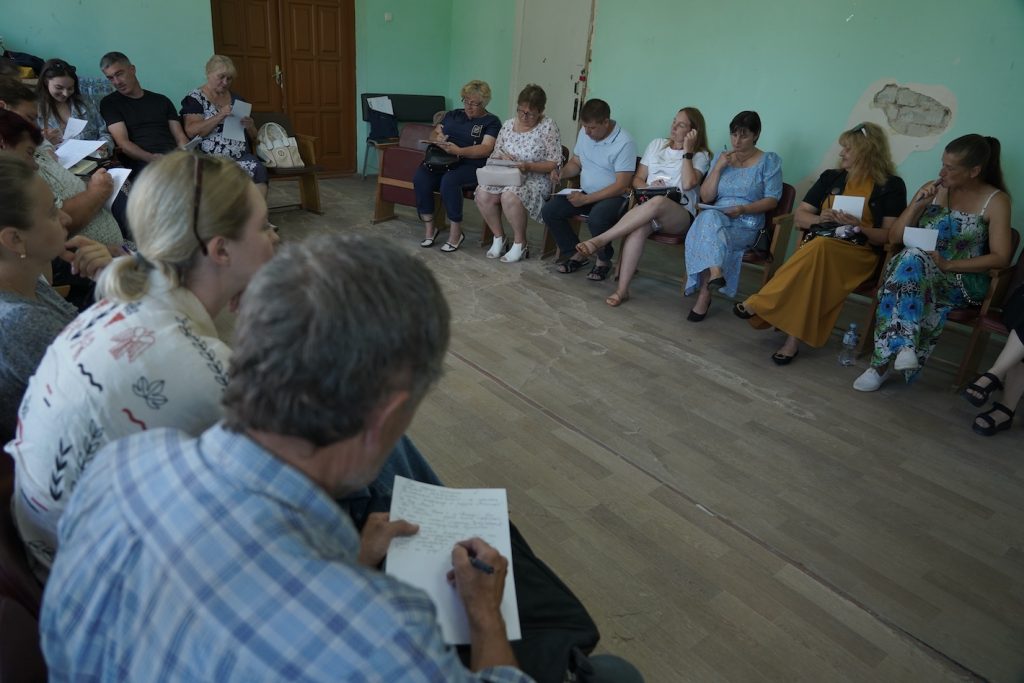
Residents of Yahidne village, who survived being held captive by Russian troops in the local school basement for 27 days, taking part in a discussion on their memories of the events they endured. The meeting was organized by the Public Interest Journalism Lab in July 2024. Photo by Maksym Savchenko
An elderly man cries from time to time but not from his memories of captivity. He remembers how life used to be before the war: ‘Yahidne was a place where everything blossomed and berries grew.’1 Now it is known for its occupation. And yet, despite the torture and humiliation villagers endured, they do not want to be remembered as victims: ‘We survived. We made it out of that basement. That is what they should remember,’ says one participant as if someone is arguing with her. ‘Freedom is something to be celebrated,’ says another. ‘You cannot understand it unless you have lived through captivity.’
Many describe their release from the basement, after Russian forces hastily left the village, as the greatest moment of their lives. But it is not marked locally. ‘The war is still ongoing. We will celebrate when it’s over,’ says Valerii.
We spend a long time talking about the month in the basement. The villagers were herded downstairs under armed guard. Some break down in tears as they recall the overcrowded conditions in which they were contained together like livestock. The cramped space, covered in mould, was pitch black. Adults lit candles to calm frightened children. Everyone breathed in dust and wiped condensation dripping from the ceiling off their faces. They were forced to sit constantly. Legs became swollen from immobility. Skin cracked and began to rot. They slept sitting down. They died sitting down.
Even now, some of them explain, locking someone in darkness and preventing them from moving would still never fully convey what they went through. ‘We didn’t know when we would get out – or whether we would get out at all,’ says a middle-aged woman. They recall that Russian soldiers offered them freedom in exchange for singing the Russian national anthem. No one agreed.
In detailed conversations about what deserves to be documented and remembered, the people of Yahidne repeatedly return, however, not to the behaviour of their captors but to their own actions and emotions.
‘I kept the children together — they stayed close to me like little chicks,’ says one of the older survivors. ‘They played games and learned to play cards. I worked in a kindergarten for 35 years, and it gave me comfort to be with them.’ Among the captives were 69 minors. The youngest, Alisa, was just six weeks old at the time. Overwhelmed by the lack of air, the dust and hunger, at times Alisa and the other children stopped responding to their families. ‘Parents begged the soldiers to let them take their children outside so they wouldn’t die,’ Valerii recalls. “The Russians said, “Let them die.’”
Several stress the importance of documenting the story of a local woman, Iryna, who managed to find food for the villagers and, risking her own life, brought it to the basement. They recall how shells were exploding all around and Iryna pushed a cart with potatoes and canned meat towards the schoolyard. ‘Where are you going, we’ll shoot you!’ said the soldiers. ‘I’ve got a job to do. I have to feed the people!’ she said, ignoring the threats.
Laughter ripples through the room, as they recall the actions of their determined neighbour. The atmosphere gets lighter. We laugh along. Someone notes how laughter helped them survive – even if some of these memories only feel light-hearted in retrospect.
The meeting’s facilitator, Maksym Yelihulashvili, a member of Ukraine’s expert community on memorialization, uses a flip chart to write down what people stress is important to remember about Yahidne. He fills several sheets of paper with words written in colourful marker pens, from top to bottom. This process will hopefully be considered in the memorialization and other activities related to the Yahidne case. It may well become history.
However, Maksym believes that memorialization during an ongoing war is not about preserving memory for decades to come but about grief. ‘This is a tactical decision — a way to hold on,’ he says.
After the meeting, Maksym recounts how he kept thinking about the daily choices being made on both sides: ‘Russian soldiers chose day after day to abuse civilians. The residents of Yahidne, meanwhile, were also forced to make daily choices – and showed resilience in … the routines of everyday survival.’ He recalls one memory in particular when Russian soldiers were searching for local council member Valerii Polhui: ‘He was sitting there in the basement, but no one gave him up.’
Maksym adds that moving communities into a proactive role is a difficult task. ‘People have already done the most important thing – they survived. What more can be demanded of them? It is the task of the authorities to organise both existing and future cultural institutions to help communities structure real, meaningful cooperation with one another – not an imitation of it.’
Having documented several hundred war crime survivors’ testimonies, we can’t help but notice that there’s so much in common between the Yahidne residents and other war crime survivors: preserving one’s dignity, while someone is specifically trying to take it away from you; focusing on helping others who are more vulnerable. We call it resilience, but what exactly does that mean?
Viktor Frankl, an Austrian psychotherapist and Holocaust survivor, described the best-known way to survive war crimes and keep your sanity: ‘Everything can be taken from a man but one thing: the last of the human freedoms – to choose one’s attitude in any given set of circumstances, to choose one’s own way.’2 In other words, focus on what you can control in captivity –your own behaviour and feelings – not your perpetrators.
Coming together, these war crime survivors are free to control their story, their own narrative. Each time they speak about their captivity can be seen as an exercise in memorialization. Memorialization, in turn, could be seen as a way to digest their experiences. If not digested, they may leave too much pain, confusion and prejudice behind.
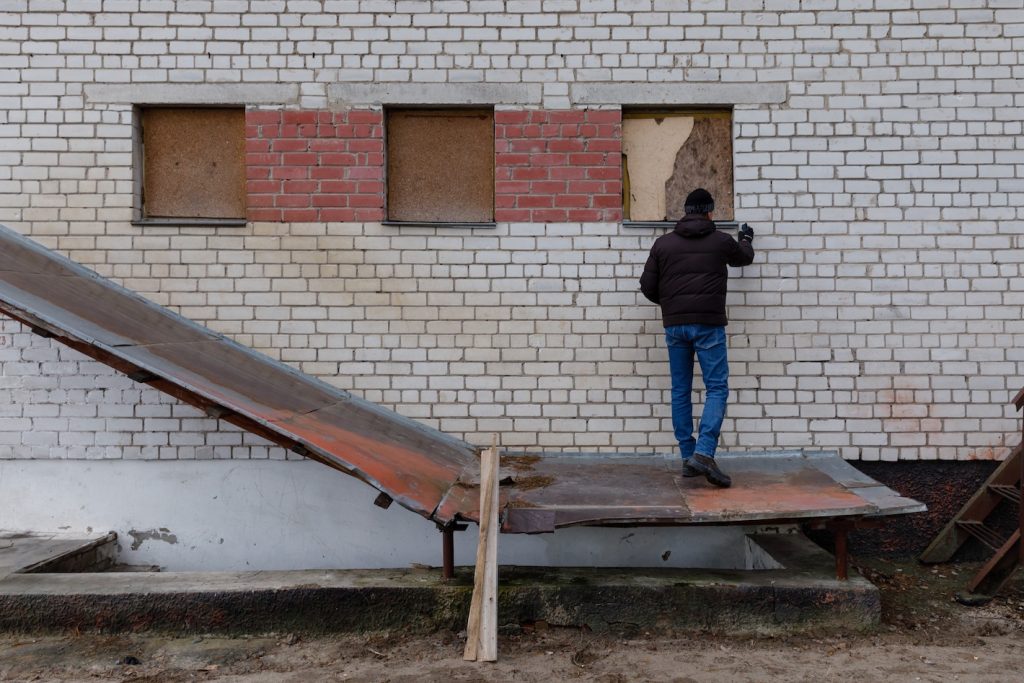
A construction worker takes measurements at the Yahinde school building, which is currently under reconstruction as a museum of war crimes. Photo by Mykaylo Palinchak, 8 January 2025
Almost immediately after their release, residents began grappling with what to do with the destroyed school where almost the entire village had been held in the basement. Parents said they could not allow children to study there.
The initial idea had been to seal off the school and just preserve the basement as it was, but everyone soon realized that would have been the wrong approach. In most Ukrainian cities, war crimes sites are typically marked with monuments or crosses, but, in Yahidne, the discussion centred on building a museum instead. Officials moved to implement the idea but quickly became mired in bureaucratic procedures. None of them had a blueprint for how to proceed.
In October 2023, a year and a half later, the Restoration and Development of Infrastructure Service in the Chernihiv region – the agency responsible for pooling funds for postwar reconstruction – announced an architectural competition to design a memorial. The winning proposal came from the architectural firm Derbin Arch, which was selected by an 11-member jury comprising prominent Ukrainian architects and local officials. Community leaders Olena Shvydka and Valerii Polhui represented Yahidne on the jury.
During the architectural competition, Olena and Valerii voted for the only proposal that met Yahidne’s residents’ demands: to preserve as much of the building as possible and leave the basement unchanged. For the villagers, this was a key condition. ‘Money would be needed both to preserve the building and to construct a museum,’ says Olena. ‘It’s better to build while Yahidne is still in the public eye. Otherwise, the memorial might never be built. There’s nothing more permanent than the temporary.’
The proposed museum will consist of a cube made of weathered steel enclosing the central part of the school. Water will run down the cube’s walls. An observation deck will be created on top. Russian military equipment will be placed in the schoolyard, recreating the events of the occupation. The school’s basement will be at the core of the museum, preserved exactly as it was during the occupation. Upper floors will house exhibition spaces, a cinema and a lecture hall.
Construction work began in autumn 2024, but progress has been slower than it should be. Building crews are short-staffed: many workers have been mobilized since the project started. Meanwhile, international delegations, journalists, officials and tourists continue to visit Yahidne. Hundreds of people are shown the basement, where debris – desks, blackboards, chairs and textbooks – cover what was once a schoolyard. But until the museum becomes a reality, preserving the space itself – and the objects inside it – remains the responsibility of the occupation’s survivors.
Most local residents try to stay away from the school – especially from going down into the basement. ‘Why retraumatize yourself?’ says Olha Shvydka.
And yet Valerii’s father, Ivan Petrovych Polhui, who recently turned 65, is often at the site. Silently fastening his jacket against the basement’s damp and cold, Ivan offers a polite smile, modestly brushing off questions about his health affected both by the month in captivity and the physical demands of his work. ‘Someone has to do it. People need to know,’ he says.
No doubt Ivan never imagined he would become a custodian of war crime memories. He has raised three sons and has two grandchildren. For more than 30 years, he worked at a sawmill on a horticultural farm, cutting timber for construction and orchards. Five years before the invasion, he took a job at the local school, where he was responsible for maintenance and security.
After the village was liberated and Yahidne’s residents decided to create a museum in the basement, Ivan was asked to guard the site. In agreeing, he became both its caretaker and, unexpectedly, its guide. Every week, Ukrainians and foreign visitors come to the school. Ivan has led tours of the basement for President Volodymyr Zelensky, EU High Representative Josep Borrell, Council of Europe Secretary General Alain Berset and former US Secretary of State Antony Blinken, as well as journalists and experts from the Office of the Prosecutor of the International Criminal Court.
When he goes down into the basement, few people ask how it makes him feel. ‘After I show it to people, I don’t sleep for days,’ he admits. ‘I live with this all the time.’ But, sometimes, even visitors to Yahidne cannot withstand Ivan’s account. Recently, businessmen from Arab countries listened to him for 10 minutes and then asked to go outside for some fresh air. ‘Outside, they were crying,’ he recalls. ‘They couldn’t understand how something like this was possible in the twenty-first century.’
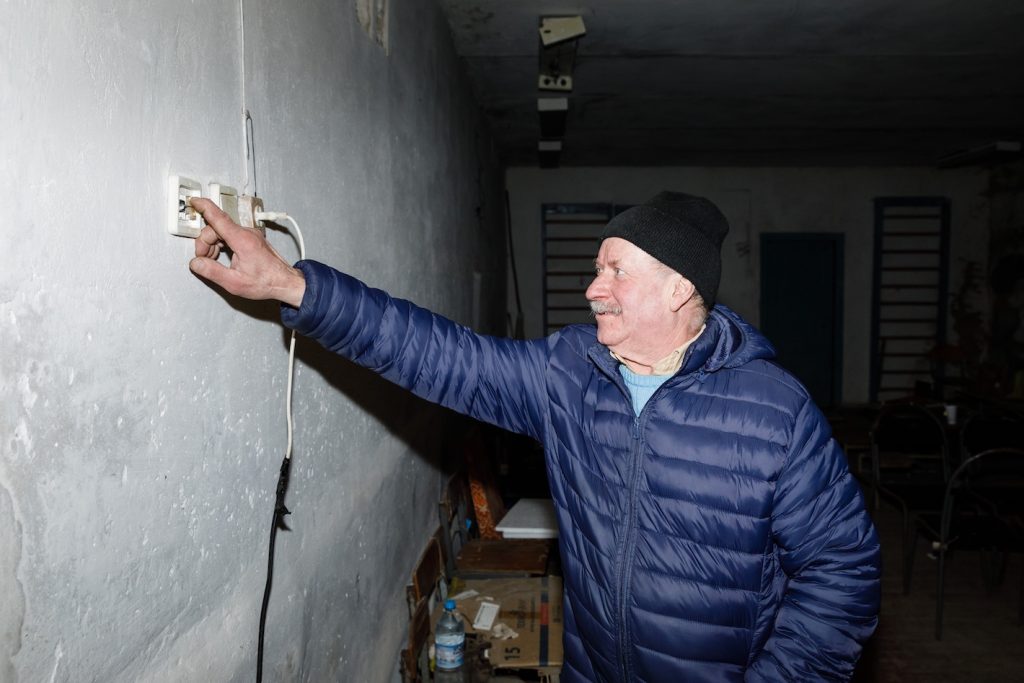
Ivan Polhui, a war crime survivor, who currently works as a caretaker and guide at the Yahidne school basement. Photo by Mykaylo Palinchak, 8 January 2025
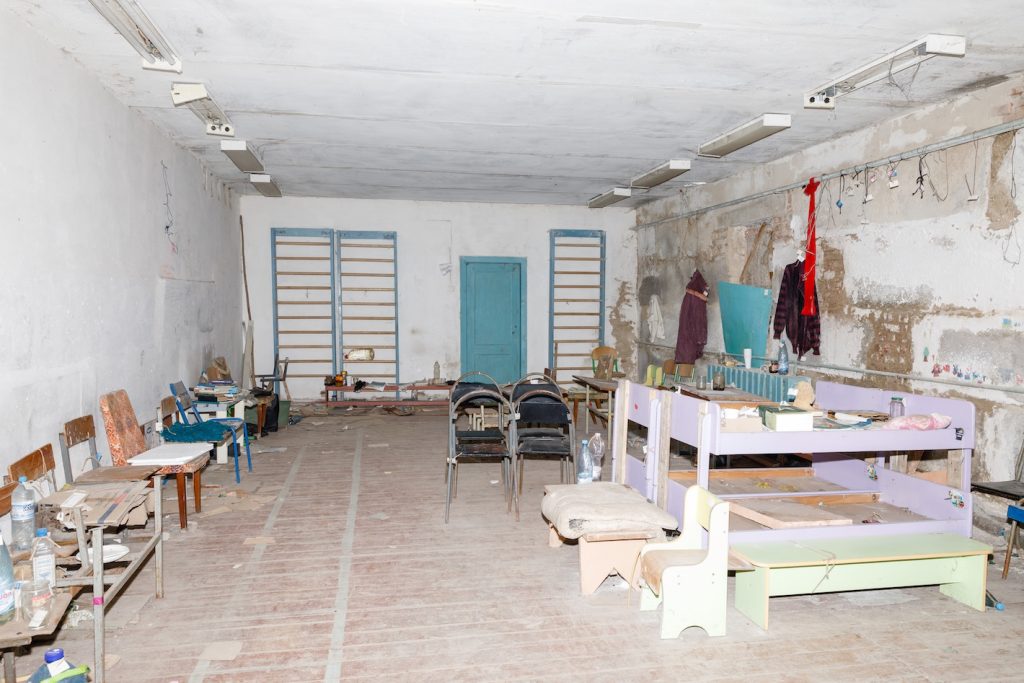
A former gym: the biggest room of the Yahidne school basement. Photo by Mykaylo Palinchak, 8 January 2025
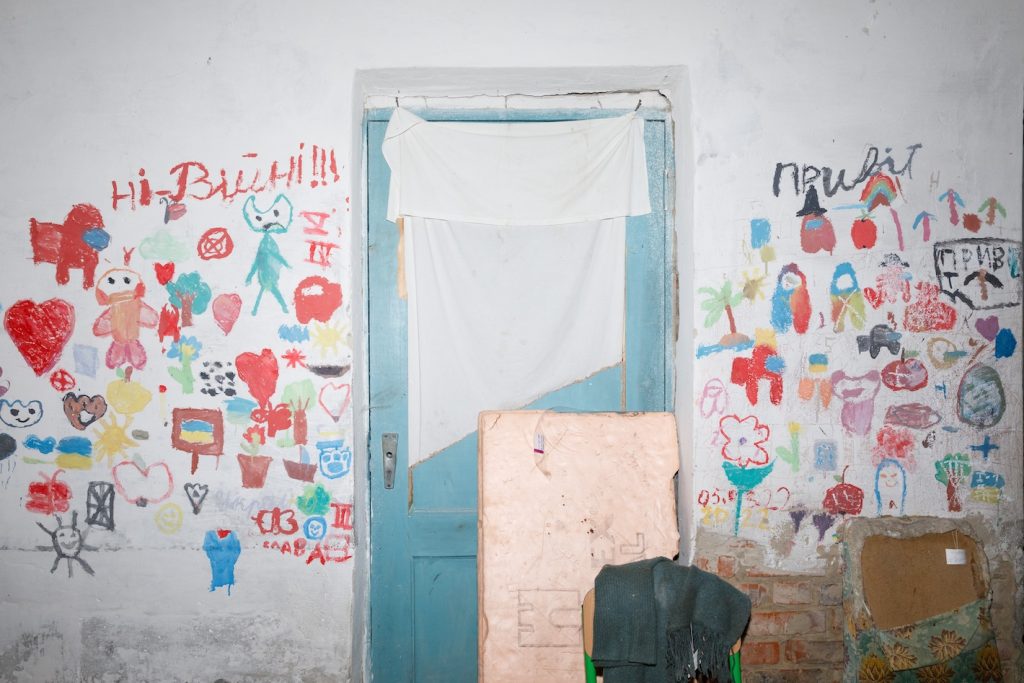
Children’s drawings on the wall of the Yahidne school basement. Photo by Mykaylo Palinchak, 8 January 2025
Ivan leads us down into the basement. The suffering from 2022 is etched into his memory in thousands of details. Even three years on, he remembers exactly where everyone had rested their heads, where their legs had been. He points to four chairs and sits down. ‘This is where I sat. My wife was across from me. A pregnant woman was next to me,’ he says, as if reenacting an investigative reconstruction.
The basement remains damp – if not outright wet. Mold covers the walls. It is creeping toward the drawings that children had made during captivity: hearts, cats, blue-and-yellow flags and the words ‘no to war’. Nearby, adults had scratched their names into the walls, written down the dates of their neighbours’ deaths.
Ivan is fighting the damp with dehumidifiers, but he is facing a losing battle. Belongings are wet and covered with a white residue. Staff from the Vasyl Tarnavskyi Chernihiv Regional History Museum wanted to treating the items with a special protective solution, but they were unable to find a dry space large enough in the village to do so. The region has been devastated by shelling.
Museum workers have left tags with inventory numbers on every item in the basement. Lists have been compiled for a future exhibition. But who will ultimately own it – the Chernihiv museum, the National Museum of the History of Ukraine in the Second World War, or a future local museum – remains unclear. Until the museum is built, there is only hope that this process will prevent any further loss.
‘I’m really looking forward to the day the museum is built. I want to show it to people, especially foreigners – so they know that Russia is evil, so they have no doubts and continue to support Ukraine,’ Ivan says. He has no plans to give up the work, even though it leaves him sleepless.
After 27 days in the basement, Ivan’s eyesight began to deteriorate. Over the past three years, he has undergone four operations, but the condition has continued to worsen. ‘Everyone who came out of that basement lost their health,’ he said. ‘But as long as I can still see, I will keep on doing this.’
The meeting of survivors from the Russian occupation of Yahidne took place in July 2024 and was organized by Public Interest Journalism Lab.
Yahidne comes from Yahody, which means berries in Ukrainian.
V. Frankl, Ein Psycholog erlebt Konzentrationslager, Verlag für Jugend und Volk, 1946; Eng. trans, Man’s Search for Meaning, Beacon Press, 1959.
Published 23 February 2026
Original in English
First published by Eurozine
Contributed by Public Interest Journalism Lab © Angelina Kariakina / Hanna Mamonova / Eurozine
PDF/PRINT

After over 20 years of publishing for free, Eurozine needs your support to get through an exceptionally lean year.
Become a Patron and get exciting perks for your help!


Want to hear a human voice?
Listen and subscribe wherever
you get your podcasts.
Subscribe to know what’s worth thinking about.
For the second year, Ukraine’s collective consciousness is exhuming mass graves and burying children killed by Russian missiles. While just beyond Ukraine’s borders, the world of the transcendent reigns.

The recent earthquake in Turkey and Syria devastated a vast area, killing tens of thousands. Escaping the rubble of not only a natural disaster but also, for Syrians, almost a decade of civil war has led to compound trauma. And survivor syndrome with its sense of guilt has become the added burden of the grieving, displaced and fearful.