With articles ranging from the legacies of occupation and exile to contemporary art, poetry, urban history and anxieties surrounding artificial intelligence, the current issue of Kultūros barai (Lithuania) reminds us that art and culture do not merely endure political, technological and historical upheavals: they help societies make sense of them and, at times, become catalysts for change.
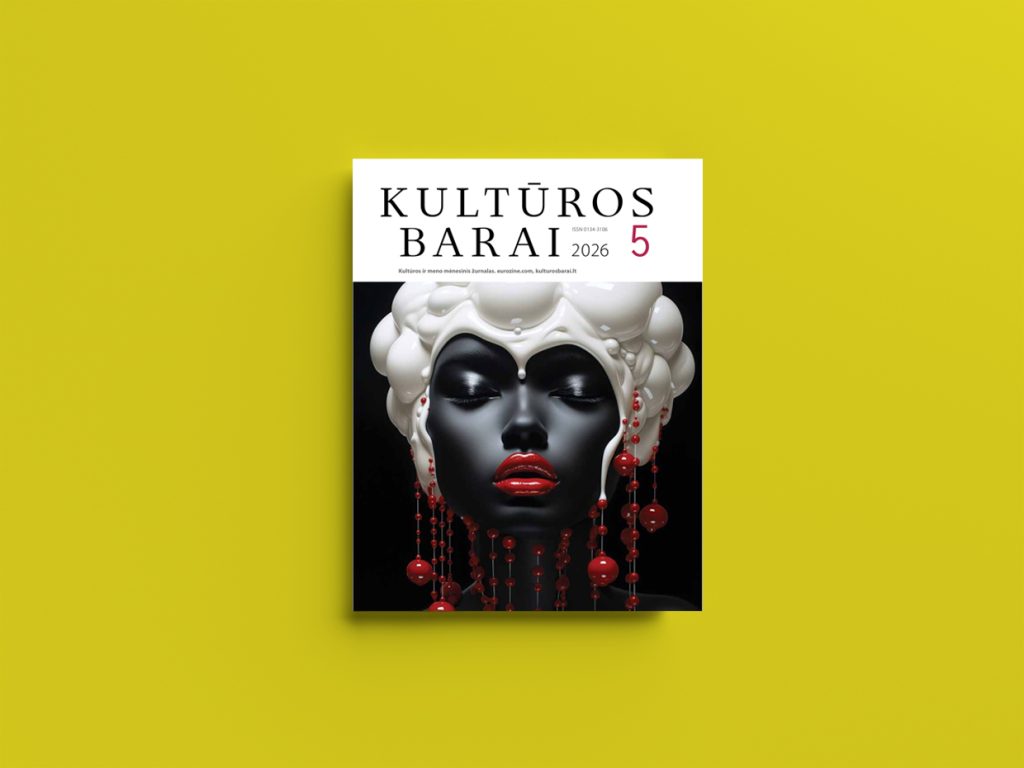
AI aesthetics
As AI advances at breakneck speed – and humanity hurtles along in its wake – how can we ensure we’re heading in the right direction? Evalina Biliunaite offers a refreshing take on AI’s impact on art and the human mind. Rather than impoverishing thought, she argues, AI merely amplifies what is already present within us: ‘superficiality or depth, carelessness or precision, the desire to impress or genuine intellectual discipline.’
Biliunaite, who designed the issue’s striking cover, insists that prompting an AI is not a substitute for artistic creation but just one stage in the creative process, because ‘every genuine creative act begins in the human mind’ – technology merely helps to realize that vision.
Urban heritage
Drawing on three letters from his own papers, Vergilijus Čepaitis recounts the long struggle against the erasure of urban heritage in Vilnius during the twilight years of Soviet Lithuania. At the time, the USSR was sliding towards bankruptcy, and the first steps of perestroika were underway. In Moscow, heritage protection was proclaimed with great fanfare. Yet in Vilnius, the reality was very different.
The first letter decries ‘the mutilation of the unique urban ensemble on Tilto Street’ and demands that those responsible be punished and the building restored. Soon, letters from Vilnius residents defending the Old Town flooded newspaper offices, forcing the authorities, however briefly, to honour the much-touted principles of openness and heritage.
Fresh protests against further demolitions were met not with dialogue but with excavators, and a feeling of despair soon set in. ‘The “Dobužinskis House” had been saved,’ Čepaitis writes, ‘but the overall attitude toward cultural heritage remained unchanged.’
Yet something had shifted. As citizens fought for every scrap – or brick – of their urban heritage, the wider movement for national revival began to gather momentum. ‘In Lithuania, nobody spoke of protecting Soviet culture … for Lithuanians had begun fighting for the right to be themselves, for their national identity.’
Moving to independent Lithuania, Čepaitis argues that the struggle has not disappeared, just changed. Lithuania is no longer ruled by a faceless occupying power, but heritage now faces different pressures – from institutional buck-passing to the sway of private capital. More than ever, he argues, it falls to citizens to expose injustice and hold those in power accountable.
Traces of the past
Martynas Purvinas also examines Lithuania through the lens of urbanity, offering a sweeping historical panorama of the country’s urban landscape and showing how centuries of shifting borders, military occupations and political upheaval have shaped (and often stifled) the development of its urban culture.
Throughout its history, Lithuania has stood at the crossroads of East and West, a position reflected in its urban DNA. ‘For a long time, the territory of present-day Lithuania occupied a middle ground between East and West and never became the centre of an independent urban civilisation of its own.’
Purvinas offers a whistle-stop tour of Lithuania’s turbulent past, from the Grand Duchy of Lithuania and the Polish–Lithuanian Commonwealth to independence, the occupations of the twentieth century and the Soviet post-war period, revealing how each successive regime reshaped not only its cities but also the communities that gave them life.
His tone is often wistful, as he reflects on what Lithuania’s urban culture might have become had successive occupations, partitions and forced migrations not disrupted its development. Early 1941 saw the repatriation of people of German descent from Lithuania to Germany; on 14 June, the first mass Soviet deportations to Siberia began. Entire urban communities disappeared.
Yet memory proved more resilient than ideology. The Soviet authorities could nationalize buildings, rename streets and attempt to remake the cities in their own image, but they could not entirely stamp out the nation’s heritage. ‘Long-time urban residents remembered Smetona-era shops filled with every kind of product: the occupiers could not succeed in erasing the traces of the life that had existed before.’
Fragments of the father
In her personal essay, Dalia Vabalienė offers ‘fragments’ of post-war Lithuania, weaving together her mother’s recollections, excerpts from letters, official documents and her own memories to reconstruct her father’s ‘path of suffering’.
One of the organizers of the June Uprising of 1941 and a member of the military staff of the Lithuanian Activist Front (LAF), her father was arrested, deported, tortured and ultimately executed by the NKVD when she was still a baby. Determined to uncover what became of him after his arrest, Vabalienė set about compiling her own ‘archive’: addresses, letters, photographs, testimonies from relatives and fellow prisoners and historians’ accounts.
The essay closes with a warning against nostalgia for the Soviet past. Vabalienė tells an old joke: a centenarian, asked under which government life in Lithuania had been best, replies, ‘Under the Tsar, my child, under the Tsar. I was young then, and the girls were pretty…’
Review by Cadenza Academic Translations