The idea of Europe as a unity of different peoples sharing a common history can be traced back to the 3rd century BC, when Apollonius’ Argonautica – composed by the Head of the Alexandrian Library – first challenged the Greek habit of labelling all non-Hellenic peoples as “Barbarian”. By explicitly naming Medea’s native Colchian a Kartvelian language, Apollonius acknowledged the diversity of the world beyond Greece, including its linguistic plurality.
This is where Europe’s democratic culture of coexistence within a multilingual world finds its roots, representing the most advanced paradigm achieved to date. European civilisation reflects, at every stage, the enduring tension between rights, freedoms, ideals and lived realities of diverse groups, nations or associations across different times and spaces, alongside the ongoing search for forms of coexistence and connections.
Never in its history has Georgia been a full-fledged member of this space. Rather, it has remained on the periphery, striving to integrate and contextualise itself within the European space – this most intriguing networking club – with varying degrees of vigour depending on historical circumstances.
The EU Candidate status granted to Georgia on 14 December 2023 is the highest position our country has ever held in relation to Europe throughout its history. It is therefore paradoxical that Georgia’s European perspective has become increasingly contested just as the country has reached its closest point to Europe. Human rights, institutional autonomy, academic freedom and other founding principles of democracy are under increasing pressure.
In early May, Marci Shore, a professor of intellectual history at Yale University specialising in Central and Eastern European intellectual history, delivered a public lecture. A student of Ilia State University was arrested right on the steps leading to the university, on her way to the lecture. She was accused of standing on the pavement while participating in a protest. Under these circumstances, it is particularly relevant that this year’s Debates on Europe was held in Tblisi, in a city that is witnessing continuous protests for EU integration.
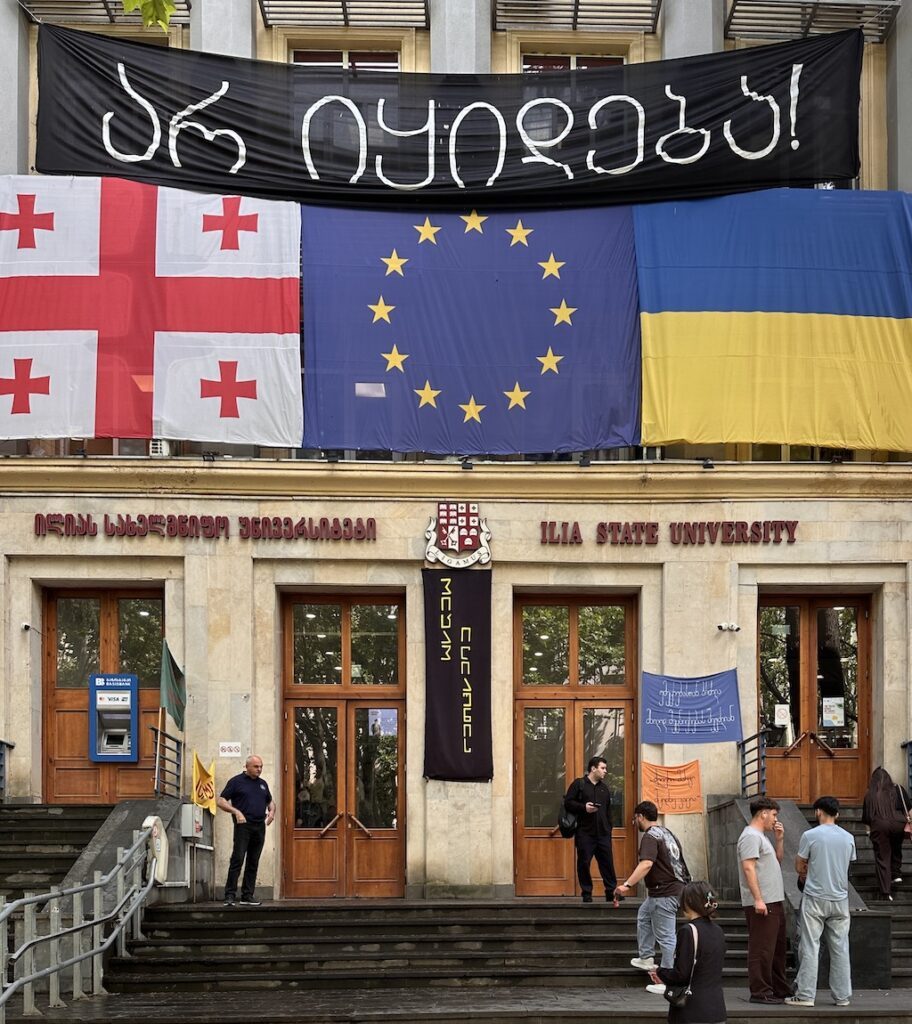
Tblisi, June 2026. The main entrance to the Ilia State University. The horizontal black banner says “Not for sale!” | Photo ©GpA
Georgia’s long European idea
The European idea has a continuous history in Georgia. According to old Georgian historiography, as early as the 5th century, King Vakhtang Gorgasali, the founder of Tblisi, introduced a radical shift in the strategic affiliation of his contemporary Georgia (or more specifically, Kartli), leaving the orbit of Iran (and hence, Zoroastrianism) and directing his country towards the Eastern Roman Empire (hence Christianity). King Vakhtang’s will expressed loyalty to the “Greek path” – a phrase that determined not only the country’s religion but also its foreign policy and its aspirations towards the West.
The will became the founding principle of Georgia’s political agenda in the 8th century: a buffer state of the Eastern Roman Empire – or as the 8th-century chronicler Iovane Sabanisdze described it, the edge and periphery of the medieval Christian world – Kartli nonetheless embodied all the characteristics that pertained to the centre.
Georgian rulers from David the Builder to Queen Rusudan sought to anchor the country within Europe through dynastic ties, diplomacy and cultural exchange. The fall of Constantinople interrupted this process for centuries. Georgia experienced a prolonged period of political fragmentation and cultural decline before reform efforts resumed under Vakhtang VI and Erekle II, who worked on dismantling old feudal structures in Georgia.
By the end of the 19th century, this process culminated in the European-style modernisation project led by Ilia Chavchavadze and the Society for the Spread of Literacy, which at the beginning of the 20th century, before the Soviet occupation, brought the country three years of independence, along with the most advanced standards of democracy.
The post-Soviet period has been neither easy nor favourable, in terms of European integration. The recent radical reversal in politics, culture and particularly education is causing irreparable damage to the European perspective of our country’s democratic development, and its future in general. These adverse processes jeopardise the alignment of the Georgian higher education system with the European one; infringe upon academic freedom and institutional autonomy that are to be guaranteed by law; and more specifically, threaten universities with effective closures.
Under a government resolution, academic programmes and student numbers at Ilia State University – which received the highest rating from international experts – have been cut by 92% for 2026.
Recent years have seen diverse expressions of continuous support for the European idea – both factual and statistical, as well as symbolic and metaphorical: 80-85% of the population voices strong support for the European future, and the EU flag has flown from Tbilisi’s streets through years of protest.
Yet enthusiasm for Europe has long coexisted with a structural weakness: the fact that Georgia was not part of the historical process that brought about the university, one of the oldest and most solid European institutions and a major factor at the core of the modern independent democratic European society, was detrimental. The country was absent from this development until 1918.
A critical examination of this gap or its alternatives in our historical development may, to a certain extent, help us understand a number of circumstances that previously seemed inexplicable. Of course, historical retrospection cannot provide a direct answer to our question concerning the deeply controversial European agenda. Yet, it can offer a clearer understanding of how the idea of university developed in Georgia, why we find ourselves where we are today, and why the prompt, smooth adoption of best practices into the post-Soviet period, already spanning thirty-five years, appears so challenging.
A missed stage in medieval history
The medieval Christian East and West developed different approaches to education, authority and knowledge. These differences shaped contrasting understandings of the university and its role in society.
Features and chronology of modernity in the Christian East are also debatable. Elements of modernity emerged in the Christian East centuries earlier than in the West with the gradual emancipation of vernacular languages as the latter penetrated all spheres of social life, ultimately becoming literary languages. By the 5th century AD, Syriac, Coptic, Ethiopian, Armenian, Georgian and Caucasian Albanian languages had established themselves as literary languages with their own alphabets.
While vernacular languages flourished, religious authority remained tightly controlled in the Eastern Roman world. Priests were prevented from designing the content of sermons on their own, independent interpretation of scripture was discouraged, and only the Holy Fathers’ homiletical work was to be used in preaching, thus limiting forms of intellectual debate that would later contribute to the rise of universities in Western Europe.
This meant that essential elements were banned in the Eastern Roman Empire: the reading and comprehension of religious texts; more or less free, individual interpretation; reflections, rewriting and revaluation. In fact, the Eastern Roman Empire restricted what gave rise to Studium Particulare and Studium Generale – the precursors of the medieval western university – in the West, the formation of medieval western universities as the corporation of students and masters.
These two religious bans caused considerable divergence in the development of the medieval East and West, the results of which are apparent today: strong tendencies of medieval ethno-nationalism, ethnic conflicts, privileged state religions in the countries of the former medieval Christian East, and the university-based values, such as Tolerance, Equality, Human Rights and Democracy in the countries of the medieval Christian West.
It is therefore unsurprising that the medieval Christian East developed not universities but a sophisticated system of Byzantine religious education centred on academies, foremost among them the Academy of Mangana and its major branches in Alexandria and Antioch. Although some modern encyclopaedias describe Mangana – established as a philosophical school as early as 425 – as a university, its status as such remains highly contested.
The same pattern can be observed in the buffer states of the Christian East, including medieval Georgia. Rather than giving rise to universities, their traditions of higher learning produced academic centres modelled on the religious academies of the Byzantine world.
When the Academy of Mangana was shaken by a wave of religious repression that led to the exile of Neoplatonic scholars and their followers, two Georgian students, Iovane Petritsi and Arsen of Ikalto, returned home and played a key role in founding the Gelati and Ikalto academies. Little evidence survives about how these institutions functioned, apart from often-contested historical traditions. However, the works written, translated and copied at Gelati and Ikalto suggest that Georgia’s centres of higher learning closely followed the model of the Academy of Mangana.
In Georgia, as in Byzantium, the idea of knowledge-based faith suffered a bitter defeat. The trends that contributed to the emergence of universities in the medieval West were finally extinguished in 13th-century Georgia when the Church declared a war against the greatest work of Georgian literature of all times, The Knight in the Panther’s Skin by Shota Rustaveli. The poem was so persecuted that none of its earlier copies has been preserved.
Thus, the omission of the fundamental stage of university formation in the Middle Ages, together with the processes following the fall of Constantinople, created a long-term gap in our European perspective.
Similar paths in different historical contexts
It was no earlier than the 19th century that Georgia could re-embark on the European path and, like the smaller European nations, commence its European project of modernisation. In 1918, this laid the foundation for the creation of an independent state, outstanding for its level of democracy at that time. Just months earlier, the first university in Georgia, and in the South Caucasus, had been established. At the beginning of the 20th century, heated debates arose between the technical and intellectual elite over the principal mission of university as the central architect of knowledge society.
For the first time in Georgia, the university and its founders drew around themselves a self-organised community of European type, bringing together the political elite and governing groups with radically differing ideological preferences, who nonetheless managed to share common responsibilities based on democratic principles.
Some three years later, the first Democratic Republic of Georgia faced historical circumstances altogether different from those of the smaller European nations. Moreover, due to Soviet and post-Soviet isolation, Georgia was excluded from the very framework in which their development was described, even though between 1870 and 1921 the country had passed through the stages of nation-state formation outlined by the historian Miroslav Hroch in his comparative study of smaller European nations.
The same fate befell Georgia’s first university, whose founders were ousted, subjected to trial or executed.
In terms of higher education, the post-Soviet period proved no less challenging, marked by the deconstruction of all previously existing standards. The modernisation of university in Georgia began in 2005, when the country joined the Bologna Process. This period signalled the beginning of the most difficult path towards the standardisation of university education in Georgia, as well as towards the strengthening of its missions – education, research and the so-called “third mission”, under which the university as an institution is called upon to foster civic culture and public awareness.
It was in this context of European integration that Ilia State University was founded in 2006. From the outset, it sought to combine education, research and public engagement, reflecting the broader effort to align Georgia’s academic institutions with European standards. In doing so, the university has attempted to carry forward the legacy of Ilia Chavchavadze, who saw education as the foundation of both national development and European modernity. As he famously wrote: “Education, knowledge, and scholarship are forces that nothing can counter today: neither fist, nor sword, nor the multitude of an army.”
As in the case of Ilia Chavchavadze’s European project, so too in contemporary Georgia, the university – and universities more broadly – should be an agent of change, an institution aiming at fostering a public space that has been significantly narrowing not only in Georgia but throughout the world; a space in which modern multidimensional pluralistic societies may come together to discuss and ultimately agree upon the forms of their networking.
This essay is published in partnership with Debates on Europe, on the occasion of the Debates in Tbilisi, held in June 2026.