


Under the Netanyahu government, Israel has aligned itself with an autocratic international whose goal is to transform sovereignty into state impunity. The war on Gaza inaugurates a global era in which consensus itself has lost legitimacy.
How do you write the history of a displaced society when sites of memory have been destroyed, libraries looted, and archives made inaccessible? Tracing the evolution of Palestinian historiography is to analyse responses to this enduring challenge.
Writing the history of Palestine raises a fundamental historiographical question: how can a historical narrative be produced in the face of exile, dispersal and destruction? Since Marc Bloch, history has no longer been understood simply as the retelling of past events, but as an inquiry into human societies based on fragmentary traces, which are always situated and unequally preserved. In the case of Palestine, this takes on a particular form: archives have been scattered, confiscated or destroyed, and access to the past itself has become bound up with power.
The history of Palestine and its people has long been marginalized by the dominant Israeli narrative. Although absent, fragmented or relegated to the margins of the ‘Israel-Palestine conflict’, this history has nevertheless continued to be written in Arab scholarly circles and, later, transnational networks. Palestinian historiography has been forged through rupture: the rupture of expulsion and exile and the disappearance of a social world.
Ever since the Naqba, writing Palestinian history has been intrinsically linked with the struggle against erasure. Palestinian historiography is not limited to the reconstruction of a national past: it enquires into the very conditions that make a historical narrative possible. How do you tell the story of a society that has been scattered? How do you write history when sites of memory have been destroyed, libraries looted, and archives made inaccessible?
Tracing the evolution of Palestinian historiography is to analyse how successive knowledge regimes have responded to this enduring challenge, from the fall of the Ottoman Empire to the present day. This article first looks at the construction of a national narrative in Mandatory Palestine and in exile, and then examines the role of archives in the emergence of a Palestinian historiographical field. It aims to demonstrate how, faced with dynamics of erasure, writing history and preserving archives are practices that are at once scholarly, activist, and existential.
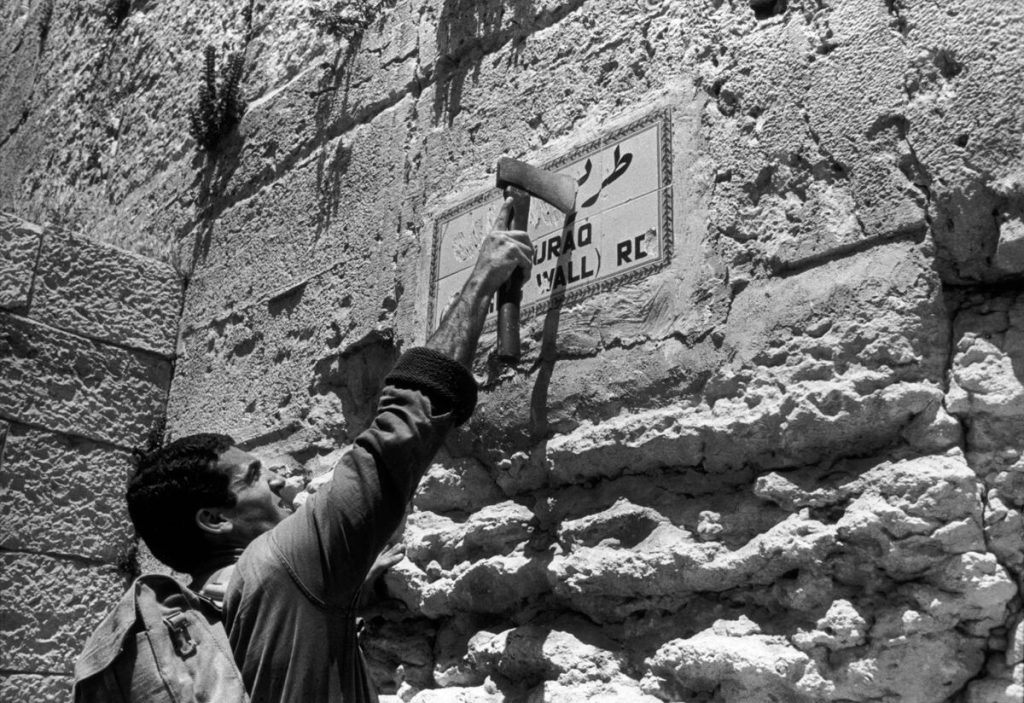
An Israeli soldier in newly liberated East Jerusalem, knocking out the Arab sign naming the Wailing Wall as ‘Mohammed’s Horse El Bourak’, June 1967. Source: Wikimedia Commons
The first Palestinian historians situated Palestinian history within a broader horizon shaped by the dissolution of the Ottoman Empire, the rise of Arab nationalisms, and the establishment of the British Mandate for Palestine. This broader framing was not simply a matter of ideology. In that historical moment, categories of belonging were being reconfigured. The term ‘Palestinian’ slowly began to emerge as a distinct identifier, without immediately replacing the terms ‘Ottoman’ or ‘Arab’. The affirmation of Palestine’s Arab identity was tied to naming and narrativization efforts, in which referring to oneself as ‘Palestinian’ helped to construct a collective subject.1
As a space for producing and disseminating these new categories of identification, the press played a central role in this process. The rise of Arab newspapers in the early twentieth century fostered the use of the term ‘Palestinian’, which gradually became a tool of cohesion, mobilized in debates relating to Zionism, migration and social change.2 The affirmation of the land’s Arab identity and the struggle against the denial of that claim by the Mandate authorities and the Zionist movement were part of a historical narrative with a strong performative dimension: the aim was not only to recount history, but to create the conditions for collective identification.3 Advanced by the intellectual elites but disseminated within a broader public sphere, this narrative sought to inspire a feeling of unity within a politically defined Arab community that spanned religious divides. It contributed to stabilizing the contours of an emerging Palestinian identity, without ever fixing it fully.
The Arab Revolt of 1936–39 was a watershed moment, widely identified in Arab historiography as a foundational moment for Palestinian nationalism.4 One of the main anticolonial uprisings against the British Empire in the inter-war period, it formed part of a broader regional dynamic of opposition to the colonial order while also revealing the distinctive features of the Palestinian case. For that reason, the Arab Revolt occupies a central place in the construction of the Palestinian national narrative.
The writings of the period are imbued with a strong political dimension seeking to strengthen the feeling of unity within the Arab community – both Christian and Muslim – in the face of foreign domination. This historiography, which strove to be extensively documented and grounded in both Arab and western archives, was produced in a unified Palestinian society, before it was shattered by the upheavals of 1948. It was written from within a territory that was still a lived, inhabited and socially organized space. The 1936 revolt thus marked the final major historical moment before the destruction and scattering of Palestinian society, while also representing a major reference point for later narratives of the national struggle.5
Both the suppression of the Arab Revolt and its ultimate failure formed part of broader imperial doctrines of counterinsurgency, based on the deliberate dismantling of the social fabric as a means of political control.6 From a historiographic point of view, the revolt was therefore not only a moment of national mobilization, but also a testing ground for colonial practices, the effects of which continued to be felt long after the end of the Mandate.
The narrative constructed around these events, widely circulated through the Arab press, contributed to the stabilization of the term ‘Palestinian’ as a political and historical category. By naming those involved in the uprising and situating their struggle within a national chronology, the press played a crucial role in transforming the uprising into a foundational moment of a collective narrative.
Thus, the 1936–39 revolt cannot be solely understood as a military confrontation: it constitutes a moment of crystallization where dynamics of resistance, practices of colonial domination, and competing forms of historical knowledge production converge. It became part of a longer series of events that culminated in the rupture of 1948 and contributed to the emergence of a national movement within which a collective consciousness was forged, built around resistance to colonialism and the affirmation of a Palestinian national narrative.7
Long understood as a strategic defeat stemming from internal divisions and an imbalance of power, the Arab Revolt is now being re-evaluated as a moment of mass politicization that helped give shape to the emerging national consciousness.8 Nevertheless, its failure weakened the Palestinian national movement at the end of the 1930s. Combined with the consolidation of the military and political structures of the Zionist project under British protection, the failure of the Arab Revolt appears to be one of the factors that helped make the rupture of 1948 possible.9 It thus forms part of a longer history of anticolonial struggles, while also underscoring the asymmetrical conditions in which historical knowledge about Palestine is produced, transmitted, and contested.
The year 1948 marked a turning point: for the first time since they had become nation states, the independent Arab countries entered war against the new Israeli state and were defeated. This is the disaster of the Naqba: the erasure of an Arab state in Palestine, the fragmentation of a society, and the emergence of the refugee problem. In Palestinian historiography, 1948 is generally taken as ‘Year Zero’,10 marking both the end of historical Palestine with its Mandate-era borders and the starting point of a history now structured by dispersal. The ‘slow, seemingly endless train wreck’ that was the Naqba completely transformed the frameworks through which the past was understood.11
Constantine Zurayk’s The Meaning of the Disaster,12 first published in Arabic in 1948, triggered a decisive shift by defining this moment as a ‘catastrophe’, a defeat that was not only military but moral and psychological, involving the entire Arab world and calling for an intellectual and political reworking of the Arab nationalist project faced. The loss of territory and the experience of exile reconfigured Palestine’s ‘geography’, with the national narrative being written from outside of its historical homeland, delineating the contours of a lost, but nonetheless constantly reaffirmed, territory.
The 1950s, however, saw a relative decline in Palestinian historiographical production, a time of silence and intellectual dispersal. The scattering of the elite to different host countries fostered the emergence of an exile literature, riven with a deep feeling of injustice and the difficulty of rebuilding shared frameworks of knowledge production. In this context, the rise of Arab nationalism tended to include the Palestinian question within a broader framework, making it a central cause for the Arab world in its interactions with the international community and thus producing a ‘globalizing’ reading of Palestine.
The defeat in June 1967 marked another major turning point that affected the entire Middle East, shifting political and intellectual balances. It coincided with the emergence of a new Palestinian leadership drawn from armed resistance movements (fedayeen), whose appearance on the scene profoundly transformed analytical frameworks. The renewed centrality of Palestine in political discourse was accompanied by a change in perspective: Palestine was no longer seen as simply a cause to be supported by Arab unity, but as a means by which that unity could be advanced.
Palestinian researchers and historians, in many cases influenced by Marxism, began to reinterpret Palestinian history through new categories, giving rise to highly politicized writings with a strong activist bent.13 This period was also noteworthy for a sociological transformation of the intellectual field: a new generation, many of whom had grown up in the refugee camps and been educated in UNRWA networks, helped redefine the key figures of the historical narrative, in particular by putting the resistant peasant and the working classes centre stage.
At the same time, from the mid-1960s onward, the production of knowledge about Palestine became institutionalized through the founding of research centres and publishing houses. These were mainly based in Beirut, the intellectual capital of the Arab world at the time, and the cultural and political capital of the Palestinian cause. This development met a central need: affirming the existence of Palestine outside of its territory, through writing its history, creating archives and disseminating structured knowledge.
Institutions such as the Institute for Palestine Studies, founded in 1963, and the Palestinian Research Center, founded in 1965 by the Palestine Liberation Organization, played a crucial role as spaces for scholarly production, contributing to the internationalization of Palestine Studies. The historiographical project took on a emancipatory dimension, foregrounding the figures of the peasant, refugee, and fighter as heroes of the national liberation narrative.
Through their publications, editorial programmes and documentary endeavours, these institutions helped to establish Palestine Studies as an academic field, combining history, social sciences, archives and memory studies. Writing history became a way of combating invisibility, by producing narratives capable of restoring a sense of Palestinian historical continuity across the rupture of 1948.
The Israeli invasion of Beirut in 1982 struck a major blow to the cultural and academic work of Palestinian institutions. Beirut’s research, documentation and cultural and artistic centres became prime targets of the Israeli army. The looting of the archives of the PRC and of the PLO’s cinematography unit deprived Palestinians of a considerable proportion of their documentary heritage. Manuscripts, photographs, films and materials relating to both daily life and the resistance were seized and incorporated into Israeli military archives, catalogued in accordance with categories and norms imposed by the colonial power.
Control over archives forms part of a wider process of rewriting collective memory, through which a colonial narrative of the past is imposed, erasing all trace of Palestinian presence or identity in Israeli territory.14By appropriating Palestinian documentary traces, Israel exerts decisive control over the conditions in which historical knowledge can be produced, preserved and passed on. In this context of dispossession, writing history and collecting archives become fundamental means of resisting erasure. Preserving, reconstructing and sharing archives take on political, memorial, and scholarly significance.
With no sovereign Palestinian state and the archives dispersed, oral history has become one of the principal modes of producing historical knowledge about Palestine. Orality becomes both a historiographical practice and a political act, aimed at affirming the existence of a dispersed people and preserving the memory of a society destroyed in 1948.15 From the 1980s onward, campaigns to collect oral testimonies about the Naqba were carried out in the Palestinian territories and among the diaspora by universities, research centres and NGOs.
The ever-increasing number of narratives, recordings, photographs and family archives is part of what Beshara Doumani has called Palestinian ‘archive fever’.16 In refugee camps, research centres and domestic settings, Palestinians gather the traces of a lost world. Life stories, folk songs, embroidery, maps of destroyed villages, and photo albums become vehicles of memory. By giving a central role to refugees, peasants and women, these narratives bring out an alternative history founded on the lived experience of uprooting and exile – a history written from the bottom up.
Three lines of reflection emerge when considering archives and history in this context.17 The first concerns the colonial relationship to archives. Since the creation of the State of Israel, Palestinian history has been marked by the confiscation, repurposing and reappropriation of traces of the past and of Palestinian cultural heritage. Archives, libraries, and archaeological artefacts are frequent targets of a colonial power that seeks not only to control territory, but also to impose its own historical narrative. The looting of Palestinian libraries in 1948, the confiscation of the PLO archives in Beirut in 1982, and the recent destruction of cultural and documentation centres in Gaza are all driven by the same logic: controlling the conditions in which knowledge is produced and passed on.18
The second dimension concerns the need to rethink the form that archives take in the context of permanent occupation. In the absence of a sovereign Palestinian state capable of protecting collections through institutions, centralized structures such as museums and archives are particularly vulnerable. The experience of the Palestinian Museum in Birzeit, opened empty in 2016 as a symbolic gesture, demonstrates the impossibility of protecting collections in the long term under colonial domination. The absence of objects on display served both as a preservation strategy and as a political critique of the colonial condition. From this perspective, Palestinian archives need to be conceptualized as mobile, scattered, digitized or hidden structures, capable of evading pillage and destruction.
The third and final dimension concerns the fact that Palestine now exists far beyond its geographical territory. The dispersal of Palestinians, a direct consequence of the Naqba and successive displacements, has contributed to spreading traces of Palestine throughout the world. Thanks to the internationalization of the Palestinian question and transnational solidarity networks, Palestinian archives now circulate in a multitude of spaces. Copies of films rediscovered in Tokyo or Rome, photographs preserved in private collections in Europe, and documents safeguarded by activists or foreign institutions all demonstrate Palestine’s fragmented but persistent presence in the world.
Dispersal, experienced first and foremost as dispossession, has thus become a means of preserving the Palestinian historical narrative. Palestine cannot be understood solely as an occupied territory: it also exists as a fragmented constellation of archives, narratives, intellectual works, and memories spread across the globe. Palestinian history is constructed from copies, oral testimonies and the circulation of documents that have escaped the dynamics of erasure. In this context, producing knowledge, publishing journals, digitizing archives and tracking down lost films are all part of the same struggle to keep the very possibility of a Palestinian history alive.
Since 2023, the war on Gaza has profoundly altered the way the Palestinian narrative is produced and passed on. Despite the devastation of lives, places and physical archives, Palestinians are still documenting their everyday life, sharing their experiences of war, and preserving the traces of their existence. Blogs, online newspapers, social media and collaborative platforms have become alternative archives, produced from the margins and partially escaping the control of dominant narratives.19 This digital documentation forms part of a longer history of the Palestinian struggle against erasure.
When archives are confiscated, libraries are destroyed, and cultural institutions remain fragile, documenting ordinary life becomes an act of resistance. Every testimony, photograph and narrative helps preserve a collective memory that is under threat of disappearance. In this sense, oral history, social media, and the Palestinian blogosphere are not only spaces for self-expression, but also contribute to the construction of a living, decentralized archive. In this way, the writing of Palestinian history has now expanded beyond the framework of academic institutions, archive centres and the borders imposed by dispersal and occupation. This constantly renewed historiography helps to contest the dominant Israeli narrative and resituate the history of Palestine in a wider, shared narrative of the land, thereby countering the dynamics of erasure.
Translated and edited by Cadenza Academic Translations

Published in cooperation with CAIRN International Edition
See Emanuel Beška and Zachary Foster, ‘The Origins of the Term “Palestinian” (“Filasṭīnī”) in Late Ottoman Palestine, 1898–1914’, Academia Letters (2021): doi:10.20935/AL1884.
See Noha Tadros Khalaf, Les Mémoires de ‘Issa al-‘Issa: Journaliste et intellectuel palestinien (1878–1950) (Paris: Karthala, 2009).
See Tarif Khalidi, ‘Palestinian Historiography: 1900–1948’, Journal of Palestine Studies 10, no. 3 (1981): pp. 59–76, doi:10.2307/2536460.
See Jihane Sfeir, ‘Palestinian Historiography: Between History and Memory’, trans. Cadenza Academic Translations, NAQD special issue 3 (2014): pp. 45–64, doi:10.3917/naqd.hs3.0045.
See Matthew Kraig Kelly, ‘The Revolt of 1936: A Revision’, Journal of Palestine Studies 44, no. 2 (2015): pp. 28–42. doi:10.1525/jps.2015.44.2.28.
See Matthew Hughes, ‘The Banality of Brutality: British Armed Forces and the Repression of the Arab Revolt in Palestine, 1936–39’, The English Historical Review 124, no. 507 (2009): pp. 313–54, doi:10.1093/ehr/cep002.
See Ted Swedenburg, Memories of Revolt: The 1936–1939 Rebellion and the Palestinian National Past (Fayetville: University of Arkansas Press, 2003).
See Zeina B. Ghandour, A Discourse on Domination in Mandate Palestine: Imperialism, Property and Insurgency (London: Routledge, 2010).
See Rashid Khalidi, ‘The Palestinians and 1948: The Underlying Causes of Failure’, in The War for Palestine, edited by Eugene L. Rogan and Avi Shlaim (New York: Cambridge University Press, 2007), pp. 12–36.
Élias Sanbar, ‘Le vécu et l’écrit: Historiens~réfugiés de Palestine’, Revue d’études palestiniennes 1, no. 1 (1981): pp. 62–75, doi:10.3917/repa.001.0062.
See Rashid Khalidi, The Hundred Years’ War on Palestine: A History of Settler Colonial Conquest and Resistance (London: Profile, 2020).
See Constantine Zurayk, The Meaning of the Disaster, trans. R. Bayly Winder (Beruit: Khayat’s College Book Collective, 1956).
See Sfeir, ‘Palestinian Historiography’.
See Rona Sela, ‘The Genealogy of Colonial Plunder and Erasure: Israel’s Control over Palestinian Archives’, Social Semiotics 28, no. 2 (2018): pp. 201–29, doi:10.1080/10350330.2017.1291140.
See Jihane Sfeir, ‘Mémoires vives palestiniennes’, in Archiver au Moyen-Orient: Fabriques documentaires contemporaines, edited by Christine Jungen and Jihane Sfeir (Paris: IISMM-Karthala, 2019), pp. 129–56.
Beshara Doumani, ‘Archiving Palestine and the Palestinians: The Patrimony of Ihsan Nimr’, Jerusalem Quarterly 36 (2009): pp. 3–12.
This section is indebted to Rana Anani’s article ‘شاعرية المتاحف في فلسطين ولزوم تمرّد الأرشيفات [Romanticizing Museums in Palestine and the Necessity of Archives Rebellion], Majallat al-Dirasat al-Filastiniyya 145 (Winter 2026): pp. 385–97, https://www.palestine-studies.org/en/node/1658299.
See Jihane Sfeir, ‘Resisting Erasure’, Expériences palestiniennes contemporaines, 8 December 2025, https://palestineshs.hypotheses.org/1134.
See Sujoud Awayes, ‘التدوين بصفته أرشيفاً مضاداً: سرديات الفلسطيني اليومية سلاحاً أخيراً [Blogging as a Counter-Archive: Palestinians’ Daily Narratives Are a Last Weapon]’, Institute for Palestine Studies Blog, 2 February 2026, https://www.palestine-studies.org/ar/node/1658464.
Published 23 July 2026
Original in English
Translated by
Cadenza Academic Translations
First published by Esprit 6/2026 (French version); Eurozine (English version)
Contributed by Esprit © Jihane Sfeir / Esprit / Eurozine
PDF/PRINT
After over 20 years of publishing for free, Eurozine needs your support to get through an exceptionally lean year.
Become a Patron and get exciting perks for your help!


Want to hear a human voice?
Listen and subscribe wherever
you get your podcasts.
Subscribe to know what’s worth thinking about.


Under the Netanyahu government, Israel has aligned itself with an autocratic international whose goal is to transform sovereignty into state impunity. The war on Gaza inaugurates a global era in which consensus itself has lost legitimacy.

‘Since leaving Khan Younis, I have not felt whole. The knowledge that complete healing will never come has become something I carry with me always, like a part of my body, like an extra limb.’ A Gazan writer on her experience of multiple displacement, written in March 2025. [Czech version added]