Palestinian historiography as struggle against erasure; a film about narrative and loss; Standing Together; debate as the first step to a renewed political imagination.
The destruction of Gaza has remained strangely invisible, despite unfolding before a global audience, write Hamit Bozarslan, Anne-Lorraine Bujon and Joël Hubrecht in their introduction to the new issue of Esprit, entitled ‘Palestine: A future to rebuild’.
At the heart of the crisis lies a political logic in which ‘the death of the other is presented as the only possible solution’, fuelling a ‘race to the abyss’ driven by regional and international actors. Yet the possibility of a different future beyond the war remains. As the contributors to the issue show, realizing this future will require ‘a series of reappropriations and a desire to unite’.
The signatories of the Paris Call for the Two-State Solution declared that ‘Our histories are filled with pain, but our future is still unwritten.’ Building a desirable future depends on recognizing this shared history of suffering and ‘breaking free of the theological-political framework shared by the warmakers’, writes Esprit.
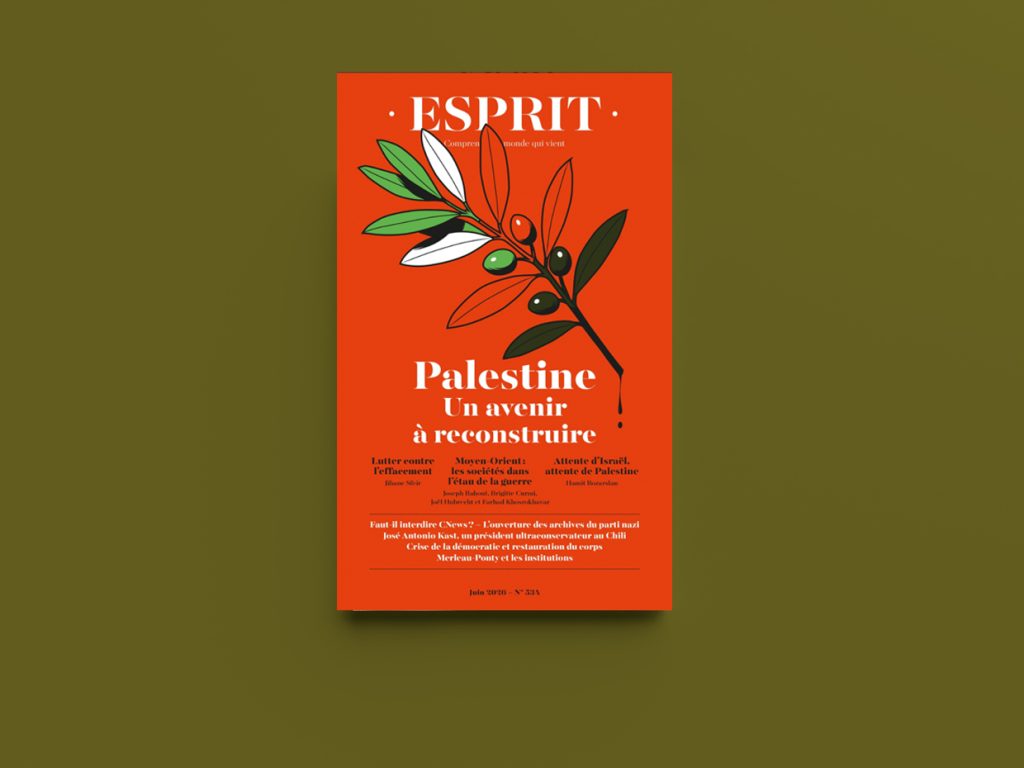
Against erasure
The writing of Palestinian history is inseparable from a struggle against erasure, writes Jihane Sfeir. The central challenge is how to produce a historical narrative when archives are ‘scattered, confiscated, or destroyed’ and access to the past itself becomes a question of power.
The formation of a Palestinian national narrative began in the late Ottoman and Mandate periods, when intellectuals and journalists contributed to the emergence of ‘Palestinian’ as a collective political identity and a ‘driver of cohesion’, especially during the Great Revolt of 1936–1939. After 1948, however, the writing of history was reconfigured by displacement, with the Nakba becoming a ‘year zero’ that ‘profoundly transformed frameworks for understanding the past’.
Since then, the Palestinian experience of ‘expulsion, exile and the disappearance of a social world’ has made historiography not just an academic endeavour but ‘a means of combating erasure’. The pillaging of libraries, documents and cultural institutions forms part of a broader effort to impose ‘a colonial narrative of the past’, and archives themselves have become sites of struggle.
To preserve testimonies and photographs is an act of resistance aimed at ‘keeping alive the very possibility of a Palestinian history’, writes Sfeir. Palestine is ‘not just an occupied territory; it also exists within a fragmented collection of archives scattered around the globe’.
To possess a narrative
Nicolas Wadimoff’s documentary Qui vit encore, inspired by the conviction that survivors must ‘speak for those who no longer have a voice’, features nine Gazan exiles in South Africa talking about their lost homes and memories of Gaza.
The film is structured around a repeated pattern, with each person drawing a plan of their old home and describing what happened to them and their families using a map of Gaza sketched on the ground for reference. The house emerges as a central symbol, in line with its importance in Palestinian culture: ‘The home is family; it’s not just four walls and a roof.’
Through drawings, stories and shared recollections, the survivors reconstruct a Gaza that has been physically destroyed but remains alive in memory as the foundation of a hope that is ‘not just an emotional response, but an epistemic and existential anchor’. Their testimony is also an act of resistance.
Haneen Harara describes her participation as driven by a responsibility to ‘challenge and counter false representations and widespread disinformation’. Despite immense loss, the film insists on the possibility of endurance, community and hope. As Harara puts it, ‘to have a legitimate right is also to possess a narrative, and so the possibility of a future.’
Standing together
Standing Together is a grassroots movement that brings together Jewish and Palestinian Israelis in opposition to war, occupation, and segregation. Emerging from the protests of 2011 and formally founded during the 2015 intifada, the movement was built around the ideal that ‘we will not live by the sword, we will stand together’. Rather than accepting conflict as inevitable, say Itamar Avneri and Amal Ghawi, they seek to create a political community based on equality, solidarity, and common struggle.
Since October 2023, the genocide in Gaza has made the pursuit of a just peace more urgent than ever. Standing Together rejects the idea that Israelis and Palestinians form ‘two irreconcilable camps’. Instead, it locates the real divide between ‘warmongers on one side, and the people on the other’. Its vision is embodied in practical initiatives from joint demonstrations to humanitarian convoys delivering aid to Gaza and protective presence campaigns in the West Bank.
The model of ‘one shared homeland and two states’ is understood as a first step towards a longer process of reconciliation. As Avneri and Ghawi emphasize, hope is not something that precedes action, but is created through collective struggle: ‘Where there is struggle, there is hope.’
A space for debate
The intertwined national aspirations of Israelis and Palestinians have been shaped by powerful expectations of statehood and historical justice, writes Hamit Bozarslan. For many Jews, the creation of Israel in 1948 fulfilled a centuries-long hope of return and marked a decisive break with the experience of diaspora, especially after the Holocaust. Yet ‘the achievement of Israel’s expectation came to the detriment of the Palestinian people’ in the form of the Nakba and inaugurated a parallel Palestinian expectation: the creation of an independent state.
Reconciling these two hopes will require both Palestinians and Israelis to ‘think differently and come up with new ways of being and acting’. Although the situation seems hopeless, it is important to remember that ‘while the present is determined, or even overdetermined by the past, the future is not a predetermined fate’.
Bozarslan turns to the past for inspiration, drawing on progressive Zionist currents and Austromarxist models of shared sovereignty to explore alternative futures. Despite the bleak political context, ‘opening a space for public debate in Israel and Palestine’ is an essential step towards a renewed political imagination capable of moving beyond domination, occupation and mutual negation.
Review by Cadenza Academic translations

Published in cooperation with CAIRN International Edition
Published 18 June 2026
Original in English
First published by Eurozine
© Eurozine
PDF/PRINT

Invest in insight!
After over 20 years of publishing for free, Eurozine needs your support to get through an exceptionally lean year.
Become a Patron and get exciting perks for your help!


Want to hear a human voice?
Listen and subscribe wherever
you get your podcasts.
Newsletter
Subscribe to know what’s worth thinking about.
Related Articles


Let our political imaginations soar
Blätter für deutsche und internationale Politik 10/2025

Related Articles

For younger Palestinians, most of them diasporic, the heroics of the past are no compensation for the absence of an organized liberation movement. Abandoning the myths of statehood through negotiated settlement, they are defining the goals of liberation and return anew.

The outbreak of the Lebanese civil war fifty years ago inaugurated an era of nation-state collapse in the Arab world. In failing to mediate, the international community carries responsibility for the sense of impotence felt in societies in which violence dominated everything.