


Since the collapse of Novi Sad’s train station in November, student-led protests have erupted across Serbia, inspiring a nationwide movement against corruption.
The Dayton Agreement put an end to the war in Bosnia and laid the grounds for today’s divided state. But what appeared as the triumph of the liberal order had been preceded by three years of political deadlock, with western policy driven primarily by media coverage of the atrocities.
Thirty years ago in Paris the warring parties signed a treaty to formally end hostilities in Bosnia after three and a half years of carnage. Negotiated in the previous month at an air force base in Dayton, Ohio, the agreement outlined arrangements for both separation and a gradual hollowing out of the three militaries. It also committed the sides to building a single sovereign state, albeit of an extraordinarily complex design outlined in a new constitution attached to the agreement as one of its annexes. In fact, when you hear people in Bosnia today refer to “Dayton,” what they most likely mean is Annex 4 of the treaty – the constitution the country has lived by ever since.
The signing ceremony was a grand affair. Initialled at Dayton on 21 November 1995, the treaty was signed by President Franjo Tudjman on behalf of Croatia; Serbia’s President Slobodan Milosevic on behalf of the Federal Republic of Yugoslavia (comprising the republics of Serbia and Montenegro); and Alija Izetbegovic, president of the Presidency of the Republic of Bosnia and Herzegovina (which by the treaty would continue its legal existence as Bosnia and Herzegovina). The presidents of the United States and France and prime ministers of Russia, Germany, the United Kingdom, and Spain (as then president of the European Council) were in attendance as witnesses, most beaming. It all looked like a triumph of the liberal post–Cold War international order – polished, unipolar, benign. Not only was the war in Bosnia over, an agreement to peacefully reintegrate parts of eastern Croatia still held by rebel Serbs was also finalized on the sidelines of Dayton by Tudjman and Milosevic and signed by their people in the Croatian border town of Erdut on 12 November; a U.S. Air Force Reserve general had already been mentioned as eastern Croatia’s transitional administrator.
It was a curious resting place for a conflict in which great powers had no discernible hard interest, something that U.S. Secretary of State James Baker memorably made clear at the outset of the conflicts that would accompany Yugoslavia’s demise. The United States had “no dog in this fight,” he quipped in 1991. Douglas Hurd, British foreign secretary at the time, wrote in his memoir that the UK “had no substantial commercial or strategic stake in Croatia, Bosnia, or the other states which made up Yugoslavia.” French leaders at the time spoke of Bosnia primarily in ethical terms or at best as a test for European credibility. Mikhail Gorbachev’s USSR and then Boris Yeltsin’s Russia never really looked with much interest beyond the so-called near neighborhood, though the Russian bear would rear its head a little on matters of prestige.
Yet, many Yugoslavs had been accustomed to the notion that their issues were by definition world issues and that all great powers, save China, had vested interests in the Balkans. Borders of great empires did run through the region for centuries. The 1914 Sarajevo assassination served as an excuse for Vienna to start a war, from which Serbia, the largest Yugoslav country, emerged both victorious and admired, albeit not for very long. In the early 1990s, memories were still fresh of the Tito regime’s official narrative, not entirely untrue, that cast Yugoslavia as punching far above its weight on the world stage, achieving attention, respect, and even influence, including as a founding member of the Non-Aligned Movement. In Europe, Tito’s Yugoslavia represented an important buffer between the two blocs during the Cold War.
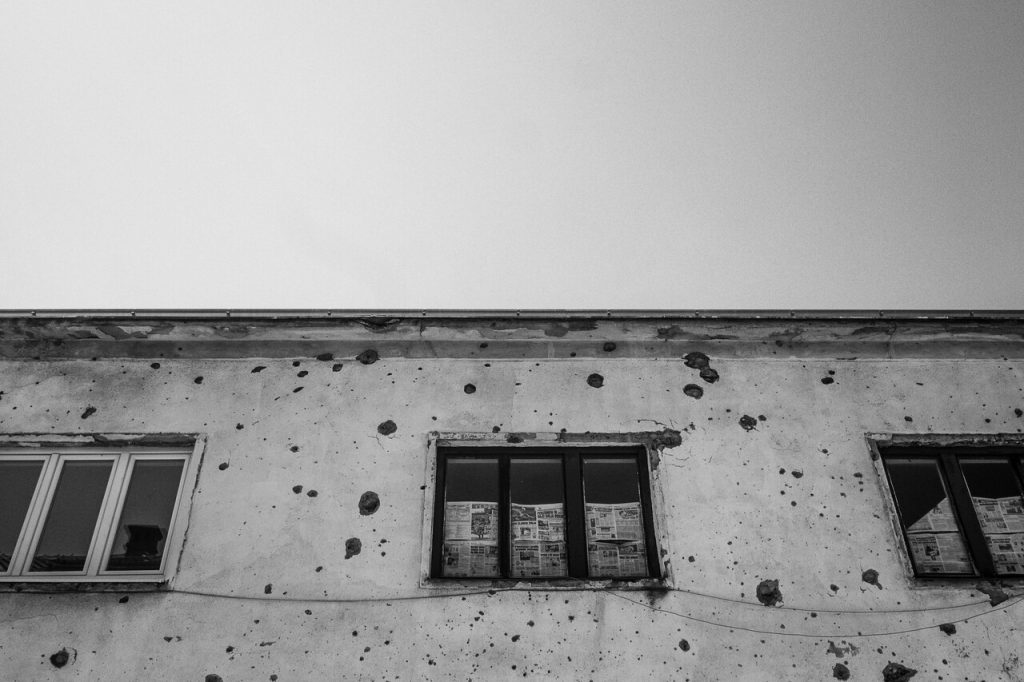
War damage in Sarajevo. Image Buiobuione / Source: Wikimedia Commons
That changed in 1989. The last U.S. ambassador to Yugoslavia, Warren Zimmermann, recalled in a BBC interview how his brief at the time was that the West “didn’t need Yugoslavia the way we did when the Cold War was on.” And when in 1991, as the Yugoslav crisis threatened to turn violent, General Veljko Kadijevic, the federal defense secretary, secretly went to Moscow to seek support for a coup, President Gorbachev refused to see him. “It finally became clear: the Soviet Union, Gorbachev in the first place, would not only refuse to support us, but, quite the opposite, would be in the forefront of international forces, our opponents,” wrote Kadijevic years later.
It would appear Milosevic didn’t get the memo. In May 1992, on the eve of the U.N. Security Council’s vote on sanctions against Belgrade, Serbia’s president wrote to no lesser authorities than presidents Bush and Yeltsin, saying “only the United States and Russia are capable of assuming effective and acceptable control” of the warring sides in Bosnia, according to UPI.
In a career of many wrong calls, this turned out to be an exception. Although not exactly for reasons or in the manner Milosevic would have had in mind, great powers did end up being deeply involved in the three wars in which he was the preeminent villain.
In the 1990s, particularly in relation to the war in Bosnia, Western governments found themselves in a somewhat paradoxical situation. While they couldn’t identify tangible reasons for a full-on engagement, Western media were flooded with coverage of the war.
This combination of geographical proximity, unprecedented media coverage, and the absence of hard interest quickly resulted in what often looked like free-for-all theater. It wasn’t only that the major powers felt compelled to “do something” in Bosnia. Unlike the response to the adjacent Persian Gulf crisis, the Yugoslav international circuit was something of an inclusive exercise. Anyone could have a say and no obligation, especially during long periods of inaction. In early spring 1993, following the Serbian onslaught on Bosniak enclaves in eastern Bosnia, the then-Venezuelan ambassador to the United Nations led the international debate on what should be done. The list of prominent international figures from many walks of life who voiced strong opinions on, or visited Bosnia, reads like a Who’s Who of the 1990s. It was a baby-boomers’ Vietnam, only a bit more relatable and much easier to visit thanks to, among other things, UN facilitation of trips in and out of Sarajevo.
It’s fair to say most visitors meant well. Their presence often conveyed a message of hope to the despairing population. Others were very obviously on ego trips, while quite a few came to say or even do outrageous things. Russian writer Eduard Limonov took a turn at a Serbian machine gun above Sarajevo, the surreal scene memorably captured in Pawel Pawlikovski’s documentary Serbian Epics.
Dramatic developments in the springs and summers of 1992 and 1995 bookended the conflict. This was especially true of the main military confrontation between the Bosnian Serb and Bosniak forces, with many frontlines settling into static, though often very intense, warfare, shifting very little in the time between those peaks.
The Bosniaks also fought a bitter war with the Bosnian Croats in 1993–1994, yet in that battlespace the opening balance of power hardly shifted throughout the fighting. An intra-Bosniak conflict unfolding in western Bosnia from late 1993 added another layer of fragmentation.
Yet the military dynamics were not necessarily the most important aspect of the conflict. In many respects, it was an opportunist, cowardly war, marked less by open battle and more by systematic targeting of civilians, besieged towns, and undefended communities, a pattern most evident in the conduct of the Bosnian Serb forces (and seen in Croatia in 1991). The Serbs utilized their initial military supremacy to not only seize territory, but also empty it of Bosniaks and in many instances Bosnian Croats as well. In parallel, the Serb forces razed the most obvious footprints of Bosniak and Croat existence in a process that gained notoriety as “ethnic cleansing.” Where the Bosniaks and Croats, who in the beginning fought together, managed to organize defensive formations, frontlines formed, with Serbs taking advantage of their superiority in heavy weaponry to pound both civilians and soldiers and stop most frontlines from moving significantly.
If all wars are battles of narratives, Bosnia’s was an extreme example. The parties to the conflict crafted and pushed them aggressively, primarily to win favor with foreign powers, whom they saw as arbiters from the outset – and who increasingly accepted that role under pressure from their own publics. The three groups’ initial accounts of the war’s origins never changed much – indeed, with a few tweaks added over time, the sentiments rooted in those narratives still shape much of the country’s public rhetoric, though perhaps much less the life at large today.
The core Serb narrative held that Bosniaks had abused their numerical superiority to declare independence against the Serbs’ will and would continue to dominate them in a centralized state; that Bosniak leaders, far from being the tolerant figures they claimed to be, were in fact Islamic radicals; and that Serb survival in Bosnia required a self-governing unit separating them from the Bosniaks in a highly decentralized state. Bosnian Croats, the smallest of the three major groups, shared much of this take, except they saw Bosnia’s independence as necessary now that Croatia itself was independent. At times, they also portrayed themselves as a bulwark of Western civilization in the country. Bosniaks cast themselves as peaceful guardians of multiculturalism pursuing a state of equal citizens who had found themselves on the receiving end of an unprovoked, two-pronged external aggression from Serbia and Croatia, with Bosnian Serbs and Croats as local proxies without much agency of their own.
All of these narratives could sometimes be backed up with bits of factual reality, which helps explain their longevity. As for their impact on the arbitrating powers, suffice to say that no major government ever accepted any local version of the conflict in its entirety. The pendulum of sentiment in the Western capitals swung both ways over time, reflecting above all the absence of vested interests that would bind Western governments to a specific position. What moved those sentiments most decisively were atrocities and other outrages, many depicted in all their gory detail in the media.
World powers would gather in a capital city, strike a compromise, and embark on a course of action to either punish the perpetrating side, narrow the space for future outrages, or pursue a peace deal, in many cases all of the above. In that sense, the televised atrocity was a force of order amid otherwise chaotic international efforts.
The pattern had already been seen in Croatia. The decisive moves by the then- European Community toward recognizing Croatia (and Slovenia) came only after the scale of the destruction by Serbian forces of the eastern Croatian city of Vukovar became clear in late 1991.
As for Bosnia, the UN Security Council imposed harsh economic sanctions against Serbia and Montenegro on 30 May 1992, three days after two shells fired from a Serb position killed 20 and wounded 70 people waiting in line for bread in Sarajevo. Shortly after, the council extended to Bosnia the mandate of the UN Protection Force (UNPROFOR), which was originally created to oversee the January 1992 ceasefire in Croatia. The August 1992 London Conference, the first wartime push for peace, had already been planned, but it gained urgency and political momentum after a British ITN crew filmed Serb detention camps in western Bosnia.
Indeed, as it became clear that Serb forces were committing most of the crimes, Western mood toward the Serbs would harden a little with each new atrocity. In terms of the broader mechanics of the conflict, it was always evident that – rights and wrongs aside – the Serbs’ overwhelming firepower, coupled with the maximalist ambitions of their nationalist leadership, which at times claimed that up to 70 percent of Bosnia belonged to Serbs, created a structural impediment to any peace settlement. That was the main reason why the two central issues debated among Western allies were whether to intervene militarily against the Serbs and whether to lift the arms embargo, imposed in 1991 on the whole of Yugoslavia, to level the battlefield.
The debate was deadlocked on both questions for almost three years, with the incoming Clinton administration initially advocating a “lift and strike” policy, but abandoning it shortly after taking office in the face of European opposition. Yet, the war came to its conclusion in 1995 precisely through the inflows of weapons to the two initially weaker sides, with the United States basically adopting a “wink and nod” approach to those willing to break the embargo, such as Iran, and a limited, but decisive military intervention against the Serbs.
To picture the oddness of such an outcome, let’s indulge in a piece of geopolitical nostalgia. On 23 October 1995, a week before some 800 people were to gather at Dayton to hammer out a peace for Bosnia, presidents Clinton and Yeltsin met in Hyde Park, New York. Even though it was their eighth summit in less than three years, both the era over which they presided and their warm relationship felt very young. The day was later described as one of laughter and diplomacy. Certainly, it projected a world of peace, cooperation, and optimism powered by the partnership between the United States and Russia that would, as Yeltsin told journalists, last “for years and years to come – tens of years, for a century.”
Indeed, when he opened the press conference, Clinton underlined the “stability and the strength of the partnership” and then explained what the two talked about. “We spent the vast majority of our time discussing Bosnia, and we reached complete agreement about how we would work together for peace there.” Moments later, he added: “We discussed a number of other issues. I think I should mention three very briefly.” The other three topics were all about the control of nuclear arsenals.
This article was first published in Transitions and is the first in a series by the author examining key turning points that led to Dayton, as well as some of the major challenges facing Bosnia today.
Published 18 December 2025
Original in English
First published by Transitions 12.12.2025
Contributed by Transitions © Tihomir Loza / Transitions
PDF/PRINT
After over 20 years of publishing for free, Eurozine needs your support to get through an exceptionally lean year.
Become a Patron and get exciting perks for your help!


Want to hear a human voice?
Listen and subscribe wherever
you get your podcasts.
Subscribe to know what’s worth thinking about.

Since the collapse of Novi Sad’s train station in November, student-led protests have erupted across Serbia, inspiring a nationwide movement against corruption.

After six months of protests, there are grounds for hope that the tide is turning in favour of the Serbian student movement: first, the unification of the opposition around the movement’s demand for new elections; second, the emergence of a strategic alliance between the students and the EU.