


Losing privileges
Young people struggling with screentime
Some governments use legal restrictions to battle social media use; others leave families and individuals to self-regulate. Who’s responsible for young people’s addiction problems?
Quackery with a university logo: the failed attempt to introduce pseudoscience onto the curriculum of Georgia’s flagship technical university was a bizarre episode in a culture war being waged by the Georgian Dream government on the country’s higher education system.
Letters of an ancient alphabet carry a hidden numerological code. Spend enough time deciphering it – covering your whiteboard with notes and formulas – and the secrets of the universe will be revealed to you. This isn’t the plot of an Umberto Eco novel; in Georgia, it almost became an actual field of study.
‘Astrolinguistics’ and ‘astroarchaeology’ – outré pastimes that forge spurious connections between stars, signs and history – very nearly forced their way into Georgia’s mainstream education system. Late last year, a government ordinance turned these quasi-scientific subjects into degree programs at none other than Kutaisi International University (KIU), drawing protests from the nation’s academic community.
This high-end state university has been touted as a new science and technology hub in the South Caucasus; but now the university’s hard science-oriented core curriculum had to make room for the government-ordained esoteric studies.
To thank for the ‘innovation’ was Georgia’s eccentric billionaire boss, Bidzina Ivanishvili – the founder of governing party Georgian Dream, the nation’s richest man and its ultimate kingmaker (and breaker). Although state-run, KIU was born of the blessing and generous funding of Ivanishvili, an oligarch who moves around top officials at whim. And not just officials, for that matter: through feats of engineering, the billionaire has harvested gigantic, century-old trees across Georgia and moved them to his private arboretum.
Ivanishvili also collects exotic animals, boasts of a shark tank, and dabbles in conspiracy theories and alternative science. He poured a billion euros into KIU, a prestige project meant to take Georgia’s education system into the future. Although the Technical University of Munich helped design KIU’s curriculum and academic structure, the oligarch’s own research interests appear to have found their way into the project.
Enter Dr Aleko Tsintsadze – Georgia’s if not the world’s foremost enthusiast of ‘astrolinguistics’ and ‘astroarchaeology’. Convinced that Georgians invented yoga and that the Georgian language holds the key to the secrets of the universe, Tsintsadze has devoted his life to excavating the astrological wisdom he believes ancient priests buried within the language for posterity to find.
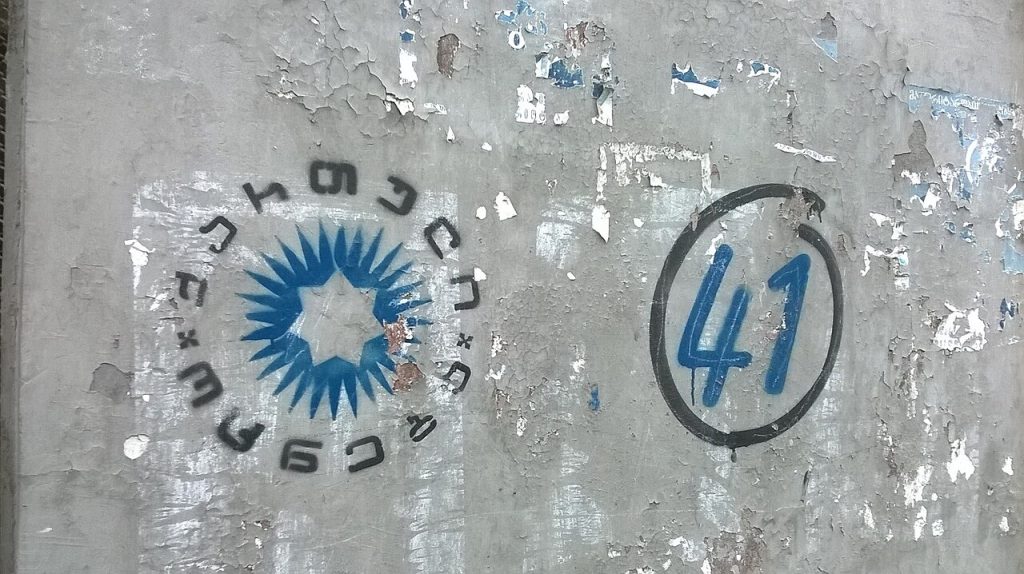
Georgian Dream electoral graffiti. Source: Wikimedia Commons
Prolific if nothing else, Tsintsadze uses gematria – the alphanumeric interpretation of texts still practiced in Jewish mysticism – to decode encrypted meanings of Georgian’s words. Assuming each letter corresponds to a number, Tsintsadze sums up numerical values of letters to understand the hidden meaning of words.
Take the Georgian word for Aryan – Arieli, which Tsintsadze writes was associated with sun-worshippers and literally meant ‘foundation’ or ‘root’. Assign a numerical value to each letter according to its alphabetic order, add these numbers up and you get 47. Is it a mere coincidence that 47° is the declination difference between the sun’s paths at the tropics? Tsintsadze thinks not.
In his search for encrypted messages from the past, Tsintsadze studies Iberia – the classical antiquity-era Georgian kingdom, not the Iberian Peninsula – and applies mathematic calculations to read between the lines of Georgian epic poetry and ancient manuscripts.
Dismissed by many in Georgia’s scientific community as a pseudoscientist, Tsintsadze appears to have connected on some deep esoteric level with Georgia’s oligarch-in-chief, Ivanishvili. Tsintsadze is a welcome guest on Imedi TV, a government mouthpiece funded by the oligarch.
The Iberian Cultural Heritage Research Center – Tsintsadze’s research outfit – is based at KIU. Senior members of Georgian Dream were present at its opening ceremony last year. The Germany-educated law professor and KIU’s acting rector, Paata Turava, delivered a keynote address.
Since then, the Center has been busy trumpeting Tsintsadze’s ‘findings’. These include the claim that the Georgian words for ‘year’, ‘tide,’ and ‘miracle’ all carry a numeric code of 94. Tsintsadze has ‘mathematically proven’ that this number is a coded reference to the adoption of Christianity, the start of a new calendar, and humanity’s embrace of truth.
Much of this wades into the realm of exceptionalism and nationalism. Tsintsadze is on a mission to prove that world culture borrowed from Georgians, not vice versa. There are scientifically sound grounds for claims that Georgia was at the crux of certain matters of global consequence, including winemaking and early human migration. Tsintsadze takes it to another level, however, suggesting for example that the world owes us a debt for inventing the performing arts.
Need proof? It’s simple, claims Tsintsadze. The word ‘mystery’, whose roots go back to ancient Greek and which evolved to describe religious performances in medieval Europe, carries no coded numeric meaning in Greek or Latin. But apply two different formulas in Georgian, and you get 666 and 99.
‘These numerals are the reverse of each other,’ said an excited Tsintsadze in one interview, claiming the word ‘mystery’ actually derives from ‘symmetry’ – hence the ‘symmetrical’ numerals. The fact that there is no linguistic proof of such an etymological connection is a minor detail. Tsintsadze has deduced from his calculations that everything from masquerades, to fertility rituals, to modern theatre can be traced back to the Georgian language.
If only it ended there. Tsintsadze insists that the world is indebted to Georgia for the word ‘fascism’ and the swastika. ‘The swastikas that [the Nazis] wore on their arms … were Iberian swastikas and Iberian symbols that were taken from us,’ he boasts.
The decision to bestow academic legitimacy on Tsintsadze’s research interests triggered a fierce backlash. ‘The Georgian Dream government is enabling new, officially recognized degrees built on numerology that is both too absurd and too simplistic even for a Dan Brown-style airport novel,’ wrote one observer, Konstanine Kintsurashvili. ‘This is quackery with a university logo.’
Many in Georgia’s academic community are convinced that the acceptance of pseudoscience by both a key university and the nation’s education regulators displays a lack of institutional spine in the face of power and money.
‘The governance system and the power dynamic we have is such that anything can be forced on the education system – or any other field, for that matter – from above. The area specialists and regulators whose job is to assure quality – and common sense – simply accept it,’ comments Elene Jibladze, an education policy expert.
The arrival of pseudoscience at the centre stage of Georgia’s education system could perhaps be dismissed as the extravagant whim of single man – were it not that the whims of that man were defining an entire nation’s present and future. For years, Ivanishvili has been steadily moulding the nation in his own image: politically, economically, even botanically.
Undoing decades of arduous work, Ivanishvili has torpedoed Georgia’s integration with the European Union, effectively banished the opposition from political decision-making, and subjected all democratic institutions to his will. By placing a stranglehold on international donor funding, his government is methodically depriving critical media and human rights and anti-corruption watchdogs of resources and income.
Ivanishvili’s compliant parliament has been churning out laws designed to stifle political dissent and shackle the freedom of assembly. Now that even standing on a sidewalk during a protest is now punishable by law, prison cells are filled with government detractors.
Education has become the latest frontier in the oligarch’s drive to consolidate power. At the same time as sanctioning questionable research pursuits, his government has been dismantling Georgia’s respected universities – traditional hubs of respected scholarship and independent thought.
Under a controversial reform project, the Georgian government is slashing student enrolment numbers and shuttering faculties. Irakli Kobakhidze, the prime minister and main champion of the reforms, has argued that Georgia has too many universities.
‘Georgia has more universities than Switzerland and Austria, yet has none of the quality,’ Kobakhidze said in a televised interview. ‘It is very similar to the Georgian national football tournament, where we have no meaningful competition between teams – either one team wins or the other, but neither can succeed in the qualifiers for the Champions League.’
He proposed a fix under the slogan, ‘One city, one faculty’ – a draconian plan to whittle down the main public universities to a single core study program and scrap duplicate offerings across the field. For instance, of the four Tbilisi-based universities that offer law degrees, only the oldest – Tbilisi State University – will keep its law faculty, while others that took years to build will be closed.
Some subjects will only be offered in regional universities, in what the authorities call an effort to ‘decongest’ the education system. Although higher education is indeed concentrated in the nation’s capital, the plan enables the government to sell off the public universities’ assets, as the closing of faculties and new admission caps will leave many a classroom empty across Tbilisi.
Calling the reform process a ‘deformation’, critics warn that the changes will undermine academic freedom, severely limit students’ choices, and ruin successful study programs. Anticipating massive layoffs and the closure of established academic programs, scores of university professors and students have engaged in protests and open confrontation with the government.
Keti Tsotniashvili, a professor of education policy, argues that the reform is ultimately about asserting control over education. ‘What we are facing now is an intellectual capture of the country,’ she comments. ‘The subjugation and hollowing-out of the education system along with the media and non-governmental organizations is a key component in the state-capture playbook. We’ve seen it happen in other countries, and it is happening here now.’
Ilia University, a Tbilisi-based progressive public institution where Tsotniashvili and Jibladze teach, will bear the brunt of the government cuts. The university’s study programs are due to be cut by over 75 per cent, and the number of students it can enrol will be slashed by a whopping 95 per cent. ‘This will be ruin of the university,’ Jibladze says.
Many faculty members are inclined to think that targeting Ilia University is the government’s revenge for what it perceives as the university’s role in the anti-government protests that have been rocking the country for over a year, in which professors and students have in many cases actively participated.
‘Personally, I’m 100-percent positive that the “one city, one faculty” principle was invented with a single goal to destroy Ilia State,’ wrote the former deputy education minister, Davit Zurabishvili, on Facebook.
Dismissing such accusations as having ulterior motives, the prime minister has argued that the purpose of the reform is to achieve a better align the education system’s output with the needs of the labour-market. ‘The goal of our reform is to improve the quality of professional education in this country,’ Kobakhidze has said in public statements, adding that 60 per cent of employed Georgians have no use for the degrees they hold.
Education experts counter that the labour-market perspective takes a very narrow view of the goals of higher education. But even the labour-market argument does not hold water. In the case of Ilia State University and other institutions, programs subject to severe cuts boast of a very high track record for graduate employability.
Moreover, how does it square with the introduction of ‘astrolinguistics’ and ‘astroarcheology’ onto the curriculum? While slashing successful study programs elsewhere, the government has gleefully greenlighted these obscure studies at KIU. Kobakhidze – who was handpicked by Ivanishvili to run the country – did not have a convincing answer.
The introduction of the bizarre study programs at KIU points to the systemic failures in the government’s handling of education. The billionaire-funded university operates above national procedure for quality assurance in education: in a striking departure from national standards, a 2022 amendment granted KIU exclusive legal exemption from the vetting processes that govern every other Georgian university.
All other institutions for higher education go through a rigorous cycle of scrutiny by the National Center for Educational Quality Enhancement. In KIU’s case, quality assurance is provided by its board of international advisers and the institutional development arm of the Technical University of Munich. The esoteric additions to the curriculum appeared to have slipped through the German-backed quality-assurance mechanism – at least initially.
‘The message is unmistakable: serious higher education can be subjugated for political reasons, but quackery is protected and even celebrated, since such worldviews resonate with the thinking of the country’s most powerful and least accountable individual,’ wrote Konstanine Kintsurashvili.
As the scandal broadened and critics pounded both the authorities and the KIU for granting official licenses to obscure disciplines, the government blinked. A new ordinance, released on 26th February, scrubbed both ‘astrolinguistics’ and ‘astroarchaeology’ from the official list of degree programs.
This marked a victory for the proponents of academic and scientific integrity and encouraged faint hopes that the authorities might back down on other educational fronts too. But the government continues to press forward and faculties remain slated for closure. While many Georgian academics continue to battle Georgian Dream head-on, others are attempting to carve a direct path to Ivanishvili to salvage study programs. Knowing that ultimately the billionaire calls the shots, they hope to convince him to restrain the prime minister and spare select faculties from annihilation.
For Dr Tsintsadze, the battle is far from over. His centre remains at KIU and his zeal for ‘decoding’ the universe remains undimmed. In a bombastic letter, he lashed out at detractors who ‘threw mud’ at a discovery he claims is a ‘source of pride’ for the Georgian nation. ‘We are talking about a cryptological message found in Old Georgian – the only true discovery of 21st-century Georgia,’ he wrote. He is certain that mainstream science will eventually embrace his findings.
According to Tsintsadze, the Soviet Union and the United States stole science from Georgia, but the nation is now reclaiming its intellectual destiny. He concluded on a defiant, messianic note: ‘Today we are taking education back; my hope is that tomorrow we will reclaim science, and eventually, we will fully take back our country.’
Published in partnership with Voxeurop
Published 16 March 2026
Original in English
First published by partnership with Vox Europ
Contributed by Voxeurop © Georgi Lomsadze / Eurozine / Voxeurop
PDF/PRINT
After over 20 years of publishing for free, Eurozine needs your support to get through an exceptionally lean year.
Become a Patron and get exciting perks for your help!


Want to hear a human voice?
Listen and subscribe wherever
you get your podcasts.
Subscribe to know what’s worth thinking about.

Some governments use legal restrictions to battle social media use; others leave families and individuals to self-regulate. Who’s responsible for young people’s addiction problems?

When war entered the lives of Ukrainian schoolchildren, their teenage years were put on hold. In the first episode of the Knowledgeable Youth podcast, Ukrainian teens talk about finding their way in a new school system.