


.jpg)

Against a backdrop of crime, corruption, inequality and sexual violence, Mexican novelists are returning to the tradition of the child narrator. Interviews with Fernanda Melchor, Luis Jorge Boone and Emiliano Monge.
Contemporary Moldovan novelists continue to thematize the struggle for linguistic, social and ethnic identity within the Soviet system. Taken together, their work forms a literature of post-totalitarian recovery.
The Soviet regime’s transformations in the Romanian lands between the Dniester and Prut rivers after the Second World War – including administrative and territorial reforms, social reorganization, changes in ethnic composition, denationalization, cultural isolation, economic centralization, collectivization, deportations, famine, persecution and restrictions – left an indelible mark on Moldovan society and its mentality. These Soviet policies that inscribed deep scars in collective memory also found their varied reflection in contemporary literature.
Over three decades after the collapse of the Soviet Union, writers from the Republic of Moldova continue to return to this dark chapter of history, seeking to process both collective and individual trauma. The linguistic, moral and identity crises endured by a community living under the weight of totalitarianism are thus most vividly explored in contemporary prose. Often understood as an act of reconstructing identity, the literary return to childhood remains one of the most resonant and enduring creative strategies in Moldovan writing today.
Over the past decade, leading publishers in Moldova and Romania have brought out a wave of novels that revisit the Soviet past. The works published over this period of time explore the social, political, and economic realities that not only shaped but also often shattered human lives in this part of the world. Among the writers who reinterpret Soviet and post-Soviet childhoods from multiple angles are Vladimir Beșleagă, Emilian Galaicu-Păun, Dumitru Crudu, Mihail Vakulovski, Constantin Cheianu, Tatiana Țîbuleac, Emanuela Iurkin, Lorina Bălteanu, Alexandru Popescu and Sașa Zare. Their prose captures the painful struggle for self-definition within a system designed to erase individuality. In their narratives, memory – both personal and collective – becomes the raw material for a new literary language, one capable of turning trauma into cultural renewal.
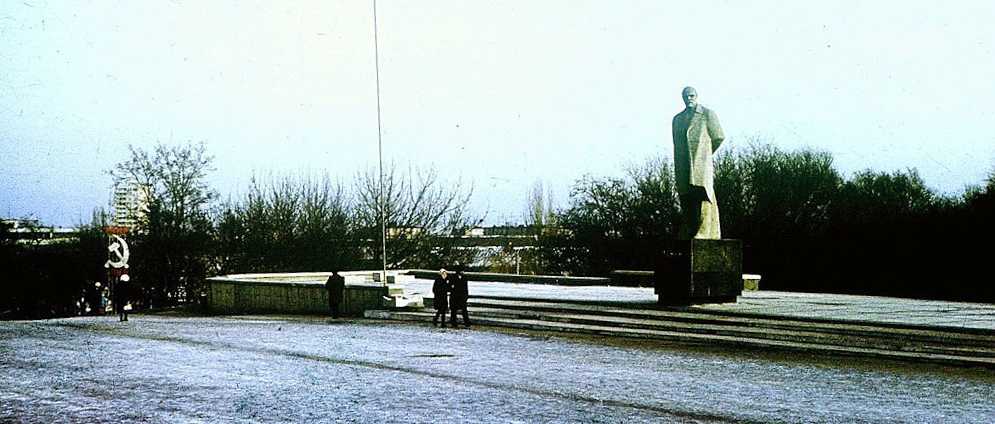
Lenin monument in Bălți, Moldova, 1970s. Source: Photobank MD/ Wikimedia Commons
Vladimir Beșleagă was among the few Moldovan writers to emerge in the 1960s and whose work marked a revival of Moldovan prose. He wrote at a time when literature was reduced to an ideological tool, with censorship curbing artistic freedom and bending literary texts to the socio-political demands of the totalitarian regime.
Beșleagă’s most accomplished works yet reveal a clear effort to move beyond the rigid formulas of socialist realism. Already in his early novels he shows the world as destabilized by the confusion between truth and falsehood, between authentic values and imposed pseudo-values. It is a world inhabited by individuals who are disoriented and deformed by a foreign ideology.
Thus, in his 1966 novel Zbor frânt (“Broken Flight”), Beșleagă transformed the experience of war into an inner drama of conscience. His protagonist, Ion Buzdugan, perfectly embodies the tension that exists between the imagined utopia and lived reality. He experiences an identity crisis that arises from a deep gap between how he understands himself and how others perceive him. Such conflicts mirror the moral disorientation that was experienced by an entire generation that lived under totalitarianism. For them, the search for truth turned out to be a painful ordeal as their world was a space of tensions, discord and unending conflict.
Beșleagă’s second novel, Viața și moartea nefericitului Filimon sau anevoioasa cale a cunoașterii de sine (‘The Life and Death of the Unhappy Filimon, or the Arduous Path of Self-Knowledge’), written in 1970 but published only in 1987, explores the existential tragedy of an individual crushed by paternal tyranny. After separating his son from his partner, the father conceals the boy’s origins, erases his identity, and raises him with ruthless severity. In this distorted world, the protagonist, who wants to find the fragile thread of his own truth, has no choice but to navigate through a labyrinth of conflicting emotions and thoughts.
A representative voice of the Moldovan literary generation of the 1980s is Emilian Galaicu-Păun. His 2011 novel Țesut viu. 10 x 10 (“Living Tissue. 10×10”) unfolds in a mosaic, non-linear narrative that reconstructs scenes from the “closed universe of childhood” of the protagonist, who is known only as “…n”. The boy’s parents are intellectuals – his mother a teacher, his father a writer, both educated in Moscow – which places him in a typical Soviet milieu with a carefully arranged daily routine. As in many families in Soviet Chișinău, a preordained order governs the household. The same gestures, phrases and rituals repeat endlessly, turning daily life into a performance reproduced across the Soviet space. Despite deprivation and misery, the townspeople ostentatiously display cleanliness and culture – they eat well, keep their homes spotless, and decorate their apartments with bookcases that imitate prosperity.
The child absorbs this world intensely, internalizing its patterns and contradictions. Everything that happens outside, echoes in his mind, reshaped to fit his own inner logic. Yet one figure resists assimilation: his father, who is authoritarian, arrogant and, in the child’s imagination, fused with the image of Lenin, the emblem of communist power. The father’s devotion to ideology distances him from his son; he cannot be absorbed as a moral or human model. Laced with biblical echoes, the narrative reconstructs not only the confusion born of politics turned into a new religion, but also the father’s claim to intellectual and moral superiority. His self-styled authority, expressed through pompous rhetoric, slips into the theatrical and absurd. The son is left to submit to – and identify with – a man who, while seemingly devoted to literature, ultimately bows before politics.
Galaicu-Păun explores the problems of identity formation faced by a child growing up in a family of regime sympathizers, in a society undergoing intense Russification – such as Soviet Chișinău. The boy’s act of rebellion begins when he desecrates the family’s sacred symbols, splashing ink on a portrait of Lenin, for which he is violently punished by his father. Through episodes of childish mischief and the rigid norms of school life, the novel reveals the inner workings of Soviet society. The children’s invented games expose their instinctive longing for freedom – their desire to give shape to life according to their own will and to create their own rules. Some of these games, recalled in the book’s final pages, emerge as a reaction to the allure of the forbidden.
Another fragile form of freedom – an escape from “paternal supervision” – arises when the protagonist spends time in the national library. Within the constraints of the Soviet world, such moments of curiosity and imagination become small exercises in liberty, gestures that later make possible a tentative moral and identity renewal.
The theme of recovering national identity also runs through the work of Dumitru Crudu, a poet, playwright and prose writer who also emerged in the 1980s. His 2019 novel Ziua de naștere a lui Mihail Mihailovici (“Mihai Mihailovici’s Birthday”) is a chronicle of a life shaped – and repeatedly disrupted – by political and social upheavals. Each chapter revolves around the events that unfold on or around June 28th – the date in 1940 when Moldova and Northern Bukovina were annexed by the Soviet Union. The work follows the protagonist, Mihai Mihailovici, from childhood to death.
One of the novel’s most remarkable qualities is its reconstruction both of the context and the social atmosphere of each era. The sense of time and place emerges through the details of everyday life – slogans, place names, and familiar Soviet markers (Ion Soltîs Street, the Molodiojnîi District, the October Palace, “Moldovan” language and literature, the village council, the Soviet militia, Komsomol, the Volga, the rouble, and others) – and the social mentality as it is embodied in its characters. Crudu depicts people not only during the years of Sovietization, when they struggle to conform to the regime’s political order, but also in the post-Soviet times, when the promise of ideological freedom reveals a deeper loss: their inability to recover a sense of authentic identity. Even when freedom finally returns, the individual shaped by false values remains a captive of the Soviet past.
Through concrete examples, Crudu shows how ideology shapes human relationships. Political loyalties become matters of destiny: ideological divisions strain friendships, fracture families, and bring misery into private life. In this way, the author captures the broader moral and social decline of society.
The 2018 novel Woldemar, by Oleg Serebrian – a Moldovan politician, diplomat, and former President of the Latin Union – explores an identity crisis through psychological, moral, social and historical lenses. The novel intertwines the personal with the political, offering an introspective portrait of a man searching for meaning and a broader reflection on the disorientation of post-Soviet society, where questions of memory, belonging and truth remain unresolved.
Haunted by what the specialist in Romanian literature, Anneli Ursu Gabanyi, calls the “psychological drama of difference”, Woldemar is a man scarred by repeated ruptures of identity that leave lasting wounds. He comes to question the fragile boundary between truth and illusion, reality and imagination, wakefulness and dream – until his very sense of self begins to split into two. The novel’s confessional structure, shaped through alternating perspectives, retraces the protagonist’s gradual self-(de)formation under the pressure of inner conflict and external constraint.
Woldemar is an abandoned child raised by his aunt in a deeply traumatic environment. Growing up with his adoptive mother, grandmother and great-grandmother, he lives in a constant state of uncertainty about what it truly means to “be a man”. Sexuality is a taboo subject; his emotional gestures toward classmates are publicly condemned and violently punished at home. For the young Woldemar, masculinity becomes inseparable from shame, while identity becomes a source of enduring guilt, one that is shaped by the social expectations and rigid stereotypes of masculinity that define his world.
Woldemar’s efforts to anchor his sense of ethnic belonging are constantly eliminated by the environment in which he grows up – a Soviet, “Romanian-phobic” republic where any sign of Romanian identity is immediately suppressed. Within this social landscape, he cannot openly identify as German or Ukrainian, while to call himself Romanian is to invite danger. Thus his personal, sexual, ethnic and social identities all remain unresolved.
As he reaches adulthood, Woldemar continues to feel the weight of his difference, trying to accept what he sees as a destiny. The novel unfolds through a blend of retrospection and introspection, where past and present constantly mirror one another.
Belonging to a younger literary generation, Tatiana Țîbuleac offers a fresh perspective on the question of identity in her 2018 novel Grădina de sticlă (“The Glass Garden”). Her book, which has been translated into French, Spanish, Croatian, Albanian and Polish, portrays human destiny during one of the most painful chapters in the history of the Republic of Moldova. Through her protagonist’s confession, Țîbuleac interweaves private suffering with the collective trauma of a country that was subjected to an experiment in identity erasure.
The protagonist is an abandoned child adopted by a Russian woman from Chișinău. At first, the arrangement appears fortunate: the girl gains security and decent living conditions. Yet from the very first day, she is stripped of her name and given a new one – Lastochka (the Russian word for bird the swallow). Lastochka’s true identity remains unknown throughout the novel. Gradually, she is reduced to an object, a possession of her adoptive mother, and forced into servitude. Only later does she discover that she had been bought from the orphanage for this very purpose.
The most painful experiences presented in the novel revolve around the process of learning Russian – a language that Tamara, the adoptive mother, regards as both prestigious and indispensable. For Lastochka, this process turns into an ordeal. What initially fascinates her soon turns into an object of aversion. The Russian language is forced upon her through humiliation and violence. She endures the nightmare of acquiring a foreign tongue under coercion. At one point, she refuses to speak Russian and is brutally punished. The question of language, presented through a series of deeply emotional episodes, gradually expands into a broader meditation on power, identity and belonging.
The novel also includes scenes from Lastochka’s adulthood. Now a doctor living in Bucharest, she looks back on her childhood and confronts the painful truth of her fractured linguistic identity. In Romania, her speech still bears the traces of another world; her Romanian sounds too foreign, too marked by the past. Whether in Chișinău or Bucharest, she remains an outsider – always different, always excluded.
Mihail Vakulovski’s 2020 novel Tata mă citește și după moarte (“My Father Reads to Me Even After Death”) is a vivid portrayal of Soviet childhood and adolescence. Structured along two narrative planes – the author’s fictionalized childhood and his adult perspective – it tells the story of Moldovan village children who, despite taboos, prohibitions and Soviet stereotypes, carve out moments of unexpected freedom within their confined world.
The protagonist, Mișca, grows up in a family of teachers. From an early age he is exposed to what were considered the most “efficient” Soviet methods of education. His father, both disciplinarian and mentor, becomes the key figure shaping Mișca’s sense of identity – including his first lessons about manhood.
Scenes from daily life in a Soviet Bessarabian village, in which the children are active participants, are rendered with striking authenticity. They include subbotniki – the “voluntary” Saturday workdays organized for ideological and communal purposes – as well as visits to war veterans, the rigid organization of the school system, pioneer camps and more. The children are required to memorize and repeat official texts and adopt a fixed understanding of the “homeland”. They are fed a steady stream of information about the history of the USSR and made to learn political poems that, within a few years, would vanish from the curriculum. All of this is taught superficially and repeated in absurd, empty rhetoric. Yet through their own innocent logic, the children begin to link everyday events to the myths of Soviet heroes. And, in doing so, they quietly dethrone them. As a result, they develop a subtle immunity to ideological falsehood.
All this said, contemporary novels offer fresh perspectives on the formation of linguistic, social and ethnic identity in Moldova, as well as on the recovery of the often-painful historical truth. Their diverse approaches to social and political experiences – and especially to the impact they had on individual lives – continue to engage readers today. Written in registers ranging from tragic to ironic to sardonic, these works compose a panoramic portrait of Soviet Moldova. As prose of memory, they imaginatively reconstruct the world of that time, with its typical characters, situations, and ideological distortions, exposing the depth of the identity crisis it produced. Taken together, these novels constitute an act of identity recovery through memory – one whose effects reach far beyond the realm of fiction.
Published 9 January 2026
Original in English
First published by New Eastern Europe 6/2025
Contributed by New Eastern Europe © Oxana Gherman / New Eastern Europe
PDF/PRINT
After over 20 years of publishing for free, Eurozine needs your support to get through an exceptionally lean year.
Become a Patron and get exciting perks for your help!


Want to hear a human voice?
Listen and subscribe wherever
you get your podcasts.
Subscribe to know what’s worth thinking about.
Against a backdrop of crime, corruption, inequality and sexual violence, Mexican novelists are returning to the tradition of the child narrator. Interviews with Fernanda Melchor, Luis Jorge Boone and Emiliano Monge.

Literary expressions of grief across the ages use representations of nature as soothing metaphors. But rarely does the death of non-human life merit a thanatography. Could literature that finds a non-anthropomorphic means to grieve for other sentiment beings provide our desperately needed resensitization to the natural world?