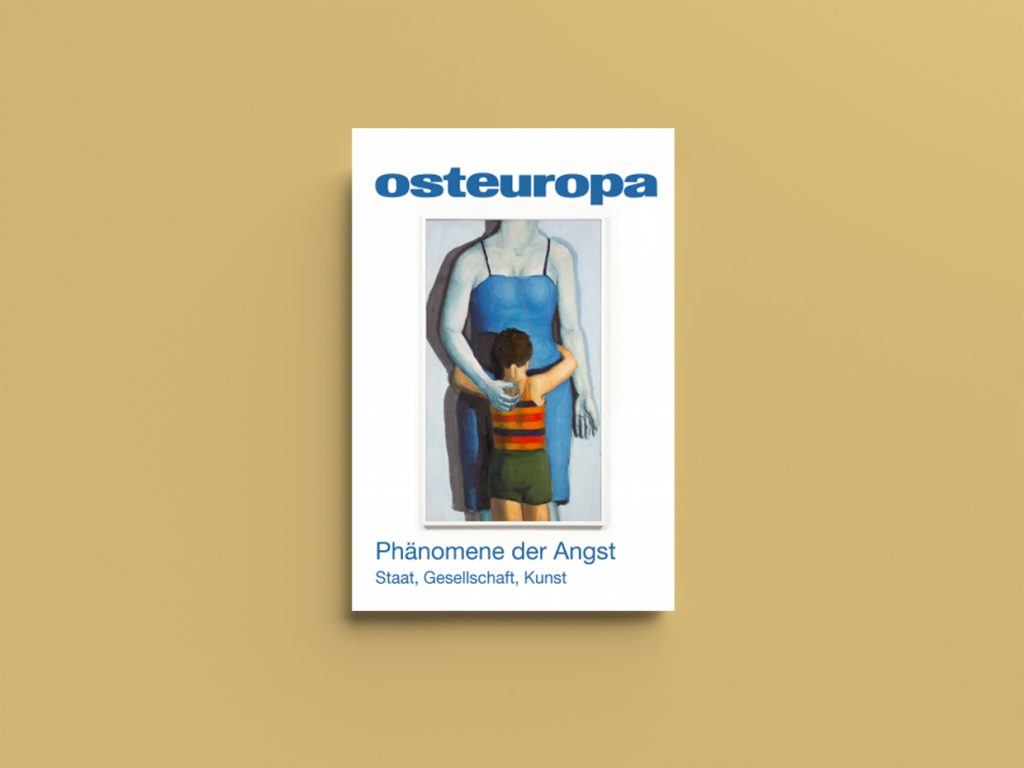
Despite being declared a foreign agent by the Russian ministry of Justice in 2025, the sociologist Lev Gudkov refuses to self-censor and compromise his scientific standards. The director of the Levada Centre polling institute is the ‘Galileo Galilei’ of Russian sociology, write the editors of Osteuropa in an issue entitled ‘Phenomena of fear’.
Gudkov traces the deep roots of the fear pervading Russian society, its institutional mechanisms, and the habit of subordination that it causes. Absorbed by children at home, inculcated in schools, and deliberately heightened by propaganda, fear forms ‘the horizon of the everyday’, shaping how people relate to each other, themselves, and the state.
It circulates through society like a system of ‘communicating vessels’, flowing from one domain to another. Arbitrary and limitless state power ‘creates the impression that what is happening cannot be understood rationally and that reality is unpredictable’. The future becomes opaque. Even the most trivial decisions are fraught with uncertainty and anxiety.
A defining feature of this vague fear is the taboo on expressing it – or even thinking about it: to admit a fear of the state, even to oneself, is a ‘thought crime’ that invites the very consequences one dreads. The result is a learned incapacity to interpret political reality rationally, and a constant, nagging fear that is unnameable and so ‘defies disenchantment’.
To neutralize this fear, citizens redirect it toward safer targets: ‘the struggle against external and internal enemies, … temporary difficulties and crises, an impending war’. Under such conditions, the only option for a ‘normal’ (tolerable) life is an almost religious reverence for a ‘numinous’, all-powerful state, in which ‘fear merges with awe for the leader’s greatness and power’.
Translation as survival strategy
Mark Belorusez remembers Soviet Kyiv in the 1970s as ‘a sea of Russian’ dotted with ‘archipelagos and islands of other languages and cultures’, including Ukrainian. One such island was the Writers’ Union, home to conformist writers who were happy to churn out ‘lifeless, stilted texts’ in return for security and money. But another was the Kyiv school of poetry, a group of writers living on the margins who, with their experimental form and unconventional subject matter, operated outside the officially sanctioned sphere of Ukrainian literature. Their works were never published or reviewed, instead circulating via samizdat, and most have not survived.
Many of these writers also worked as translators into the Ukrainian language, in large part because translation offered a ‘survival strategy’: a middle ground between the paths of conformism and security, and literary freedom coupled with social and economic exclusion. ‘In many respects, translators enjoyed greater freedom than authors, who were subject to extremely strict political oversight, especially in Ukraine’.
The prestige of writers like Boccaccio or Goethe gave translators greater latitude – both to use authentically Ukrainian words instead of Russian loanwords, and to experiment with tone, imagery and form under the cover of fidelity to the original author. As a result, translation played a crucial role in raising the status of Ukrainian.
Rendering major literary classics in Ukrainian was not a neutral endeavour; it expanded the language’s expressive range and its cultural authority. Hugely popular Ukrainian editions of works like the Decameron or the poetry of Apollinaire ‘helped to increase the standing of Ukrainian-language literature among the predominantly Russian-speaking readership of Kiev’.
The EU and Belarus
As the human rights situation in Belarus worsens and Moscow tightens its grip on Minsk, the EU must urgently rethink its Belarus policy and adopt a more pragmatic approach, argues Ina Rumiantseva. Reliance on sanctions has ‘been largely ineffective’ and may have even backfired: ‘under increased pressure, the regime reacts aggressively’. In contrast, US negotiations have produced concrete results, including the release of hundreds of political prisoners since summer 2024, ‘a process in which the EU played almost no role’.
The lesson is clear: ‘sanctions must be used as an active diplomatic instrument, not as a substitute for diplomacy’. The immediate priority is the release of further political prisoners, followed by ‘improvements to mobility and an end to the migration crisis’.
The EU’s blinkered insistence on sanctions has multiple causes: frustration with previous failures, an increasing tendency to equate Belarus with Russia, and a high-minded refusal to negotiate with the perpetrators of human rights abuses. But this all-or-nothing attitude merely pushes Minsk further into Moscow’s embrace, argues Rumiantseva, and ‘unwittingly legitimizes Moscow’s claim that Belarus is part of Russia’s “natural” sphere of influence’.
EU leaders must come down off their high horse and accept the impossibility of full democratization and justice in the short or medium term. A more realpolitik approach – focused on achievable, verifiable humanitarian steps and the conditional, phased lifting of sanctions to incentivize Minsk’s continued engagement – stands a far better chance of success.
Armenia and Iran
Anna Gevorgyan examines the strategic significance of the Armenia–Iran relationship in the shifting geopolitical landscape of the South Caucasus. In the aftermath of Azerbaijan’s victory in the Nagorno-Karabakh War, Armenia and Iran share concerns about the growing alliance between Azerbaijan and Turkey. With Russia weakened by its war in Ukraine and Armenia’s borders with Azerbaijan and Turkey closed, Armenia is dependent on Iran for energy, regional connectivity and security, and Yerevan is keen to ‘exploit Tehran’s desire for a counterbalance to the Ankara–Baku axis’.
But there are important divergences in the two countries’ priorities. While Armenia ‘champions the principle of self-determination for the ethnic Armenians in Nagorno-Karabakh’, Iran, fearing a separatist movement among its own ethnic Azeris, ‘emphasizes the principle of territorial integrity’. Meanwhile, Yerevan is seeking to bolster its position by strengthening ties with the EU and the US – a dangerous tightrope act that risks alienating Iran.
These tensions are also reflected in competing connectivity projects. Tehran’s vision of a North–South transport route linking Iran to Russia is at odds with the ‘Trump Route for Peace and Prosperity’, set to run East–West from Turkey to Azerbaijan.
Armenia, it seems, is trying to have the best of both worlds with its ‘balanced and balancing policy’. But much will depend on ‘whether Tehran continues to pursue its recent pragmatic approach to South Caucasus policy’, as well as other developments beyond Yerevan’s control. Renewed escalation between Iran and Israel, or internal destabilization from separatists in northern Iran, could shift the regional balance in Azerbaijan’s favour.
Review by Cadenza Academic Translations