


While civilizational rhetoric in the West reflects a sense of threat, globally it is recognition-seeking. Common to all civilizationalisms, however, is a blurring of the distinction between authoritarianism and democracy.
On the emancipatory gap between words and things; language, authority and resistance; metaphors of politics; educators under strain.
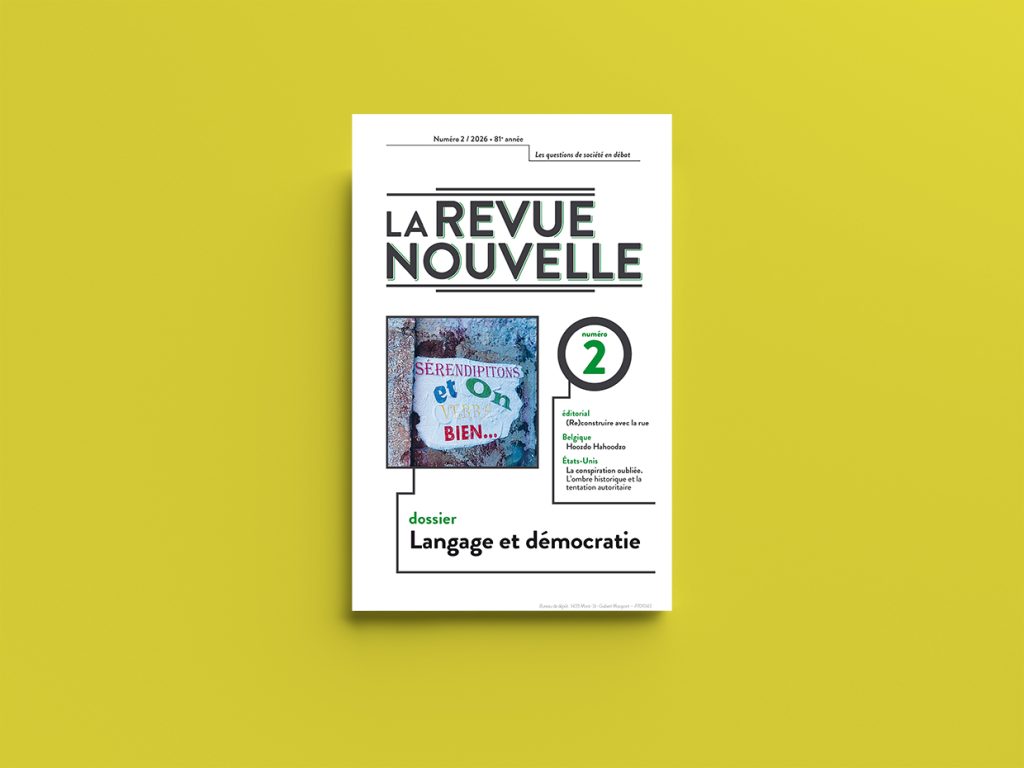
La Revue Nouvelle (Belgium) examines the relationship between language and democracy, asking how words can include or exclude, empower or marginalize. Dossier editors Laurence Rosier and Anne Vervier frame the topic through a broad range of practices, from institutional language policies to grassroots linguistic creativity.
The capacity of everyday speakers to reflect on and transform language constitutes, they write, a ‘metalinguistic’ awareness that forms the basis for democratic engagement. If ‘language is one of the keys to individual autonomy’, the central challenge in a linguistic landscape being flattened and standardized by AI is to ‘continue to believe in language learning as a tool of emancipation and liberation’.
Rosier and Vervier acknowledge the tensions within this perspective, including the risk of overestimating the power of words. Still, the central claim is clear: language is inseparable from democracy. Whether through institutional reform, creative experimentation, or political struggle – to shape language is to shape the conditions of collective life.
Julie Abbou’s discussion of the possibilities of linguistic expression is inspired by ‘a vague sense that language is being distorted’. One of the most overt examples of this is censorship, as in the Trump administration’s attempt to ‘prevent opponents from talking about and deploying alternative visions of the world’ by banning the use of terms including ‘ethnicity’, ‘diversity’, or ‘privilege’ in official documents. Other examples are more subtle: the ‘linguistic ideology that language is univocal’ and that meaning can therefore be controlled; or the hollowing out of language in conversations with AI bots – conversations which remain merely a semblance of dialogue, lacking any subjectivity.
Abbou shows how meaning constantly slips, shifts and resists control. Words cannot perfectly describe identities or experiences, and this limitation becomes a resource: it is the gap between words and meaning that opens space for resistance. In this sense, linguistic instability becomes politically productive. ‘The inability to exhaust the meaning of language, far from being a defect, is the condition for escaping the fantasies of power and authority’.
In a wide-ranging interview, sociolinguist Laélia Véron argues that language is not a neutral medium but a central arena of political struggle. For Véron, whose work explores how ‘types of narrative … circulate across different spheres of discourse’, language is something to be actively questioned and appropriated. Encouraging people to reflect on their own speech practices becomes a form of empowerment, she says that ‘the act of talking about discrimination, reflecting on the forms it takes and how they operate, is the first step to combating it’.
Véron also challenges common assumptions about linguistic authority. Rather than seeing language as fixed or governed solely by institutions, she emphasizes its dynamic, social character. Different contexts produce different ways of speaking, and these variations reveal underlying power relations. Véron is particularly interested in marginalized spaces, such as prisons, where argots such are often misrepresented or stereotyped ‘in romanticized terms as a foreign, exotic language’ rather than understood in terms of power and resistance.
Language must always remain open to debate, Véron concludes. Treating it as a public issue, rather than a technical or academic one, allows language to function as a tool of emancipation.
Cognitive linguistics holds that our worldviews are structured by ‘conceptual metaphors’ embedded in bodily experience and social relations. This approach can shed light on how we understand freedom, writes Gérard Pirotton.
For example, we conceptualize government using the metaphor of the family, which has two competing versions: the ‘strict father’ or the ‘nurturing parent’. In the former, the father’s role is to discipline his children, to redress their innate lack of moral sense and to prepare them for success in an inherently adverserial world. The ‘nurturing parent’ model, meanwhile, sees both parents sharing equal responsibility for ‘empowering’ children and ‘enabling them to fulfil their potential’.
These models correspond to the two opposing views of freedom characteristic of the right and left. In the ‘strict father’ model, argues Pirotton, ‘the individual is an island and freedom is conceived as a right exercised against other people’. If success is the result of discipline, then poverty must be deserved, and any state intervention to combat inequality is an infringement on the liberty of those who have prospered thanks to their hard work.
In the ‘nurturing parent’ model, meanwhile, the focus is on ‘the conditions that enable the concrete exercise of freedom’, understood in ‘emancipatory’ terms as the absence of discrimination, violence and other obstacles to a good life. This conception of freedom ‘involves the political, the collective and the social, rather than a mosaic of isolated individuals in competition with each other’. We must reclaim the concept of freedom from narratives that frame it as personal autonomy, writes Pirotton, and instead mobilize a model in which ‘freedom is the realization of social justice’.
Teaching in Belgium today feels like a struggle between ‘commitment and exhaustion’, writes educator Chloé Vanovervelt. Recent policy changes have intensified workloads while reducing support and recognition, she writes. Reforms include an abrupt restructuring of the curriculum, the removal of certain subjects, and increased working hours ‘without financial compensation’ for senior teachers. At the same time, hours have been reduced for those entering the profession, often forcing them to take two or three part-time jobs.
These decisions are experienced not as isolated adjustments but as part of a wider pattern of disregard for teachers and their work. Responses to teachers’ concerns from the Minister of Education have been utterly disheartening: ‘sterile Q&A sessions, divisive and condescending comments’ and ‘mechanical repetition of the same ideas in the same phrases’.
Vanovervelt confesses that ‘nowadays, as for many of my colleagues, my energy reserves are running dangerously low and the passion that drives me is undeniably fading’. Students will feel the consequences of this burnout in the teaching profession, especially those already affected by social inequalities.
Review by Cadenza Academic Translations
Published 9 April 2026
Original in English
First published by Eurozine
Contributed by La Revue Nouvelle © Eurozine
PDF/PRINT
After over 20 years of publishing for free, Eurozine needs your support to get through an exceptionally lean year.
Become a Patron and get exciting perks for your help!


Want to hear a human voice?
Listen and subscribe wherever
you get your podcasts.
Subscribe to know what’s worth thinking about.

While civilizational rhetoric in the West reflects a sense of threat, globally it is recognition-seeking. Common to all civilizationalisms, however, is a blurring of the distinction between authoritarianism and democracy.

Free speech in the US: how book bans are targeting independent thought; why Trump’s assault on education imitates Erdoğan’s; what the closure of Radio Free Asia means for the region’s information space; and how American liberals can learn from Soviet dissidents.