


Two opposing interpretations of 1945 form the ideological core of today’s confrontation between Russia and the states of central and eastern Europe. Both are reactions to the collapse of the Cold War order.
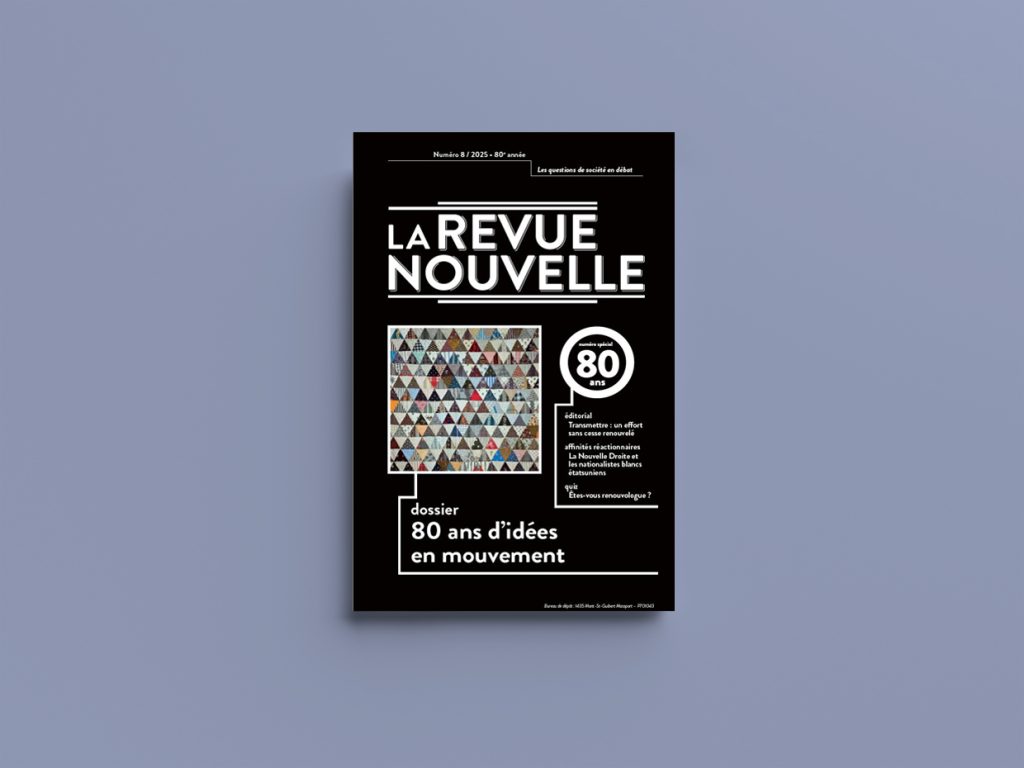
The Belgian journal marks 80 years of publishing by returning to debates central to its history, including: media and democracy, the prison system, mental health, and the politics of memory.
The first issue of La Revue Nouvelle was ‘put together in a Belgium still at war’, appearing in February 1945. To mark the journal’s 80th anniversary, former directors Michel Molitor and Luc Van Campenhoudt discuss the concerns that have shaped La Revue Nouvelle’s trajectory, from non-conformist Catholicism and the labour movement to environmentalism and gender studies. They recall its causes célèbres, including a call to end the punishment of collaborators after Liberation, and its questioning of the compatibility of democracy and monarchy. A constant has been the rejection of personal attacks: ‘We didn’t engage in invective or accusations, or put individuals on trial’. After all, it’s ‘the mechanisms that are interesting’.
Ricardo Gutiérrez sounds the alarm. ‘The press is dying’, he writes. Journalists are the ‘watchdogs of democracy’, yet national governments in Europe are failing them. They face growing economic precarity, intimidation and violence. Deepfakes are used to discredit them, spyware to identify their sources, and abusive lawsuits to silence them. Worse, cases of journalists being imprisoned or murdered abound. In Europe, the situation is so dire that the European Union has overstepped its competence to compel member states to act.
‘In democracies, a healthy media ecosystem requires a range of public and private operators,’ Gutiérrez writes. But, emboldened by Trump’s rhetoric, growing numbers of illiberal politicians in Europe are attacking public broadcasters. In Belgium, where media ownership is already highly concentrated, the conservative party leader wants the country’s French-language public broadcaster to ‘be privatized or shut down’. A ‘lack of objective economic criteria’ to determine funding for public media has led to budget cuts that threaten their future, a problem compounded by recent reforms allowing politicians to sit on the boards of local media.
Nearly a third of Belgians already get their news from Facebook. Such platforms, however, ‘are guided solely by their own financial interests – or even their political agendas’; they have no moral responsibility to serve the general interest. The dismal prospect, then, is the demise of traditional media as it is ‘swallowed whole by Big Tech’ or discredited by its new oligarch owners. But, writes Gutiérrez, there’s another side to the coin: ‘the chaotic, timely rise of innumerable local journalistic initiatives founded on the principle that information is a public good’.
‘Prisons often make the front page in Belgium’, observes Christophe Mincke. Frequently, it’s because of their failures – particularly overcrowding and inhumane treatment of prisoners. Yet their place in society is taken for granted. Given this paradox, a few simple questions about the existence of prisons and the current situation are in order.
First, ‘Have prisons always existed?’ In short, no. Until the end of the eighteenth century, imprisonment was not a form of punishment as such, but merely a holding mechanism before trial or sentencing. Punishments instead ranged from the galleys to branding, amputation and death. The practice of depriving a person of their freedom emerged later as a supposedly ‘less cruel punishment’ and one ‘easier to match to the crime’.
Second, ‘Are there lots of people in Belgian prisons today?’ According to data on Council of Europe countries, Belgium’s detention rate (number of prisoners per 100,000 inhabitants) is slightly below average. But its ‘prison population has risen sharply since the mid-90s’ and it has the seventh worst rate of overcrowding. Both prisoners and staff suffer. National and international courts have repeatedly condemned the Belgian state for allowing ‘inhumane and degrading treatment’ of prisoners.
‘So should new prisons be built to solve the problem?’ ‘Is ongoing overcrowding a result of rising crime?’ ‘Do prisons protect us from crime?’ ‘Are alternatives to prison the solution?’ Mincke’s often surprising answers dispel complacency about the system and offer ways forward.
Across all social strata, ‘mental health disorders are rising steadily’. They tend to be perceived as a personal matter, resulting in ‘limited responses (personal development, therapy, coaching)’. And yet, write Sophie Tortolano and Yahyâ Hachem Samii, ‘no mental health problem is individual, no solution to this problem is individual’. Here they explore the ‘political dimensions’ of mental health and argue for its rightful place in the public sphere.
‘As with general health, there are determinants of mental health’. They may be personal, like genetics, or socioeconomic, social, environmental or cultural. As a result, ‘some people are at greater risk of developing mental health disorders or of being confronted with bigger problems’. The playing field is not level, and the problem is compounded by unequal access to care.
There are many probable causes for the rise in mental disorders. But what if ‘being sick in a sick society were a sign of good mental health, a natural reaction?’ The authors suggest a two-pronged response to the crisis. The first step is prevention: ‘using policy to mitigate or eliminate factors that provoke or aggravate mental disorders’. The second is a cure based on information, which will help break the taboo, demystify mental illness and empower people to seek solutions.
Imperialism, it seems, is back. Should we be surprised? While ‘decolonization is generally considered complete’, writes Emmanuel Klimis, political decolonization ‘is not synonymous with the decolonization of ideas’. Belief in the relative ‘superiority or inferiority of one group of people compared to another, based on their geographical origin or skin colour’, has not disappeared. ‘Structures of social domination’ persist.
Klimis retraces the global dynamics of colonization and decolonization, with a focus on Belgium. The country has recently reckoned with its colonial past, as the renamed streets, toppled busts and paint-spattered statues attest. Yet at school, that past is not widely taught. Maps remain distorted – oversizing the north and placing Europe at the centre – and African, Asian and South American authors are conspicuous by their absence from the curriculum.
Understanding that past, argues Klimis, is key to understanding the ‘multiculturalism of Brussels, football-stadium racism, social inequalities’ and ‘political discourse that portrays certain foreigners, particularly non-Europeans, as sources of danger or precarity’. An intersectional approach is needed that ‘simultaneously critiques colonialism, capitalism, racism and the patriarchy’ and that challenges the ‘supposed universality’ of European concepts. Only then will we raise citizens ‘capable of … building a more just society’.
Review by Cadenza Academic Translations
Published 27 January 2026
Original in English
Translated by
Cadenza Academic Translations
First published by Eurozine
© Eurozine
PDF/PRINT
After over 20 years of publishing for free, Eurozine needs your support to get through an exceptionally lean year.
Become a Patron and get exciting perks for your help!


Want to hear a human voice?
Listen and subscribe wherever
you get your podcasts.
Subscribe to know what’s worth thinking about.
Two opposing interpretations of 1945 form the ideological core of today’s confrontation between Russia and the states of central and eastern Europe. Both are reactions to the collapse of the Cold War order.

Controversies over the legacies of dictatorship and civil war have polarized the Spanish debate for over two decades. Now, on the fiftieth anniversary of Franco’s death, the legitimacy of the transition is uncertain. Could things have been done differently?