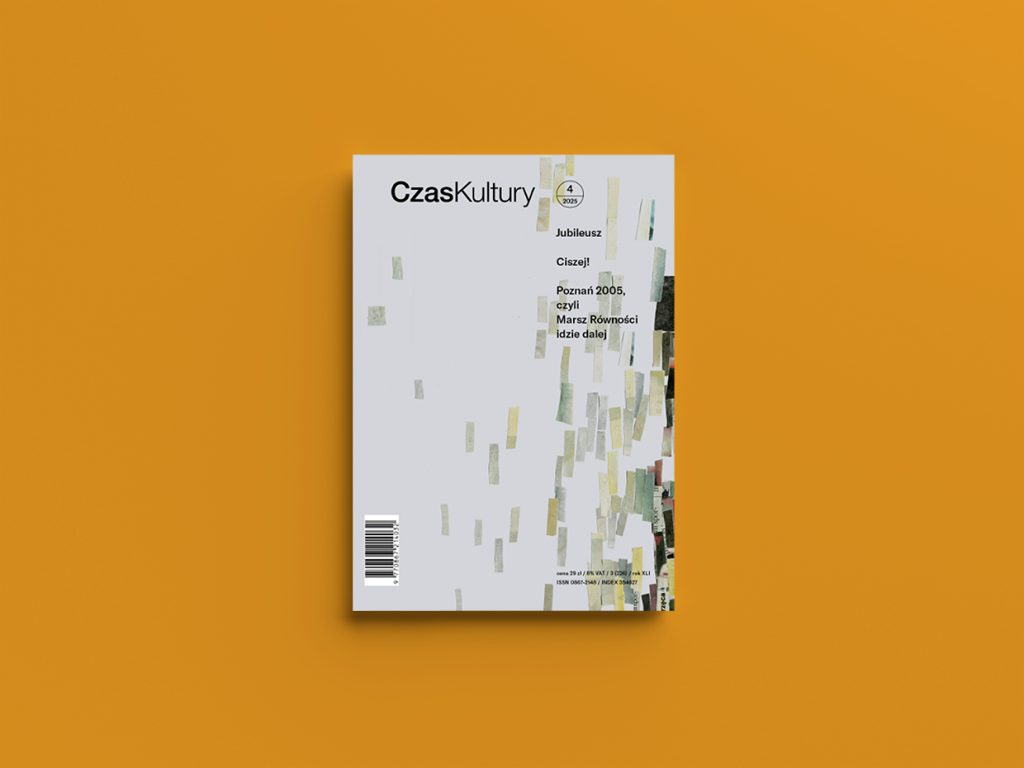
Silence can be an exploratory form of social interaction, a protest, or a technique for accessing higher states of consciousness. It can signal non-resistance, subordination, or act as emblem of economic domination and power. In times when inequalities, instability, technical innovation and online chat predominate, it is a ‘vessel waiting to be filled with meaning’, writes Patryk Lichota in an issue of Czas Kultury that explores the socio-political implications of hush.
Today, serenity is to be found less in cultural or spiritual practices that consolidate or express communities, than in the logic of free enterprise. Calm has been commodified: it is distributed digitally and online, curated by algorithms and managed by the wellness industry. ‘Quiet is not an alternative to the noise generated by the system, but its sublimated continuation’, Lichota argues. ‘Silence has lost its social and symbolic potential and functions as a resource within the attention economy … The consumer pays for a temporary “reset”. Stillness – traditionally either contemplation or resistance – has been absorbed by the logic of productivity.’
The late capitalist world runs on an internal imperative of individual self-improvement, aimed at successful functioning within existing structures. Mobile apps, ANC earphones, retreats and therapies offering relief and regeneration are not remedies but symptoms. They do not question capitalist values but recycle them into an infrastructure devised to encourage adaptation and manage the effects of stress on productivity. Market-regulated forms of silence promote separation, exclusion and class distinction, leading to increased tensions between the social order and the acoustic environment. Burnt out individuals buy techniques of silence to isolate and shield themselves from an excess of stimuli generated by a system that remains unchallenged.
Sensory deprivation
In the 1950s and 1960s, CIA-financed investigations into mind control included sensory deprivation, hypnosis and the use of hallucinogenic drugs. Parallel projects financed by the Canadian Defence Research Board initiated work on the potential of auditory and visual deprivation for military and intelligence purposes, including interrogation. Katarzyna Szafranowska outlines the story of early research into isolation tanks and ways in which human perceptions changed when deprived of sensory stimuli. Noted effects included a slowed awareness of time, calming sensations, and the opening up of new dimensions of experience.
By the 1980s, flotation tanks were commercially available as therapy for stress and fatigue, despite criticisms which compared their use to solitary confinement or torture. ‘Deprivation combined relaxation and cruelty, freedom and coercion, autonomy and subordination,’ Szafranowska writes. Nevertheless, the escape offered by flotation therapy remains a widespread option in spas today, though the pressure to ‘rest productively and quickly’ in effect creates an ‘active enterprise’ that promotes the neo-liberal ideal of workers who are effectual, industrious and wholly self-sufficient.
Deprivation chambers may promise relaxation and control over auditory stimuli, but ‘the control is illusory, just as silence is an illusion broken by sounds inscribed into the body’. Quiet can heighten an awareness of breath, digestion, heartbeat or indeed tinnitus. ‘Flotation offers an unattainable ideal, a fantasy about happiness, peace and harmony, whereas it is a strategy for survival … a symptom of the way societal issues remain inadequately addressed, further straining the relationship between the human body and its auditory location.’
Emancipatory muteness
Magdalena Dziurzyńska considers how speculative feminist fiction written between the 1960s and the 1980s can serve as ‘a laboratory for the political imagination’ today. The writing of the time was an experimental space in which notions of power, language and communication were radically reformulated. Dziurzyńska focuses on two utopian novels in which women create communities outside the patriarchal norm, using silence as a tool to build alternative communicative landscapes where awareness, intuition, community and non-domineering forms of expression take precedence.
Sally Miller Gearhart’s The Wanderground (1979) and Diana Rivers’ Journey to Zelindar (1987) depict communities of women that overstep the boundaries of language to form egalitarian and integrated groups, living in tune with the natural environment. Their muteness represents a symbolic discarding of linguistic constraints in favour of authentic and inclusive forms of articulation, which point to new affirmations of self.
Dziurzyńska acknowledges that the model of ‘true’ and harmonised womanhood, created in the novels, has been exploited to justify stifling women’s political agency and diversity. Nevertheless, the texts propose untried possibilities for the exploration of feminine autonomy, communality and ecological balance, she argues. Late twentieth-century feminist writing creates space for formulating strategies to resist the revival of patriarchal rhetoric and build new codes and connections in times of climate crisis, identity-based exclusion and growing brutality.
Performative silence
Silence is not realised by withdrawal from the external world but by participation in its immanent reality, Monika Bakke suggests. Maintaining stillness can challenge ingrained thought patterns, pave the way to re-evaluating values, and offer a secular re-articulation of established spiritual practices, Eastern and Western. Applied in performance art, with an attentive participating audience, it can subvert our tendency to give language disproportionate power to determine what is real or desirable. Bakke looks at two performance artists – Marina Abramović and Amrit Karki – whose work draws on traditional quietist and meditative techniques.
Abramović emphasises that ‘an artist has to create space for silence to enter their work’. The practice of silence forms a bridge between material experience and her art, which explores the exchange of energy between living bodies and inorganic material. In Abramović’s ‘Transitory Objects’ cycle, audiences are encouraged to interact with sculptures made from mineral blocks like amethyst, quartz or copper, and enter into a direct relationship with the inanimate world. Overstepping the boundaries of thought and language can reconfigure human psychological states, emotions and levels of physical energy, so that ‘the binary divide between subject and object, matter and consciousness, animate and inanimate comes to be dismantled’.
Amrit Karki’s work ‘What You Have Given Me, I Set Free Forever’ is inspired by Abramović’s Method for accessing higher states of consciousness, but also invokes cleansing rituals in Nepalese Hindu traditions of worship, performed on objects such as the four-faced Chaturmukha Linga. Karki’s filmed performance, exhibited at the Rubin Museum of Art in New York (2024), invites the public to pour a stream of water over his head and body, symbolising a washing away of impurities and surrender to the divine, that forms part of daily religious practice in Nepal. Though filled with sacred symbolism, Karki’s performance looks beyond religious tradition: ‘While remaining in the sphere of silent, open and inclusive spirituality, it embraces an ordinary, universal desire for renewal… a new beginning in the domains of perception and culture.’
Review by Irena Maryniak