Hic sunt leones – ‘here be lions’ – was the cartographer’s discreet confession of ignorance: a phrase inscribed at the edges of medieval maps to mark territories uncharted, misunderstood or deemed perilous. The words signalled not just danger, but the limits of knowledge itself.
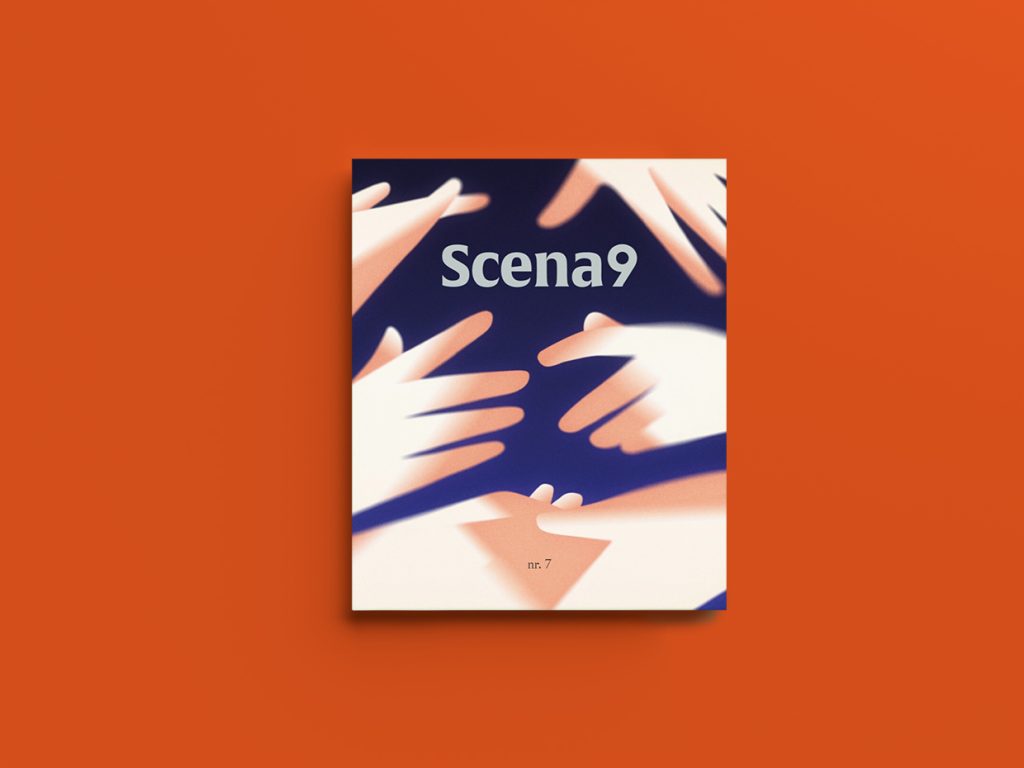
In her editorial to the seventh annual print issue of Scena9, the Romanian online culture journal, Ioana Pelehatăi reclaims the dictum as a method. The task, she suggests, is to move toward those blank spaces rather than leave them hidden: to make sense of the zones of daily life that, for all their ubiquity, remain curiously unexamined. What was once a warning becomes an invitation to look more closely at what we have learned not to see.
This is no small undertaking. In an age when digital feeds amplify outrage and flatten nuance, the act of seeing what has long been hidden has become unmistakably political. What is revealed, and what remains in shadow, shapes not only our sense of reality but the very limits of our ethical imagination. It is precisely this tension that Scena9 probes: what do we choose to conceal, and what might we uncover if we dare to look?
But the poetics of visibility carry material consequences. To publish in the Romanian language today – to gather voices for a local readership in an increasingly desolate print landscape – is already an act of commitment. The print publication’s annual appearance lends it weight: over 250 pages of illustration, photography, poetry, short fiction and reportage, assembled into a single, well-considered object. In a culture of speed and scroll, this deliberateness is not nostalgic but resistant.
Infrastructure as monument
Beneath the forest canopy, under moss and root, lies a city of water and stone – one that the map forgets, but that memory maintains. To reach these hidden structures and unearth the invisible, artist-writer Nicoleta Moise and photographer Andrei Becheru descended into the crevices between the Piatra Craiului and Iezer-Păpușa mountains.
They are searching for the remains of the workers’ colony of Richita: a small, temporary town of concrete once inhabited by workers employed on the construction of the Pecineagu dam. It was a 1988 article published in the communist‑era magazine Femeia (‘The woman’) chronicling the lives of betoniste – the ‘concrete women’ who carved out a place for themselves on construction sites – that sparked the inquiry into the hidden histories of colossal infrastructure and its gendered labour. Today, the settlement’s last remaining ruins are being slowly swallowed by unrestrained vegetation, writes Moise: ‘It feels as though we might be the first and the last people ever to have arrived here’.
A link in the chain of some 250 such dams built under Ceaușescu’s rule, Pecineagu embodied a decade-long effort to bend time, space, and water to human will. As Moise observes, these dams were ‘mammoth constructions, standing as living proof of industrial progress and part of an ambitious project of re-writing the landscape and “civilising” rural space.’ Mammoth indeed: the Pecineagu dam can ‘hold up to 63 million cubic metres of water, a volume equivalent to 25 Houses of the People,’ the third-largest administrative building in the world by volume.
Although ‘a trickle from these hidden heights reaches our morning tea and coffee cups in Bucharest’, Pecineagu is more than a piece of utility infrastructure. It is also a monument to aspiration. And still, the hidden remains: beavers and European bison, old film sets (Lucian Mardare’s 1980 Zbor Planat was shot here), and faint echoes of forsaken voices. Moise and Becheru achieve a reconstructive ethnography of place and infrastructure, where human and nonhuman histories intertwine, and where to excavate is to acknowledge the weight of what has long been hidden.
Museums and memory wars
In an era of rising populism and far-right influence, cultural institutions are often caught in the crossfire of memory wars. Oana Filip turns her attention to museums, which are far from neutral and can be enlisted in the nation-building strategies of exclusion and weaponisation alike. In ‘A populist’s guide to using museums’, illustrated by Oana Barbonie, Filip reveals how memory is manipulated, and how institutions intended to safeguard it are drawn into broader struggles for power. Those who exploit museums – ‘mnemonic warriors’, as the Croatian political scientist Ljiljana Radonić, one of the experts interviewed, calls them – harness democratic mechanisms to impose a singular version of historical truth.
In such a climate, the museums’ role as spaces for reflection and debate are potentially compromised. Filip confronts these tensions head-on, tracing the fragile boundary between memory, authority and the public imagination. The problem seems universal: from Washington to Warsaw, politicians deploy the same techniques to weaponize history: ‘Change the directors, cut the funding, rewrite the narrative’. In Romania too, museums conceal as much as they reveal: no official space for the communist past, Roma culture, or LGBTQ+ histories; no reckoning with Roma slavery or Romania’s role in the Holocaust. These absences reverberate into the present. For, as the author warns, ‘how we fail to confront our less glorious past leaves us divided [and] more vulnerable’.
Folklore and identity
Photographer Maria Guțu first arrived in the village of Tețcani, in the Republic of Moldova, in the last days of 2022, drawn by the villagers’ vibrant, uncanny rite of welcoming the new year. She returned in subsequent years, witnessing the place transform as locals – young and old, farmers, teachers, neighbours – dress as witches, wizards, dragons and other mythic figures. The streets become a psychedelic stage: dances, performances, music, and processions winding through the narrow roads.
Beyond the bricolage of costumes and the ingenuity of their materials (plush toys stitched into capes, extravagant floral headdresses, grotesque masks meant to ward off evil spirits) something more elusive takes shape. From the hidden currents of everyday life bubbles a kind of collective effervescence: a spirit that dissolves distinctions of age, profession or status, and binds together shared memory, local identity and the histories that hold a community in place.
Review by Petrică Mogos