


As capital consolidates, culture recedes, funding vanishes, access narrows. The question persists: why fund culture at all? Cultural managers from Austria, Hungary and Serbia discuss.
The journal Dialogi closed at the end of last year. Its editors reflect on the publication’s sixty-year history and why the challenges faced by a Slovenian magazine of culture and society proved insurmountable.
At the close of 2025, Dialogi published its final issue. The Maribor-based cultural journal had been running for 60 years, making it one of the oldest periodicals of its kind in Slovenia. Dialogi joined the Eurozine network in 1999.
Articles in the final issue were contributed by all of the editors: Emica Antončič (editor-in-chief), Boris Vezjak (critical thought), Matic Majcen (film), Igor Bašin (music), Nataša Kovšca (visual arts), Meta Kordiš (independent culture), Jasmina Založnik (feminist approaches), Primož Jesenko (performing arts), Ciril Oberstar (social sciences) and Petra Kolmančič (literature). Each looked back on their editorial work over the years, sharing their experiences, dilemmas and concluding reflections.
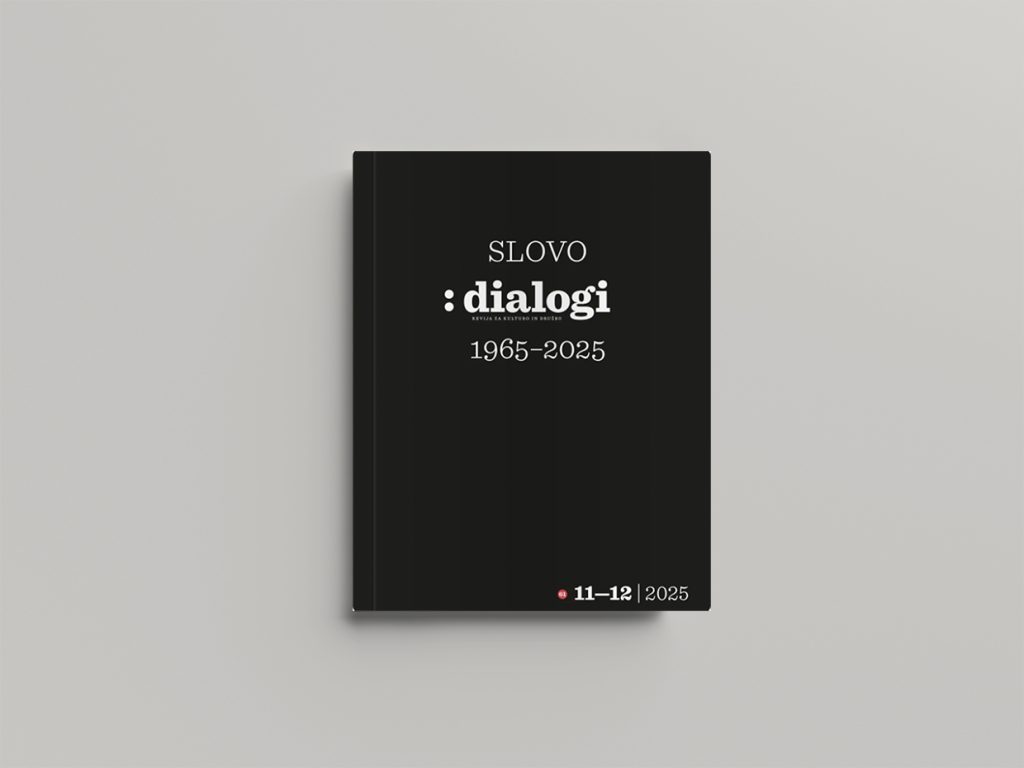
Contrary to local mythology, Dialogi was not intended as a literary magazine when it was first founded, notes editor-in-chief Emica Antončič. On the contrary, the conceptual starting point was that it be a magazine of culture and society.
As an industrial city, Maribor historically lacked a critical public and humanistic intellectuals. The first editorial boards of Dialogi from 1965 onward set ambitious aims for the magazine: critical treatment of local as well as broader social and cultural issues; openness to different genres; and dialogue between generations of writers and intellectuals.
However, the generalist aims of Dialogi‘s founders were not always followed. During the socialist era, there were periods in which the magazine mainly featured literature, leading Dialogi to be called the ‘Maribor literary magazine’.
But the brief periods during which Dialogi returned to its original concept were eloquent enough to pave the way for Antončič and her editors to design a magazine with a wide purview and critical sharpness.
When Antončič took over the editorial and publishing duties in 1994, a new state was being founded, civil society was taking shape, and industry was declining. Maribor was searching for a new identity and ideas for how to build the future. Dialogi became a space for analytical and in-depth debate on cultural and social issues and gave space to independent culture.
An ambitious editorial policy required professionalization. ‘Dialogi grew into a large organizational machine, with which around a hundred authors collaborated annually,’ writes Antončič. The editorial board slowly grew and eventually comprised ten members; unlike in the older periods of Dialogi, board members came from different parts of Slovenia. Boards were also gender-balanced. All of this contributed to Dialogi becoming a reference humanities journal at the national level and beyond. At the same time, the number of subscribers increased.
Antončič also touches on her experience of being a female editor with one of the longest tenures in this position in Slovenia. These positions are still mostly held by men today.
Boris Vezjak held the longest tenure on the editorial board after Antončič. Citing Hannah Arendt, he emphasizes the importance of cultivating critical thought in a time of social normalization of non-thinking. Throughout his time, he cultivated ‘intellectual culture’, not in an elitist sense, but a ‘rationally supported analysis of everything that affects society, that can enable the best possible understanding of the world and humanity’.
This is all the more important for a small country such as Slovenia and for the post-industrial city of Maribor. Both have a complex history filled with traumas, and therefore need ongoing analysis all the more. This must offer ‘maps of thinking about life, the specificities of the nation and the state’.
The loss of Dialogi thus means a shrinking of space and power for critical thinking, because ‘without a human-focused, humanistic view, we are becoming more of a statistical unit in Slovenia’s reports at the national level or in the almanacs of the European Union, and much less of a nation that thinks about its essence, identity or destiny’.
For Jasmina Založnik, writing and editing thematic issues on feminism meant a form of activism that arose from intellectual necessity, concern for community, and maintaining an open space for dialogue and argumentation. For her, editorial work was primarily about collaboration, exchanging ideas, listening, and learning.
‘Being part of the editorial team of Dialogi meant working on the boundary between public and reflective space, between theory and practice, between the necessity and the desire for the magazine to remain a place where thought is constantly evolving. And in this collective process, I learned that editorial work is never an individual act, but the work of many who transform their differences into a shared direction of thought.’
The thematic issues that Založnik has co-edited over the past ten years are all the more important to read and reflect on today, when the pressures of re-patriarchization and re-traditionalization are increasingly evident, when battles are being fought for reproductive rights, when femicide is on the rise, and when societies are sliding into authoritarianism. The issues ‘preserve a community, even if it is a fragile but persistent network of people who believe that reflection still changes something’.
Ciril Oberstar imagines scenario in which his middle-aged son must prepare a speech for his father’s jubilee. When the son searches for information about Dialogi, he discovers that the last thematic issue edited by his father was entitled Teaching in the Age of Artificial Intelligence.
The picture Oberstar paints of 2064 is not appealing. People are practically cyborgs who coexist with androids. Privacy is effectively nonexistent or prohibitively expensive. There is no public space. Originals of songs, articles and films from the past are a rarity, as they have mutated greatly in the process of being stored and transferred from various platforms. Authorship and originality are outdated concepts. Everything is controlled and managed by corporations.
At the end, Ciril Oberstar recalls Brecht’s poem about a drowned girl. Death, he thinks, we can somehow endure, but being forgotten is much harder. And he has exactly the same feeling when he hears the news that Dialogi has been shut down. The editors will somehow survive the end of publication, but will they endure being forgotten?
‘Two and a half years ago,’ writes Emica Antončič in her editorial, ‘I did everything I could to enable the legal transfer of Dialogi to a new publisher, but it quickly became apparent that there simply is no functioning organization in the city of Maribor that would be capable of taking over such a professional programme as Dialogi has become in the last three decades. Above all, there is not even a minimal group of young intellectuals who would be interested in creating critical media and willing to take on the job.
‘The major reason for the cessation is certainly the steady decrease in the share of co-financing from the City of Maribor. The budget of Dialogi was made up of state co-financing from the Slovenian Book Agency (formerly the Ministry of Culture), local co-financing from the Maribor City Council, and its own funds obtained through activities on the market. The municipal share has been steadily shrinking since 2012, and the first problems began in 2008, or more precisely, all the crises coincide with the period of Franc Kangler’s mayoralty. However, new ones have been added in recent years.
‘So we can say that the city slowly weakened and destroyed us, gave priority to other programmes, and in the end managed to spit us out … The platitude that prevails mainly in literary circles, that Maribor must have its very own magazine, is moot. If the city is not willing to co-finance a magazine to the extent required to produce a quality professional publication, then this simply means it does not want one and will not have one. Anyone can create an amateur magazine at any time.
‘In general, characteristic of the Slovenian cultural space of the recent period is that the organizations and programmes that paved the way for Slovenian independent culture and civil society in the 1990s are retreating. This is simply because their systematic and in-depth way of working can no longer keep up with today’s extreme hyperproduction, which produces a vast volume of sloppy, fast, and unpolished cultural products created in ruthless competition for public funding. In recent years, quite a few interlocutors in Dialogi’s Interview section have warned of this.’
Review by Meta Kordiš / translated by Jean McCollister
Published 24 February 2026
Original in Slovenian
Translated by
Jean McCollister
First published by Eurozine
© Eurozine
PDF/PRINT
After over 20 years of publishing for free, Eurozine needs your support to get through an exceptionally lean year.
Become a Patron and get exciting perks for your help!


Want to hear a human voice?
Listen and subscribe wherever
you get your podcasts.
Subscribe to know what’s worth thinking about.

As capital consolidates, culture recedes, funding vanishes, access narrows. The question persists: why fund culture at all? Cultural managers from Austria, Hungary and Serbia discuss.

springerin looks back on 30 years of art and cultural criticism: including Boris Buden on the benevolent westernizer; Yvonne Volkart on altered artistic landscapes; Süreyyya Evren on spaces of conflict; and Hans-Christian Dany on illusions of subjectivity.