

In a world saturated with information, stimuli and industrialized noise, silence can be a reprieve – a vital force that is at least as clear as the ‘loud’ slogans raised at protests and rallies.
Contrarian pleasures; the art of science; the parameters of the erotic; poetry as ongoing experiment.
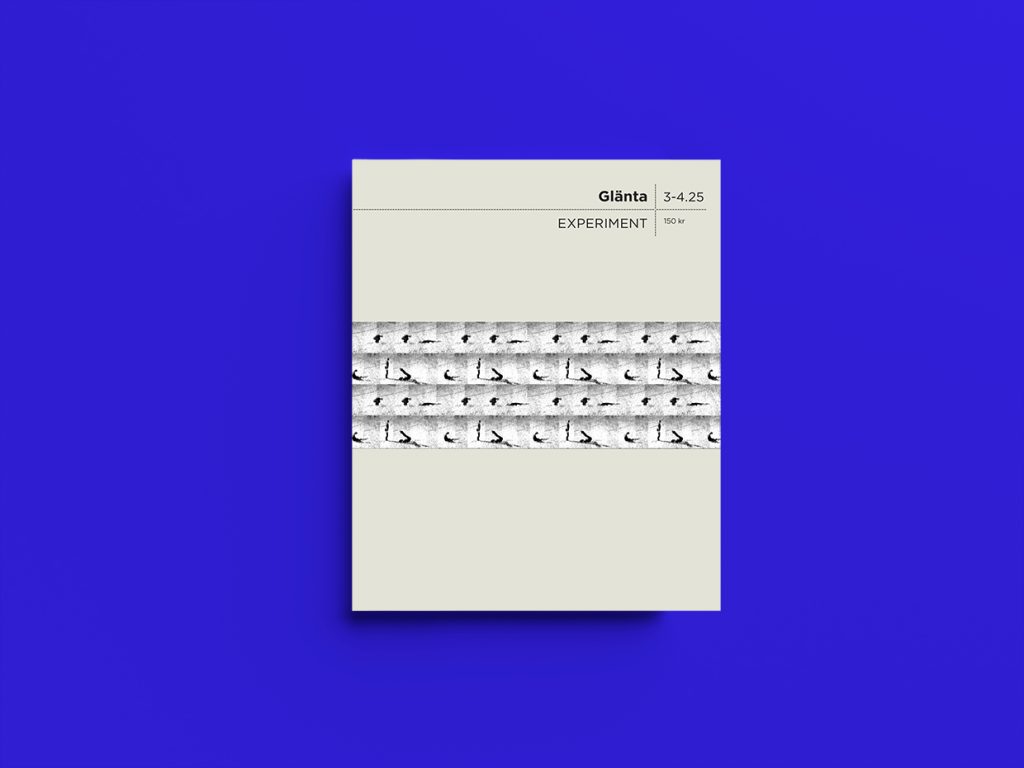
A thematic issue of Glänta considers ‘experiments’ from the natural sciences to poetry. In their editorial, Göran Dahlberg and Julia Ravanis point out that the very term ‘essay’ derives from the Latin verb for experiment, experiri, so that this is an issue full of experiments about experiments.
Sanna Beijnoff, who works as a psychologist, explores the pleasure and pain of her ambivalence to her own discipline. She focusses on the promise of increased happiness found in self-help literature. In recent books by Siri Helles and Björn Hedensjön, she finds ‘an unholy alliance between scientific claims and the language of marketing’ that leads to self-satisfied professional platitudes. But she is also at pains to question her own negative reactions to these platitudes – for who doesn’t want to be happy?
Happiness is coupled to freedom and play, which psychological research threatens when it provides behaviourist solutions and cookie-cutter advice, Beijnoff writes. But the freedom to do as one pleases is itself determined by predictable psychological mechanisms.
Beijnoff considers the concept of ‘reactance’, or the pleasure found in not doing what we are told. ‘Humans have many loyalties’, she writes. ‘We want to obey, but we also want to break free. We want out, and we also want to be caught.’ In Beijnoff’s hands, the essay becomes a place to play with – and perhaps disarm – the impulse to do something else entirely.
‘In all experimentation there exists a tension between freedom and method, openness and control,’ comments Julia Ravanis in a conversation with the experimental physicist Lars Hellberg, the economic historian Ann Ighe, and the artist and researcher Michele Masucci.
Hellberg confirms this by reflecting on the formative role that a 24-hour, 7-day-a-week experimental workshop at his high school in the 1970s had on his own development. In his teaching at the Chalmers University of Technology, a research university in Gothenburg, Hellberg has over one hundred students in engineering physics, too many to give free rein. At some colleges in the US, the student-teacher ratio is much lower, and freedoms correspondingly greater.
While physics hopes to achieve certainty through its experiments, in artistic production and research, uncertainty is more important, Ighe argues. According to Masucci, artists are the first and last experimenters, since humans organically create playful experiments, in the process posing questions about values that cannot be answered empirically. Artists and physicists need each other, though. The first image of a black hole in 2019 required artists to interpret light that humans can’t see into visible colours. The result, says Masucci, resembled an abstract painting.
Modern dating has become rationalized through reality TV and dating apps, but the core dilemma of love – ‘to retain one’s self-determination and also be able to give oneself over to the throws of passion’ – is transhistorical, according to Carin Franzén.
Interesting parallels emerge between contemporary dating and its representation in European literature over the past millennium. Franzén is particularly interested in reality shows like ‘Love is Blind’ and ‘Married at First Sight’, arguing that ‘the programs’ ritualized structure with tests, conflicts and ceremonies around decisive moments, strengthen our impression of a modern morality play, in which the public’s values are mirrored and reproduced.’
Franzén is attentive to a second paradox in contemporary dating culture: we want relationships to be compatible with our personal autonomy and freedom of choice, but are also inclined to leave our choice of partner in the hands of experts, whether the algorithms of Tinder or the psychologists on a dating show. ‘Love might be free in a democratic society,’ she writes, ‘but the participants in a dating show must submit themselves to the conditions of the experiment.’
Similar experiments can be seen in Margaret of Navarre’s Heptaméron, a series of stories published in 1558, often about the travails of love, told by different characters. Unique about the book is that every story is followed by a discussion between the characters, who provide different interpretations of its lesson, not unlike the viewers of a modern dating show.
Lina Ekdahl’s poem ‘Title: Experiment’ explores the preconditions for both writing and life. It begins, ‘Can I write a text about experiments. / What are the conditions. / What do I have. / Theme. / Title. / Coffee. / Time.’ The poem declares itself to be ‘some kind of metatext’ that no one will be satisfied with. Ekdahl explores how to write and, with reference to Marguerite Duras’s book Writing, the impossibility of doing so. ‘It must be said: we can’t. / And yet we write.’
Ekdahl also considers the inability to eat, sleep, and indeed to live. ‘Sleeplessness, an experiment I engage in every other / night. Not just me. An ever-larger experiment.’ While playing with these difficulties, the poet meets a plumber, who informs her of the dangers of not eating. He also offers the cliché ‘Life itself is an experiment!’ The final experiment of the poem becomes to confront the inability to live: ‘To live. / I can’t. / Nobody can. / It must be said: we can’t. / And yet we live.’
Review by Joel Duncan
Published 1 April 2026
Original in English
First published by Eurozine
© Eurozine
PDF/PRINT
After over 20 years of publishing for free, Eurozine needs your support to get through an exceptionally lean year.
Become a Patron and get exciting perks for your help!


Want to hear a human voice?
Listen and subscribe wherever
you get your podcasts.
Subscribe to know what’s worth thinking about.


In a world saturated with information, stimuli and industrialized noise, silence can be a reprieve – a vital force that is at least as clear as the ‘loud’ slogans raised at protests and rallies.

Being diagnosed with ADHD can be a relief for those who have struggled long and hard to adopt constraining social norms. For neurodivergent women, masking can lead to poor mental health, substance abuse and hyper-sexuality. Vox Feminae takes a first-hand dive into positive coping mechanisms for the inattentive and/or hyperactive.