


On political speech and the paradoxes of critique after Trump and Gaza; why the far right fills the gap left by restorationist liberalism; and how fascization depends on white middle-class solidarity.
Which Iranian artist in exile isn’t asked how their work relates to oppression, protest and war? How can creatives overcome colonial expectations of intelligibility? Opacity – questioning transparency’s supposed purity – becomes a technique of survival and a form of protection, as in the work of Chohreh Feyzdjou.
Walking through the Fondation Louis Vuitton this fall, I kept staring at Gerhard Richter’s paintings I knew by heart. These were works I had devoured as a young art student in Tehran, following blurred brushstrokes, copying images from screens and imagining what it would be like to stand in front of those vast, abstract, erased surfaces. Yet, standing before them now, I felt strangely distant. The issue did not lie with the paintings, nor the institution, or even Richter himself. It was the realization of how differently a painting is permitted to function for different bodies.
Instead, my attention kept returning to someone else: a young museum guard seated in one of the rooms, near a large painted Pantone grid. Dressed in black, with an uneasy, self-conscious expression, his presence beside that cold system of color felt closer to me than the paintings themselves. Staring back was his job. Unlike the paintings, which invited prolonged looking, his presence was purely functional, regulated and replaceable.
Watching him, I became acutely aware of how abstraction circulates freely for some bodies while others are fixed into roles that enforce distance. The room staged an uneven economy of attention: one in which certain entities are granted autonomy, while others are tasked with maintenance and containment. He was charged with protecting a form that would never fully inhabit him. The abstraction belonged to Richter; the guard belonged to protocol. That division between who may remain abstract and who must remain legible does not stay inside the museum.
It leaks outward, into daily life, into bodies marked before they speak, into modes of being present without ever fully arriving. The guard’s body was legible before his thoughts ever could be, assigned a function before it could drift. In that moment, the distance I felt from the paintings sharpened into something else, an awareness of how certain bodies are read in advance, and how looking itself can become a form of demand.
There is a particular kind of question you learn to fear when you are an Iranian painter working in Europe. It may arrive politely – or sometimes not at all – but you can feel the question mark hanging in the air: But what does it say about your situation? There is nothing quite like being immersed in the daily news of your country while painting in a quiet studio in Ghent or exhibiting in Berlin to make that question sting. I see your work is abstract, layered, fragmented … but what’s happening in Iran? What does this say about the situation there?
Sometimes I wonder whether these questions come from others or whether I am echoing them back to myself, repeating a million fractured feelings of longing, guilt, belonging, and refusal. On better days, I manage to answer: the layers are not metaphors or covers. They are a lived method, what the painting moves toward, and it’s all about being seen and negotiating a demand. This is not a desire for neutrality. Neutrality protects those who already inhabit the canon. Instead, I want to move within the painting without the interpretive frame snapping shut – a frame that claims to offer visibility while quietly stripping agency.
I often think of a bowl that shattered in my suitcase last year – a bowl I believed I had safely carried across borders. Its fragments still sit on my desk, taking up more space than the whole ever did. I imagined gluing it back together, restoring it, finishing it. But that would have been a small violence, a denial of what movement does to fragile things. The fragment tells a truth that the whole never could.
This is why my practice remains committed to a visual and painterly language. What arrives on the surface does so from elsewhere – across borders, histories, and systems of legibility – and resists being made whole. Painting becomes the site where fragmentation and opacity are not problems to be solved, but conditions to be worked within.
In post-revolutionary Iran, visibility is inseparable from surveillance. To appear is to become legible to power. Under such conditions, opacity – through masking, layering, erasure, and withholding – is more than an aesthetic or conceptual choice. It is a technique of survival and a means of exercising artistic agency. The painted surface becomes a threshold, determining what may be seen, by whom, and under what conditions.
This logic shaped my relationship to painting early on. Partial erasure was never an abstract strategy; it was a lived experience of navigating exposure. After relocating to Europe, the terms of visibility shifted again. Here, artists from the Global South are often expected to translate cultural and political experience into legible form. In ‘Signs Taken for Wonders’ (1985), for example, Homi K. Bhabha understands visibility as operating through a colonial logic of intelligibility, in which to be seen is to be made knowable on someone else’s terms.
My practice does not resolve this demand. It works within its language.
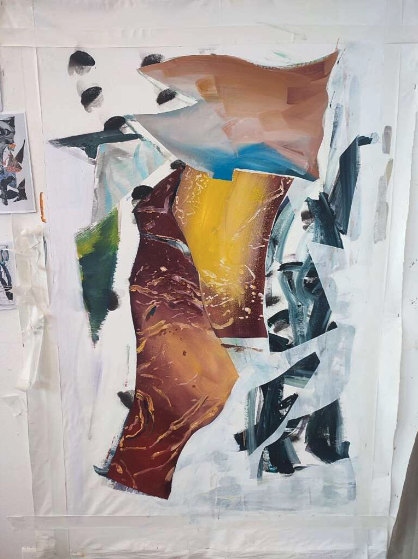
Work in progress, Yasaman Nozari, 2025
When I layer a painting until earlier strata disappear, I am constructing a different logic of meaning. Erasure, in this sense, is not reactionary, nor is it a refusal staged for interpretation. Let me explain. My process begins with various image sources: images I have engaged with throughout my practice, paintings by other artists, or fragments of older works of mine. I build the initial layer quickly using acrylics, then proceed through drawing and repainting. I consistently use pieces of masking vinyl to cover parts of the surface, which allows traces of previous layers to remain visible in the next. These vinyls are reused until their adhesive fails. Over time, they accumulate layers of paint from multiple works, carrying unconscious, accidental gestures.
In this way, the vinyl fragments become both conceptually and formally significant, producing texture, rhythm, and interruption within and between works. The process mimics the passage of time and the formation of memory. It acts as a reminder that total continuity is often – perhaps always – an illusion. Fragmentation reflects not only my own memory but memory itself. It is as though I am building an ecosystem of incompleteness: abstract patterns that repeat, overlap, and partially resolve one another. These patterns can be read like a score or a text, inviting entry without guaranteeing comprehension. They mirror the world as we encounter it – fragmented, layered, and interpreted differently by each of us.
Traditions of indirection, allegory, and veiling have long been embedded in my cultural context: in classical Persian poetry, where meaning unfolds through layered metaphor; in Sufi practices that treat concealment as discipline; in linguistic structures reliant on inference; and in forms of coded communication shaped by political precarity. Within this archive, erasure and opacity are not absences but carriers of meaning.
Paint, as a material, plays a specific role here. It allows all layers to remain present, even when covered. Up close, the surface reveals accumulated time. These layers are not steps toward a final image; they are records of all the versions the painting could have been. This is why I work with paint. Language demands conclusions — paint does not.
Beginning in the late 1980s, Chohreh Feyzdjou (1955-1996) systematically blackened her own paintings, drawings, and objects using walnut stain, wax, and pigment. Earlier works were sewn together, rolled up, sealed in boxes, or stored in jars, then coated until their original surfaces became barely perceptible. This gesture has often been read symbolically, but its force lies in its structural clarity. The blackening does not merely negate the image; it reorganizes the conditions of access.
What remains visible is not content; the viewer is confronted with the certainty that something is present and the impossibility of reaching it. Meaning shifts from recognition to duration: the time spent lingering, returning, waiting for the surface to give something up. The surface no longer primarily serves transparency; it serves protection.
Feyzdjou’s black layer operates as a threshold, producing a deliberate gap between object and gaze. This gap is neither silence nor withdrawal. It is a rigorous strategy that preserves complexity by resisting premature interpretation. Opacity, here, is containment, as Julia Eckhard also argues in Verbergen, Umschließen, Vergraben (2023), her brilliant study on Feyzdjou’s work.
Rather than presenting a unified oeuvre, Feyzdjou constructed a dispersed field of fragments, each marking a duration of studio time through the serial accumulation of drawings, paintings, and objects. Accumulated without resolution, incompleteness functioned as a structural condition. In interviews, she likened her covered works to memory – only partially accessible, never fully shared.
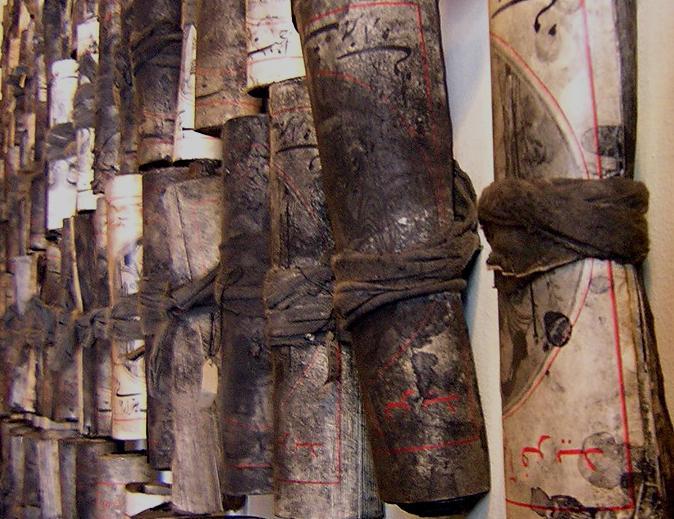
Tout art est en exil, Chohreh Feyzdjou, 1995. Musée d’art contemporain de Bordeaux, France, 2007. Image by Josh Clark via Flickr
Earlier exhibitions presented scrolls that remained rolled up while visitors watched filmed documentation of them. Most visitors never asked whether the scrolls could be opened. Her strategy extended further in Buried Paintings (1994), which were documented in catalogues while being physically buried underground. Their existence was affirmed, but the images themselves were inaccessible.
Her work was also informed by spiritual traditions, including Sufism and Jewish mysticism, in which dissolution signifies transformation rather than disappearance. Coating, darkening, and burial became slow processes of breakdown and recomposition; identity was dismantled rather than represented.
Moreover, Feyzdjou openly resisted institutional framing. When she was to participate in the contemporary art exhibition Heart of Darkness (1994-1995) at the Kröller-Müller Museum, she titled her installation I Don’t Agree With This Show. In the catalogue, she rejected the exhibition’s framing of exile and colonialism. Instead, she insisted that her work belonged to an ‘imaginary and utopian universe of Man born into the World’. Exile, for her, was not geographic but structural. Belonging remained unreachable.
By working within institutions and interrupting their demand for transparency, Feyzdjou protected complexity from being flattened, accessed, or distorted.
It is perhaps ironic to conclude an essay on incompleteness. However, there are many types of incompleteness. Some are transitional, others imposed. Some are inherited, others reactionary. There is also a chosen incompleteness – one that functions as a language of refusal.
In this light, the question I asked in front of Richter’s paintings shifts. It is not about whether I could ever paint ‘like that’. Like that describes a condition rather than a style – a condition sustained by how some works are read and others interrogated – in which opacity is permitted and biography can recede without being summoned back as explanation. This condition is not evenly distributed, nor is it reducible to identity alone, but shaped by how institutions, histories, and bodies intersect. Although Richter’s work is deeply shaped by history and politics, it is often perceived as operating independently from them. The possibility of such a reading is itself unequally granted.
What is available to me instead is a different language of painting. In my practice, erasure reorganizes meaning rather than negating it. Layering and partial visibility are ways of carrying the work’s conditions. I have come to understand that insisting on wholeness may itself be a form of violence, a denial of the forces that fracture and unsettle. This is not nostalgia for process, nor a romantic defence of openness. It is an acknowledgment of how form behaves under pressure: how it accumulates, fragments, resists closure, and holds multiple temporalities at once. The surface becomes a record of negotiation rather than resolution.
This article first appeared in Unfinished, Rekto:verso, 109 (spring 2026).
Published 25 March 2026
Original in English
First published by Rekto:verso 109/spring 2026
Contributed by Rekto:verso © Yasaman Nozari / Rekto:verso / Eurozine
PDF/PRINT
After over 20 years of publishing for free, Eurozine needs your support to get through an exceptionally lean year.
Become a Patron and get exciting perks for your help!


Want to hear a human voice?
Listen and subscribe wherever
you get your podcasts.
Subscribe to know what’s worth thinking about.
On political speech and the paradoxes of critique after Trump and Gaza; why the far right fills the gap left by restorationist liberalism; and how fascization depends on white middle-class solidarity.

Cultural humanitarian aid risks diminishing the complexity of creative work to ethnic kitsch: well-meaning initiatives rate nationality over content. And when the work does receive critical attention, only art that portrays trauma cuts it. Soon thereafter, Western interest fades. Could answers for meaningfully decolonizing Ukraine lie with other formerly colonized communities?