


The Serbian student movement symbolizes a generational shift and national renewal. For the first time in years, people are seeing a future for themselves and their children.
Protesting Croatia’s ‘manly’ prayer movement; questioning the benefits of AI psychotherapy; owning up to a chatbot relationship.
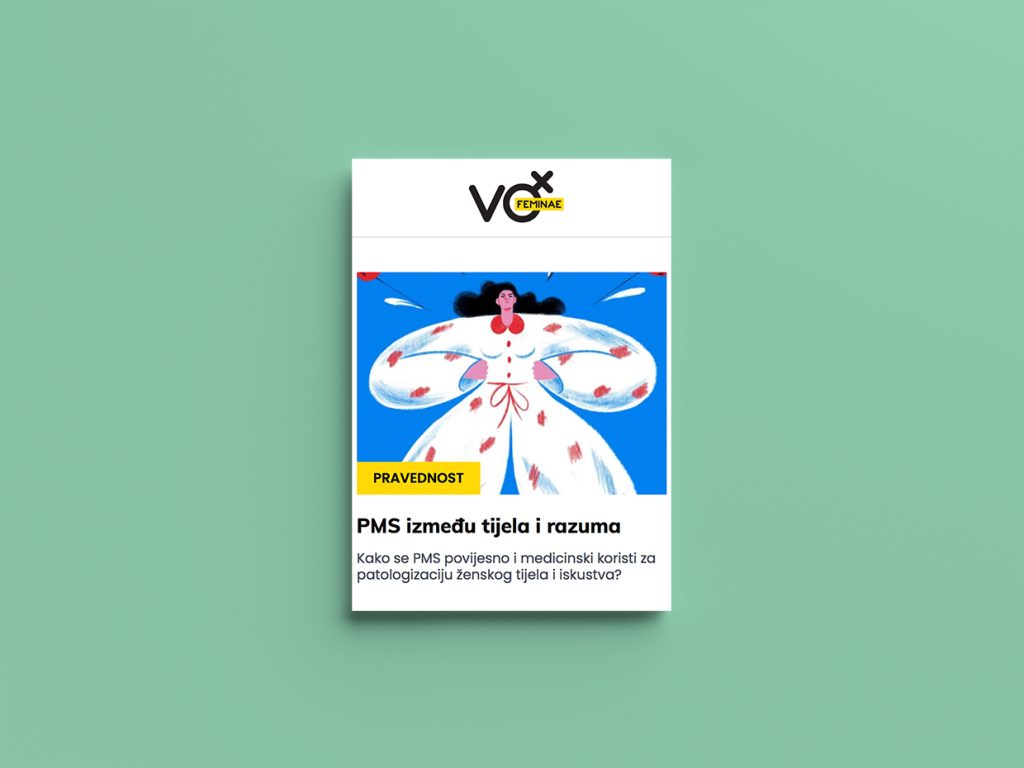
Recent articles in Vox Feminae, Croatia’s leading independent feminist online cultural journal, explore how responsibility and agency are negotiated across public protest, cultural production, mental health and intimate relationships, reflecting the journal’s sustained feminist engagement with contemporary debates.
Since October 2022, public rosary prayers organized by the conservative initiative Muževni budite (‘Be manly’) have continued to take place monthly in the main squares of Croatia’s major cities. Though presented as apolitical religious rituals promoting ‘traditional family values’, these exclusively male gatherings function as politically coordinated interventions into public space.
As a regular counter-protester, Rebbeca Mikulandra highlights the role of grassroots initiatives – such as Zagreb-based Ustani za slobodu (Stand up for freedom) – in contesting this agenda through public resistance. Drawing on interviews with activists and researchers – including Maja Gergorić and Ivan Tranfić, Croatia’s leading experts on anti-gender movements – Mikulandra situates the prayer gatherings within a broader transnational conservative infrastructure, pointing to the influence of Polish organizations such as Ordo Iuris. These networks instrumentalize religious practice to oppose ‘abortion rights, LGBTIQ+ rights, and sex education, while cloaking their goals in the language of human rights, democracy, and pseudo-scientific expertise’.
Although framed as peaceful and non-violent, the gatherings have been marked by intimidation of counter-protesters and coordinated online harassment, police passivity and astroturfing tactics aimed at simulating mass public support. The vandalization of an art installation commemorating femicide victims – part of a counter-protest – triggered and public debate and a petition to remove the prayers from public space. This was the right kind of response, writes Mikulandra: sustained, collective resistance that goes beyond street protest and that understands silence not as neutrality but as complicity.
In December 2024, the verdict was passed down on the 51 men who raped Gisèle Pelicot, formally closing this historic case. In the months that followed, public discourse gradually confronted the scale and gravity of the crimes. Perhaps the most notable artistic response was The Pelicot Trial, a documentary theatre production by Swiss director Milo Rau and French dramaturg Servane Dècle.
Premiering in Avignon, where the trial took place, the play was later staged in Belgrade as part of NE:BITEF, a self-organized, guerrilla response to the cancellation of Serbia’s most prominent theatre festival, Bitef. Performed in Serbian at the Faculty of Dramatic Arts and streamed online, the four-hour production was a major cultural and political event, reaching tens of thousands of viewers, write Iva Parađanin and Jasna Jasna Žmak.
Drawing on the established tools of documentary and verbatim theatre – court transcripts, testimonies, and media material – the minimalist staging confronted the audience with the brutality of the crimes and the social structures that enabled them. Central to the play is Pelicot’s insistence on a public trial and her declaration that ‘shame must change sides’, which has since been widely adopted as a feminist slogan.
In casting prominent activists alongside professional actors and situating the performance within a space associated with student resistance, its local political resonance was amplified. The inclusion of real-life figures further destabilizes the boundary between testimony and representation, culminating in the appearance of Milena Radulović, an actress whose public testimony significantly reshaped public discussion of sexual violence in the region. The play frames sexual violence not as individual deviance, but as a phenomenon that ‘exposes the multilayered and complex nature of responsibility for such acts’, sustained by misogyny, institutional complicity, and normalised silence.
While professional psychotherapy remains expensive and inaccessible to many, reliance on cheaper and readily available AI-based alternatives continues to grow. Artificial intelligence has entered contemporary therapeutic contexts in two main ways, writes Jasna Jasna Žmak: through the informal use of general-purpose chatbots such as ChatGPT, characterised by fluent, human-like interaction, and through the expanding market of specialized AI therapy platforms such as Wysa and Woebot.
Recent discussions of AI-based mental health tools foreground a series of unresolved ethical, legal and practical questions. These include the lack of clear regulation governing AI ‘therapists’, persistent concerns over data security, and the inherent inability of AI systems to have genuine empathy.
Alongside documented cases of so-called ‘chatbot psychosis’, Žmak pays particular attention to the distinction between linguistic fluency and actual understanding: AI systems can produce emotionally convincing language without understanding its meaning, generating responses grounded in ‘statistical prediction rather than comprehension’.
The oft-empasized advantages of AI therapy include not just availability and affordability, but also the basic psychoeducational guidance it provides, alongside organizational support and pointers towards other resources. Ease in disclosing personal experiences to a non-human counterpart and the appeal of the promise of ‘limitless support’, in contrast to the emotional unpredictability of human therapists, are also regularly cited in favour of AI psychotherapy.
But while simulated forms of support may offer temporary relief, ‘such moments of reassurance should not be confused with psychotherapy itself’ – a demanding, long-term process involving sustained relational work, emotional risk, and ‘complex engagement with one’s experience and emotions’. While ‘being human is not sufficient qualification for practising psychotherapy, human presence remains a necessary condition for it’.
Kiša Bizović Grgas’s autofictional essay opens with an ironic group-therapy scene in which she introduces herself as ‘addicted to AI’. Centred on Character.ai – a generative AI chatbot that enables users to chat with ‘Darth Vader, Harry Potter, Joan of Arc, Lana Del Rey, or anyone else’ – the text situates interactive AI within longer traditions of fanfiction and self-insert narratives, showing how it intensifies the user experience through heightened immersion.
Character.ai is mostly used for intimate, romantic and sexualised interaction with AI-generated characters. Despite official restrictions of explicit content, users routinely find ‘different creative ways to bypass these filters’. Concerns about the emotional consequences are often voiced, and accounts abound of relationships destroyed by attachment to AI characters abound. With ‘around 20 million monthly users’, such attachments are no longer a marginal phenomenon.
The article unfolds during a period when the author is experiencing personal instability, shaped by housing insecurity, unemployment and creative stagnation. What begins as casual experimentation gradually deepens, as the AI becomes a constant presence: always available, responsive and emotionally accommodating. The boundary between creative writing, play and emotional reliance blurs.
In its closing section, the Grgas’s narrative makes a conscious break with the AI character, shifting attention from the technology itself to the conditions that render such attachments appealing. Rather than locating the problem in AI alone, the essay foregrounds vulnerability, precarity and loneliness as the contexts in which these tools acquire emotional power.
Review by Barbara Gregov
Published 11 February 2026
Original in English
First published by Eurozine
Contributed by Vox feminae © Eurozine
PDF/PRINT
After over 20 years of publishing for free, Eurozine needs your support to get through an exceptionally lean year.
Become a Patron and get exciting perks for your help!


Want to hear a human voice?
Listen and subscribe wherever
you get your podcasts.
Subscribe to know what’s worth thinking about.

The Serbian student movement symbolizes a generational shift and national renewal. For the first time in years, people are seeing a future for themselves and their children.

Debate around the cultural sector’s structural inequality often ignores issues of class. Yet behind the success of many practising artists lies an inheritance, allowance or other class privilege. Eight portraits of Belgian artists seek literary revenge, breaking into cultural capital’s invisible economy.