Eastern European memory politics today: why numbers wars are bad diplomacy; the commodification of communism; Russia’s civic memory cult; Lukashenka’s ahistorical limbo.
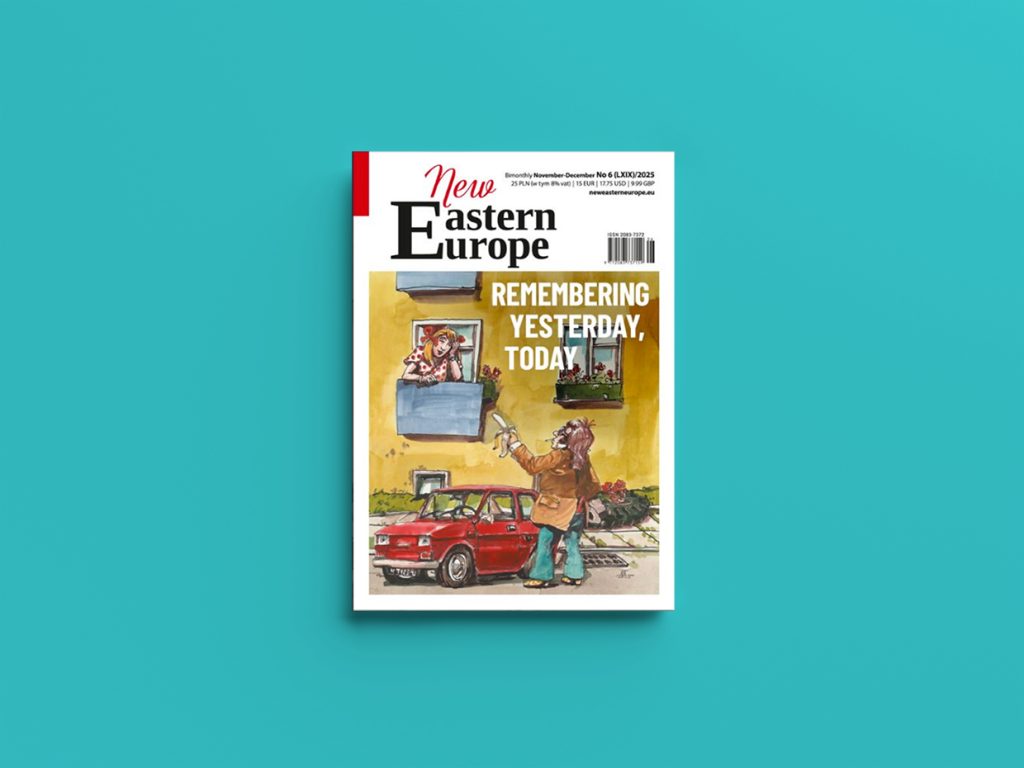
Titled ‘Remembering yesterday, today’, the November-December issue of New Eastern Europe focuses on how the reinterpretation, instrumentalization and invocation of the communist past shapes contemporary debate across Central and Eastern Europe.
Diplomatic forgetting
In the past two decades, the memory of the Holocaust and the suffering endured under Nazi rule that had previously dominated the historical narrative has increasingly been challenged by countries in eastern Europe, where the end of the war did not bring liberation, but new cycles of repression.
Arguing that Nazi and Soviet state violence had a moral equivalence, these post-communist states seek equal commemoration of the suffering caused by both regimes. But in doing so, writes Dymitr Romanowski, they have stoked bitter disputes over which victims merit commemoration, as well as ‘numbers wars’ that question which regime was deadlier.
Romanowski asks whether, ‘by continually placing the past at the centre of public life’, initiatives aimed at ‘truth-telling’ are always in the interests of peace in Europe. There are times, he writes, when silence might be the more diplomatic option. ‘An excessive focus on memory can also hinder reconciliation; at a certain point, sustained attention to past grievances may even deepen existing tensions or reignite conflict’.
Marketplaces of memory
Across eastern Europe, party headquarters, mausoleums, apartments and bunkers have been repurposed as event venues, tech hubs, museums and nightclubs, while vintage symbols of everyday communist life such as Poland’s milk bars or East German Trabant cars are now staple features of nostalgia tours. ‘What was once propaganda is now performance; what was once ideology is now experience’, writes Jovana Janinovic.
The socialist past is now sold as a palette of experiences that range from irony to reverence. But this commercial relationship between visitor and host conceals tensions between memories and political narratives on the one hand, and market demands and tourist expectations on the other. It raises questions of ethics, trauma, nostalgia, authenticity and identity – how should the past be remembered, and by whom? What is the cost to post-socialist societies of the touristification of memory?
The development may not be all negative. This ‘marketplace of memory’ mirrors broad cultural transformations in the region, writes Janinovic – these countries are no longer peripheral states but ‘dynamic spaces of creativity and self-reflection’. While memory has become a commodity, through this very process it remains visible and can be collectively debated and encountered.
Russia’s martial holy day
Bartłomiej Brążkiewicz analyses how the memory of the Soviet defeat of Nazism has become both a disciplinary ritual and a marker of loyalty to the Putin regime, as well as a key instrument of Russian foreign policy. Charting the sacralization of the 9 May Victory Day celebration, Brążkiewicz tracks the history of the holiday, from its marginalization after World War II, through its reinstatement in 1965, to its increasing significance in the late Soviet era and the 1990s, when it ‘started to re-emerge as an important point of reference for a society searching for stable symbols of identity’.
Since Vladimir Putin came to power, the holiday has become a piece of militarized theatre with quasi-religious overtones. In this ‘civic cult’, the victory in 1945 serves as a triumphalist symbol of Russian military might; Russian and Soviet identity is conflated in ‘a decisive reorientation of Russia’s politics of memory’. This allows Moscow to brand countries that remove Red Army monuments as Nazi revanchists, guilty of betraying the history of their ‘liberation’.
Precisely this propaganda has been used to frame the war on Ukraine as a ‘holy war’ against ‘fascists’ and ‘Nazis’. ‘In this way, the rhetoric of 9 May has been transformed into a geopolitical weapon, justifying Russian claims and aggressive actions’.
Lukashenka’s limbo
In Belarus, too, the past is used to reinforce an authoritarian project. Tatsiana Astrouskaya addresses a tangible doctrinal change in the historical policy employed by Alyaksandr Lukashenka’s regime since the failed revolution in 2020 and his collaboration in the full-scale invasion of Ukraine in 2022.
These two events, Astrouskaya writes, have left Belarus isolated and exposed ‘the inherent finitude’ of Lukashenka’s rule’. The regime has responded by embracing an abstract timelessness detached from authenticity. No longer anchored in the emotional charge provided by specific moments in socialist history, ‘the narrative now floats in an ahistorical, fictitious register, where the past is not recalled for its facts but for its utility in sustaining power’.
‘What is striking is the way in which an old dictator’s toolkit has been fused with new instruments in this struggle’, writes Astrouskaya. In order to maintain its grip on power, the regime is making use of war, constitutional changes, the personality cult and digital technologies.
Review by Alastair Gill
Published 22 December 2025
Original in English
First published by Eurozine
© Eurozine
PDF/PRINT
Invest in insight!
After over 20 years of publishing for free, Eurozine needs your support to get through an exceptionally lean year.
Become a Patron and get exciting perks for your help!


Want to hear a human voice?
Listen and subscribe wherever
you get your podcasts.
Newsletter
Subscribe to know what’s worth thinking about.

