


Against a backdrop of crime, corruption, inequality and sexual violence, Mexican novelists are returning to the tradition of the child narrator. Interviews with Fernanda Melchor, Luis Jorge Boone and Emiliano Monge.
Focus on the 20th-century Croatian poet and novelist Antun Šoljan: literary translation and political subversion; intertextuality and Socratic irony; Mediterranean humanism; a denim Homer.
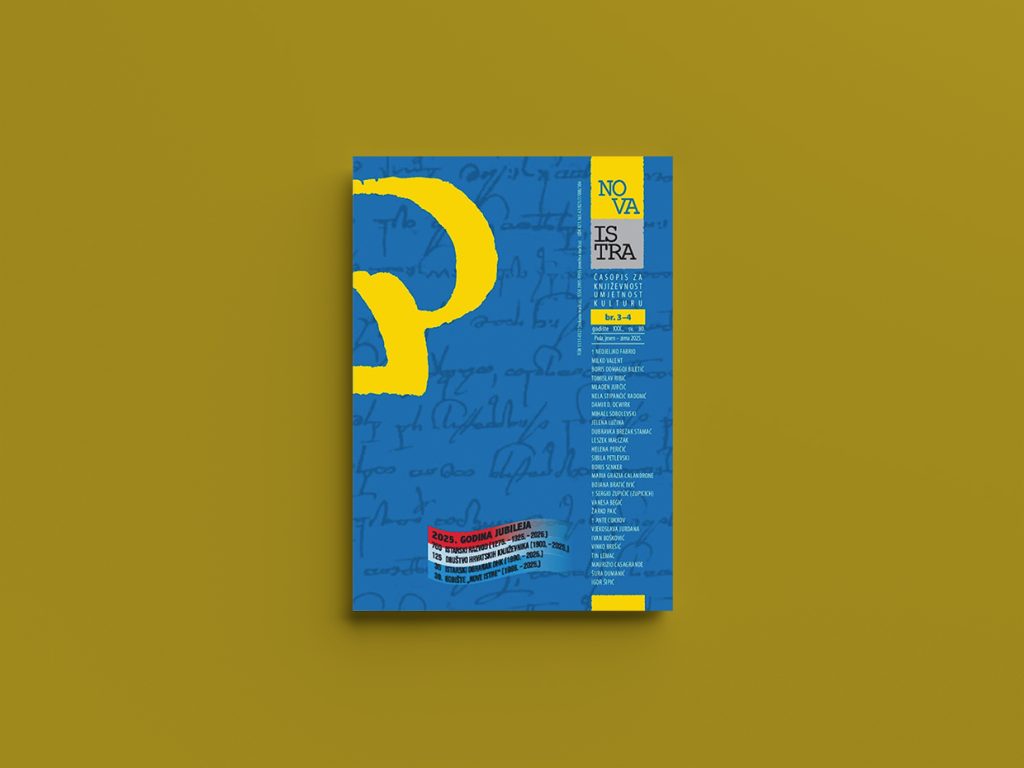
Nova Istra focuses on the major Croatian poet, novelist and translator Antun Šoljan (1932–1993) – one of the most versatile and and widely translated literary voices in Croatian literature of the latter half of the twentieth century.
George Orwell’s Nineteen Eighty-Four (1949) was published relatively early in Yugoslavia, with translations into Slovenian (1967), Serbian (1968), and Croatian (1984), the latter by Šoljan. A defining feature of Šoljan’s translation practice is the creative adaptation of the translated text to the present or to a local context, writes Leszek Małczak. Šoljan’s translation of Orwell’s novel adopts a polemical stance towards the earlier Serbian version, expanding and modifying passages, adding explanations and additional terms absent from both the original and the Serbian translation, and thus clearly ‘exhibiting features of a politically subversive translation’.
Particular attention is given to the treatment of Orwell’s neologisms, especially newspeak and crimethink. While the Serbian translator, Vlada Stojiljković, translated these as novogovor and zlomisao, Šoljan introduced the more idiosyncratic novozbor and zlodum. These, as well as his other lexical choices, carry culturally specific connotations and references to the Yugoslav political context. Particularly associations with what was colloquially known as ‘verbal offence’ (verbalni delikt) in criminal law, or ironic references to state institutions – hint at a critical engagement with the political realities of socialist Yugoslavia.
While Yugoslavia was relatively open to publishing dissident literature compared to other communist countries, internal criticism remained restricted. In this context, writes Małczak, Šoljan’s translation exemplifies how literary translation can function as a site of political subversion.
Helena Peričić examines intertextuality in the construction of irony in Šoljan’s play Romance of Three Loves (Romanca o tri ljubavi, 1976). While its plot and structure are relatively simple, the play is distinguished by its stylistic complexity: it is written entirely in verse, which renders it an exception within ‘both Šoljan’s dramatic oeuvre and Croatian drama of the 1970s’. At the same time, it foregrounds love as a totalizing experience, marking a departure from the existential concerns of his earlier works and from the dominant socio-political focus of the period.
Šoljan’s writing is shaped by a complex, Socratic irony, realised through intertextual strategies that subvert literary authority. Several modes of intertextuality are identified in the play, including structural and thematic borrowing from canonical works, historical or metonymic references, mythological and religious allusions, citation and paraphrase. Within this framework, two principal instruments through which irony is produced are foregrounded: genre and verse.
The most evident intertextual effect lies in the author’s own oxymoronic classification of the play as a ‘sentimental farce’. This is reflected in the use of traditional farcical elements, such as the juxtaposition of elevated language with trivial, even bawdy language, as well as the presence of character types. The use of verse likewise functions as an intertextual reference to earlier literary traditions. In both cases, irony operates by destabilising formal and generic authority while paradoxically reaffirming their centrality.
Sibila Petlevski situates Šoljan’s work within a postmodern framework characterised by intertextuality, genre hybridity and a sustained negotiation between authorial voice and cultural context. Šoljan’s poem Gazelle (Gazela, 1971) functions as a paradoxical construct – both hermetic and accessible – reworking the ghazal (amatory poem or ode) originating in the Arabic poetic tradition into a self-reflexive form. The poem’s articulation of longing can be read as a form of cultural positioning, oriented toward ‘Mediterranean humanism, in contrast to the socio-political context of 1970s Yugoslavia. The motif of the gazelle functions as a metaphor of the author’s personal and generational ‘spiritual ecology’, which remains fundamentally unattainable, appearing as an elusive, ‘mirage-like’ ideal.
Petlevski broadens the discussion to Šoljan’s wider poetics, particularly in relation to modernity, emphasising the structural role of dialogue. His work consistently stages an interaction between the individual and external frameworks – geographical, historical and cultural. This dialogic principle extends across genres, shaping both his poetry and drama. His modernity is ‘established beyond the schematic adoption of modern poetic forms’ and ‘outside any ideological stance that would negate its predecessors so completely as to exclude them altogether’. In this sense, Šoljan’s modernity is inherently paradoxical: it emerges through a sustained and self-conscious engagement with tradition.
Boris Senker’s reading situates Antun Šoljan’s The Other People on the Moon (Drugi ljudi na mjesecu, 1978) within several literary traditions. The novel can be read as both an inscription within, and a relativisation of ‘jeans prose’, canonically associated with J. D. Salinger’s The Catcher in the Rye (1951) and, in the local context, Šoljan’s own A Brief Excursion (Kratki izlet, 1965). Jeans, in their torn and worn materiality, primarily function as ‘a metaphor for the protagonists‘ shattered illusions’. Structurally circular, the novel depicts the protagonists’ attempt to ‘escape the constraints of everyday life’ as culminating in failure, returning them to ‘their point of departure’.
Alongside beat literature, most notably Kerouac’s On the Road (1957), Šoljan’s text also draws on the long tradition of maritime literature, from the Odyssey onwards. His narrative of two friends sailing the Adriatic in search of sunken treasure – symbolically understood as ‘lost and forgotten values’ – unfolds against the backdrop of the Moon landing, foregrounding a tension between technological achievement and characters’ existential emptiness.
Senker’s reading classifies Šoljan’s text as a ‘novel of navigation’. By attending to the novel’s episodic structure and vivid imagery, he emphasizes its filmic potential. Senker also points out a range of problems the novel articulates, both within the fictional world and in a broader social context, such as the representation of contemporary Adriatic tourism and its ‘commercialization and dehumanization’ of the coast, as well as gradual environmental degradation.
Review by Barbara Gregov
Published 25 March 2026
Original in English
First published by Eurozine
© Eurozine
PDF/PRINT
After over 20 years of publishing for free, Eurozine needs your support to get through an exceptionally lean year.
Become a Patron and get exciting perks for your help!


Want to hear a human voice?
Listen and subscribe wherever
you get your podcasts.
Subscribe to know what’s worth thinking about.
Against a backdrop of crime, corruption, inequality and sexual violence, Mexican novelists are returning to the tradition of the child narrator. Interviews with Fernanda Melchor, Luis Jorge Boone and Emiliano Monge.

Contemporary Moldovan novelists continue to thematize the struggle for linguistic, social and ethnic identity within the Soviet system. Taken together, their work forms a literature of post-totalitarian recovery.