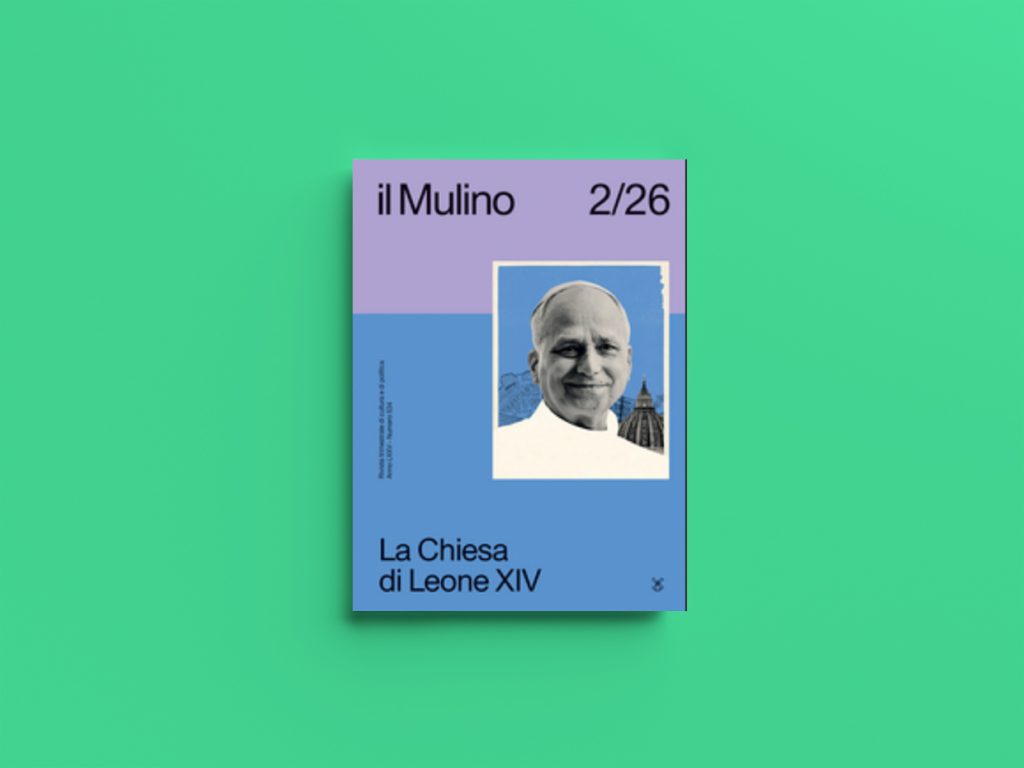
A year after the election of Leo XIV as the 267th pope of the Catholic Church, Il Mulino identifies the distinctive features of Leo’s new leadership and the conditions in which he must operate.
The Church of Leo XIV needs to be understood not simply as the beginning of a new papacy, but as a historically decisive juncture, write editors Paolo Pombeni and Francesco Clementi: ‘an interplay of institution and charisma, memory and innovation, continuity and discontinuity’.
The communicator
‘Peace be with you all!’ With these opening words, Leo XIV did more than greet the faithful. For Dario Edoardo Viganò, Leo’s choice to deliver a theologically structured address signalled a distinctive style: one in which papal speech is at once pastoral and magisterial.
‘Within symbolic systems, form is itself content’, writes Viganò, arguing that everything from the pope’s speeches and vestments to his observations on cinema, sport and AI forms a coherent symbolic language.
This style of communication, Viganò argues, reflects Leo’s personal and ecclesiastical formation. His US American upbringing gave him ‘a familiarity with public culture’, while his missionary experience in Peru fostered a commitment to pluralism. This dual inheritance – Chicago and Chiclayo, centre and periphery – allows their implicit opposition to be resolved: the centre is challenged by the margins, which are at the same time given an institutional voice.
In this way, Robert Prevost represents a distinctly Augustinian politics of communication, in which the possibility of being ‘together’ is articulated through a language that is at once ‘unarmed and disarming’.
The unexpected pope
Leo XIV is the ‘unexpected pope’, writes Massimo Faggioli: not simply because he is the first pope from the United States, but also because his theological and political outlook resist easy classification.
The election of an Augustinian pope comes at a moment when Augustine has again become central to debates over religion and politics. Faggioli contrasts Leo XIV’s ‘Pan-American Augustinianism’ with both the post-liberal vision of Radical Orthodoxy and the nationalist neo-integralism that has gained traction in parts of American Catholicism.
Rather than seeking a return to Christendom or embracing secular liberalism, Leo offers a distinct alternative, rooted in religious freedom, pluralism and the Church’s engagement with the contemporary world. Achieving this will be no mean feat, says Faggioli: Leo XIV’s vision ‘will have to find its place along a narrow path, between an expanded Trumpian America … on the one hand, and transatlantic woke culture on the other’.
Women’s equality
Adriana Valerio turns the discussion to the voices of women – or their conspicuous absence – within the Catholic Church. Time and again, women have fought for greater equality, only for their demands to be passed over in favour of ‘more pressing matters’, leading to ‘inevitable and painful ruptures’. While some redoubled their efforts, others abandoned religious practice altogether.
Women’s equality has not always been sidelined, however. In a speech that helped pave the way for Pope Paul VI’s decision to invite women auditors to the Second Vatican Council, Archbishop Leo Joseph Suenens remarked, with characteristic irony: ‘It seems to me that women make up almost 50 percent of humanity.’ Yet Paul VI’s efforts were ‘inadequate and contradictory’ – as were those of Benedict XVI – ‘masking the prohibition of any real change behind a superficial celebration of women’.
Genuine progress, Valerio argues, came only under Francis, whose programme of de-clericalization and ‘synodal method’ sought to expand women’s participation in a ‘listening Church’. Leo, by contrast, appears more cautious. Although he supports a broader role for women, ‘Pope Leo XIV does not seem willing to go further, such as by admitting women into the ordained ministry’, for fear of deepening internal divisions and straining ecumenical relations.
Intellectual Catholicism
Renato Moro traces the evolution of Catholic intellectual life through Don Giuseppe De Luca’s distinction between the cattolico intellettuale (‘the Catholic who is an intellectual’) and the intellettuale cattolico (‘the Catholic intellectual’). The former is an independent thinker shaped by personal faith, argued the 20th-century priest, essayist and publisher; the latter understands intellectual activity as part of a collective Catholic mission.
From Erasmus and Bellarmine to Agostino Gemelli and Jacques Maritain, Moro shows how these rival models developed over the centuries, alternately defending a restored ‘Christian civilisation’ or seeking dialogue with modernity in the construction of a ‘new Christendom’.
This long tradition, Moro maintains, has largely come to an end. Since 1989, Catholic intellectual culture has declined amid increasing polarization and a preference for practical action over broad cultural projects. Francis, he suggests, encouraged this shift in emphasis by urging intellectuals to engage directly with social problems.
Neoconservatism, which linked free-market politics with traditional Christian values, was a symptom of this wider process of disintegration, according to Moro: its worldview was ‘no longer merely Catholic, or even merely Christian’. This, in turn, paved the way for the ‘Christian atheists’. While ‘Catholics who are intellectuals’ have largely fallen silent, ‘the secular intellectual has assumed the place, the function and the model once occupied by the Catholic intellectual’.