


Popular culture in flux
Varlık 5/2025
In Varlık: how northern cultural hegemony is being challenged by Bollywood, Korean television dramas, K-pop and Nollywood; also, post-emotional human relationships and the aesthetics of uncertainty.
Profiles without selves, or boycott Facebook now; Sartre, Heidegger and Whatsapp; a biography of Orhan Veli, one of Turkey’s great 20th-century poets.
In his introduction to the current issue of Varlık, editor Mehmet Erte reminds us of a time when a literary magazine published in any province of Anatolia could find its place on the shelves of Istanbul bookstores. Magazines printed in Istanbul, meanwhile, reached readers all over the country. Those days are over. ‘Let alone distribution, how many daily publications are left that can survive?’
Erte identifies the culprit of print’s death in social media, which failed to bring the pluralism it once promised. Instead, through ‘algorithmic encirclement’, social media is ‘rapidly homogenizing society, imprisoning it in echo chambers.’ That’s precisely why we need to support literary magazines like Varlık, which is now in its 93rd year of existence. ‘When we lose the magazines, only those who produce according to market demands and customers designed by social media algorithms will remain.’
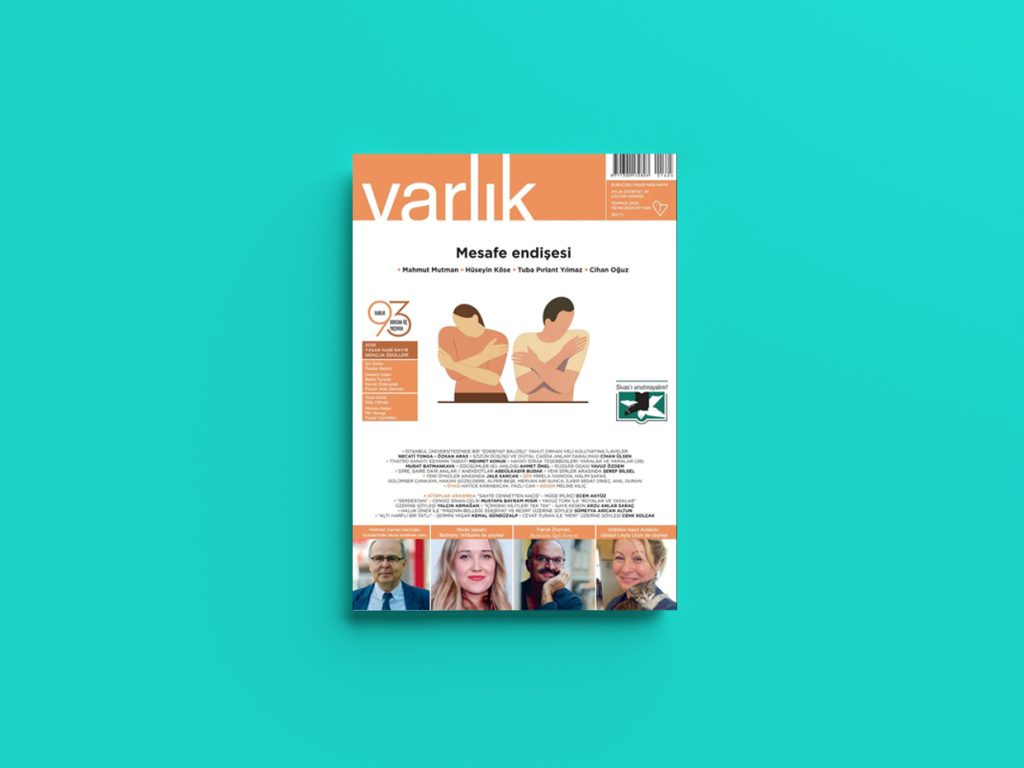
In Varlık’s symposium, ‘Anxiety of distance’, writers from different disciplines (philosophy, literature and cultural studies) critique social media. Mahmut Mutman asks what a social media profile is, philosophically. Where exactly are we writing to when we post on social media? In rhetoric, Mutman notes that the ‘face’ on Facebook is a ‘synecdoche’: a part (face) that stands in for the whole (identity). Like other social media platforms, Facebook ‘is a place where I construct my face, my appearance, my feelings and thoughts, in short, my “identity”.’
Social media seemingly allows one to present herself as she wants to be seen, but is, in fact, ‘a machine operating with an algorithmic system integrated into an economic mechanism.’ Meta, the owner of Facebook, profits from collecting demographic and behavioural data from approximately 3 billion users worldwide (34 million of whom reside in Turkey) and selling it to advertisers. There is, in other words, no ‘self’, just quantifiable data accrued for these platforms.
Mutman agrees with Theodor Adorno and Max Horkheimer that the culture industry ‘ruthlessly erases all forms of individuality by invading the realm of imagination or fantasy’. He offers a way out for users of social media, which has replaced radio and television as the medium of the culture industry: we wield the power not to use it. ‘Can you imagine that approximately 3 billion users worldwide, and 34 million in Turkey, stopped using Facebook for, say, a week?’ Without those many millions of profile pages, Facebook would cease to exist.
Tuba Pırlant Yılmaz’ reminds us of Jean-Paul Sartre’s analogy in Being and Nothingness about someone getting caught while looking through a keyhole. ‘Their consciousness, which until that moment flowed freely, suddenly becomes visible from the outside, solidifies, and stands there like an object.’ Sartre was describing a moment of shame, moral reckoning, and ontological shock. When we send a WhatsApp message, wait for the blue tick that acknowledges receipt, and exist in that interval between reading and responding, we inhabit a similar space, in a ‘waiting room’.
Social media platforms profit from the precarity of that space. The difference from Sartre’s character is that on social media platforms the observer and the observed are the same person. ‘The subject is both spectator and actor, and the scene never closes.’
Yılmaz looks at Byung-Chul Han’s The Transparency Society (2017), Rachel Cusk’s Outline trilogy (2014–2018), and Bong Joon Ho’s 2019 film Parasite and identifies a shared interest in transparent, fake and invisible identities. She recommends Heidegger to understand subjectivity fully: ‘In the digital age, Dasein cannot detach itself from the network, and even if it does, it does not remain silent; it becomes an attitude, a definition in itself.’
On social media, for example, attitude becomes definition. ‘Someone posting on Instagram doesn’t just upload a photo; they condemn themselves to a narrative, a consistency, and an identity. Someone making a video on TikTok acts by inwardly sensing how the algorithm will read them – which category, which audience they will be placed in. Expressing an idea on X transforms the subject into that idea. He no longer exists as the thinker, but as the thing he thinks.’
A 2020 report by the American Psychological Association found that 63% of Generation Z identified the pressure to be visible as a significant source of stress. It is good to be anxious, Yılmaz contends, as it’s a sign of not having surrendered, of resisting being defined, of trying to maintain one’s ambiguity, and of not fully internalizing the gaze of the other. ‘In this sense, anxiety is a form of resistance; it is the very act of refusing to disappear.’
The issue also features a work of literary biography, co-authored by scholars Necati Tonga and Özkan Aras. They focus on the university years of Orhan Veli, arguably the most significant poet of Turkish literature in the 20th century, alongside Nâzım Hikmet. Veli studied at Istanbul University’s Philosophy Department between 1933 and 1936, where he befriended Mîna Urgan, Azra Erhat, Güzin Dino, and other cultural luminaries.
During his studentship, Veli attended conferences by Hans Reichenbach, the German philosopher who founded the ‘Berlin Circle’ in 1928 but was dismissed from his university post in Berlin because of his Jewish ancestry in 1933. Reichenbach emigrated to Turkey where he headed the department of philosophy at Istanbul University. Veli, we learn, attended one of his lectures on skiing.
The poet dressed very well, always wore a tie, and would have his shoes polished at the shoemaker’s in Taksim. He ‘never missed a single tea party or ball organized by the Society of Literature Faculty Students.’ In 1934, the Society published a culture supplement, ‘the Literary Ball’. There Veli published two satirical drawings of university professors (one is the legendary exiled philologist Leo Spitzer) as well as a mocking poem, all reprinted in Varlık, where Veli published many of his poems and essays in his time.
As Varlık’s editor Erte writes, despite all the difficulties, ‘the journey of our literature’s flagship continues,’ for which one feels grateful.
Review by Kaya Genç
Published 29 July 2026
Original in English
After over 20 years of publishing for free, Eurozine needs your support to get through an exceptionally lean year.
Become a Patron and get exciting perks for your help!


Want to hear a human voice?
Listen and subscribe wherever
you get your podcasts.
Subscribe to know what’s worth thinking about.

In Varlık: how northern cultural hegemony is being challenged by Bollywood, Korean television dramas, K-pop and Nollywood; also, post-emotional human relationships and the aesthetics of uncertainty.

The protests over the arrest of Istanbul mayor Ekrem İmamoğlu are the biggest display of anti-government feeling in Turkey since Gezi Park. Again, people are challenging the culture of public silence; and again, they are being punished for doing so.