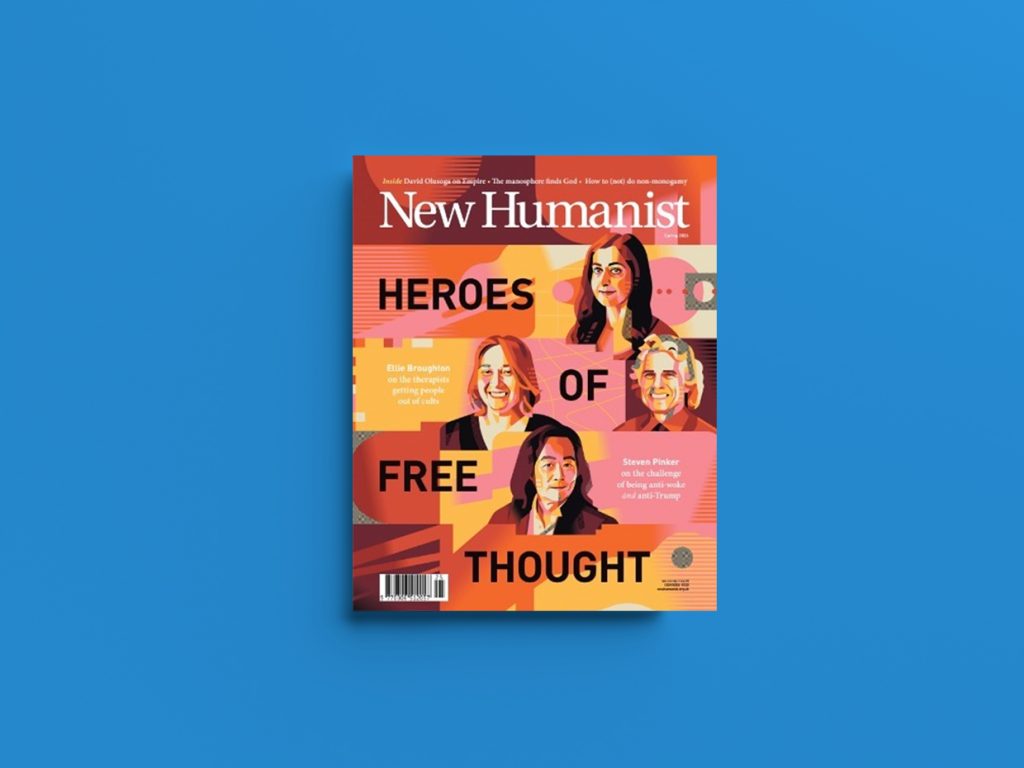
In its first issue of the year, titled ‘Heroes of Free Thought’, New Humanist pays tribute to the ‘difficult people’ who refuse to conform to ideological expectations and seek to stand up for the facts, whether intellectuals on the frontlines of public debate or those who are courageous enough to step away from systems of indoctrination.
Breaking free from faith
Ellie Broughton speaks to UK therapists who specialize in helping people break their connections with religious communities and forge a new identity for themselves. This process, which the US author and non-denominational pastor Brian Zahnd has described as ‘the process of paring away the extraneous elements of culture, myth and toxic dogma from their faith’, is referred to by professional therapists as ‘deconstruction’.
As Broughton explains, there are a range of therapeutic approaches to supporting people who are seeking to leave a religious group or recover from associated trauma. Besides ‘post-cult counselling’ methodologies, these also include secular spiritual practices that help patients fill the gap in their lives left by religion, such as music, psychedelics and somatic practices. In the UK, there are also volunteer support groups and helplines.
Some of those who manage to leave institutional religion behind become therapists themselves, applying their lived experience to gain ‘unique insight and understanding’ and to empathize with clients’ beliefs, fears and vulnerabilities post-religion. But while having personal experience of leaving a faith helps in many ways’, writes Broughton, ‘it can also be a hindrance’ – practitioners must avoid projecting their own experiences onto patients. Nonetheless, she writes, specialized therapists will be ‘ahead of the curve’ in providing deconstruction services in countries where religion is in decline.
In God’s name
Katherine Denkinson explores the rise of a new breed of misogynistic online influencers who are reframing themselves and the theories they espouse as Christian, using religious values to argue for a reestablishment of ‘the natural order’ and a return to traditional roles for women.
These figures are ‘gaining a disturbingly large following of young men’, she writes, citing a study that shows young British men are increasingly likely to identify as rightwing and anti-feminist. ‘It’s a shift that is being leveraged to gain legitimacy and influence for their misogynistic ideas in the outside world – including in political circles’, she writes.
With their calm demeanour and pseudo-intellectual theories, these men have secured appearances on national news channels in the UK, making them an even more pernicious threat than cartoonish, aggressive characters like Andrew Tate. They offer what appears to be a persuasive alternative to radical ‘manosphere’ politics – but in reality they are ethno-nationalists with close links to advocacy groups that oppose abortion and women’s rights, and whose talking points have been echoed by candidates from the Reform UK party.
Although some parts of the Christian establishment are attempting to distance themselves from these figures by adopting a consciously egalitarian public position, writes Denkinson, the risk is that such moves will merely further radicalize members of the Christian manosphere.
Red lipstick resistance
Alexandra Domenech documents the experiences of Belarusian women arrested and jailed for their opposition to the regime of Alyaksandr Lukashenka following the mass protests of 2020. Inspired by opposition presidential candidate Sviatlana Tsikhanouskaya and fellow opposition figureheads Maria Kolesnikova and Veronika Tsepkalo, thousands of women joined the protest movement, participating in women’s marches and calling for an end to the country’s patriarchal political culture.
Despite the harsh treatment they have received, ‘the women who have emerged from these colonies tell stories of defiance and solidarity’, writes Domenech. Although a recent amnesty saw many released, 175 women remain in prison for their political beliefs.
Domenech interviews several female dissidents about their experiences in jail, where systematic efforts were made to crush their spirit. Despite intense surveillance and harsh punishments, these women refused to be victims. Many organized morale-boosting activities for fellow prisoners and engaged in ‘secret, small acts of protest’ such as decorating small items with the colours of the red-and-white Belarusian flag or wearing red lipstick in imitation of Kolesnikova’s distinctive style.
As one former detainee explains, ‘some of the guards couldn’t help but feel moved by the dignity and integrity of the political prisoners’. Perhaps, writes Domenech, the future of Belarus ‘will be led by women – once they return from exile and are released from jail’.
Perils of rewilding
Richard Pallady explores the consequences of rewilding processes on plant and animal species. Although many organisms are ‘more than happy to rewild themselves,’ he writes, ‘they are not the static, placid entities we think they are’. Rewilding may appear to be a benign process, but it has complex practical outcomes that question our assumptions about modification and what is ‘natural’.
‘Introgression’, the ‘entry of one genetically defined population into another’, is an age-old process, but in the modern world, where huge regions are used for crop and livestock farming, and domestic animals are often free to wander, the opportunities for introgression – whether through cross-pollination or interbreeding – are far greater.
As Pallady explains, rewilding carries the potential risk of ‘genetic swamping’ – altering the wild population to such an extent that it is no longer able to adapt to changing conditions. Unfortunately, since limited research has been done on introgression – mostly on cases such as salmon or aggressive hybrid weeds – ‘we simply do not know what the effects will be’ in the long term.
Countries are increasingly adopting rewilding policies aimed at restoring populations of animals on the verge of extinction, often using specimens identified as the genetically ‘purest’. Pallady points out that we would do well to reflect on the practical, ethical and moral questions raised by such attempts at reverse engineering. We should also ‘pay more attention to genetics – and not just due to abstract ideas around “purity”’.
Review by Alastair Gill