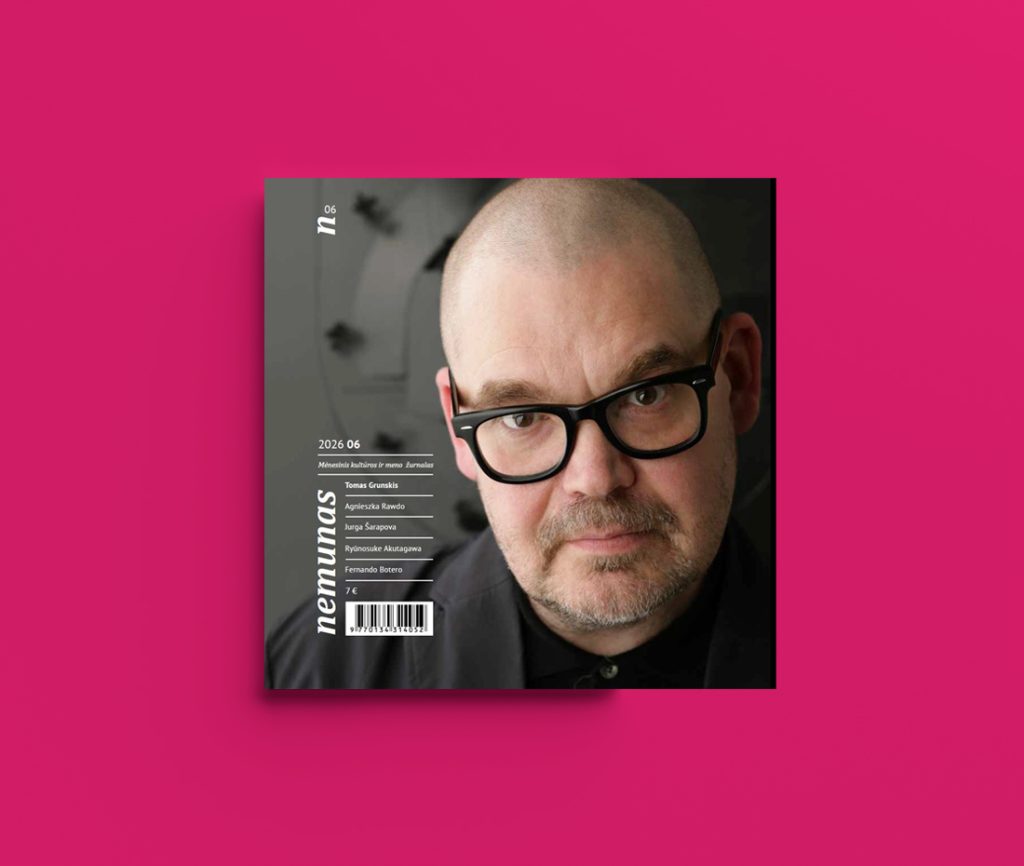
The Lithuanian architect Tomas Grunskis thinks of his profession holistically, as ‘a way of life’. Talking to Matas Šiupšinskas in Nemunas, Grunskis explains that architecture is ‘the art of creating space rather than buildings. A sculptor moulds clay; we mould space’. Architecture cannot be separated from culture, society, and personal growth. Grunskis describes his practice as resting on ‘three essential pillars: self-development, teaching and creative work’.
His childhood in Kaunas and the time he spent in his grandfather’s home helped shape his architectural sensibility: ‘That childhood environment has settled somewhere deep in my mind’. His grandfather encouraged discipline and ambition, while his mother’s technical drawings sparked his fascination with the relationship between lines on paper and built reality.
Grunskis recalls his student years as a period of experimentation, play and rule-breaking, abounding with generous teachers and a creative peer group. This openness later fed into AEXN, the architectural practice he sees as his greatest achievement. He stresses that architecture is a collective endeavour built on shared values, trust and long-term relationships.
A recurring theme is balance. Grunskis says that good architecture ‘strikes a perfect balance between discipline and freedom, between conceptual thinking and poetic sensitivity’. Grunskis deplores excessive regulation, declining trust in architects and irresponsible public speech, arguing that genuine criticism requires understanding and responsibility. He emerges from the interview as a philosopher of architecture, and someone for whom teaching, collaboration and reflection are central to creative life.
Lithuanian film
Returning from Cannes, film producer Marija Razgutė describes to Marius Giedraitis the ‘admiration and astonishment’ contemporary Lithuanian cinema has aroused there. With fewer than three million inhabitants, Lithuania has more directors at A-list festivals than Italy. Over her eighteen-year career, filmmaking in the country has gone from ‘years when not a single Lithuanian film was released’ to ‘a premiere every week or two’. A major contrast with the past is the existence today of a ‘smoothly functioning, organically connected ecosystem’ of independent production companies and a community of film professionals.
She characterises Lithuanian cinema as emotionally direct: it ‘picks at an exposed nerve’, addressing social wounds, generational pain and uncomfortable themes while still maintaining audience appeal. Unlike Nordic cinema, which she sees as more inclined to avoid or ironise difficult subjects, Lithuanian films often confront them directly.
Razgutė explains that international success depends on consistency, trust and a strong track record. Awards at Sundance helped Lithuanian films such as Slow and How to Divorce During the War reach a wider audience, but she rejects formulas for success: everything begins with a compelling story, fresh context and distinctive characters. Producing, for her, means turning text into images while managing time, people, and money throughout long periods of uncertainty.
She stresses that producer-director relationships are built on belief, respect, compatibility and long-term partnership. Because filmmaking is risky and emotionally driven, motivation comes from the possibility that a film might have an impact on individuals, communities or conversations in the public sphere. Although Lithuanian producers compete for limited funding, she sees that competition as healthy: ‘Every Lithuanian film that reaches a prestigious international festival opens the door a little wider for the rest of us’.
Warhol and Beuys
Inspired by a photograph he comes across on Instagram, Ignas Zalieckas explores the relationship between Andy Warhol and Joseph Beuys. The image of the two artists in Naples in 1980 reveals both intimacy and tension, symbolising the meeting of two giants whose artistic visions appeared worlds apart. Yet beneath these contrasts, the author argues, lies a remarkable kinship. For Zalieckas, the image is ‘more than a photograph. It captures the meeting of two opposing poles of post-war art – a symbol of friendship, or perhaps of a quiet, underlying opposition’.
Their first meeting in Düsseldorf in 1979 sparked a lasting mutual respect and inspired Warhol’s celebrated portrait series of Beuys. Although their styles differed dramatically – Warhol embracing glamour and mass production, Beuys championing social engagement and political action – both were driven by the same impulse to preserve and reinterpret everyday life. Warhol obsessively documented his daily experiences through conversations recorded by Pat Hackett, while Beuys collected postcards, found objects, and artistic multiples, turning the ordinary into something meaningful.
Ultimately, Zalieckas suggests that collecting and serial production form the hidden thread connecting these artists. By elevating everyday objects and experiences, Warhol and Beuys challenged audiences to rethink the familiar. They were not simply creating art but showing us that ‘the true wonder of life reveals itself precisely in the everyday. That, it seems, is what they were trying to tell us all along’.
Body intelligence
The actress Agnieszka Rawdo talks about the method she uses for overcoming anxiety, panic and bodily tension. Through movement, somatics and nervous-system awareness, she developed an approach centred on ‘what I call body intelligence, an invitation to develop the ability to feel oneself more deeply’.
Body awareness has helped her manage fear and stage fright, though she still sees acting as a craft requiring discipline. Rawdo distinguishes ‘value’ from ‘self-worth’, arguing that people should seek an inner anchor rather than depend on external validation. Criticism is information to reflect on, and when criticised one should ask oneself ‘What, if anything, is genuinely valuable in these words?’
Review by Cadenza Academic Translations