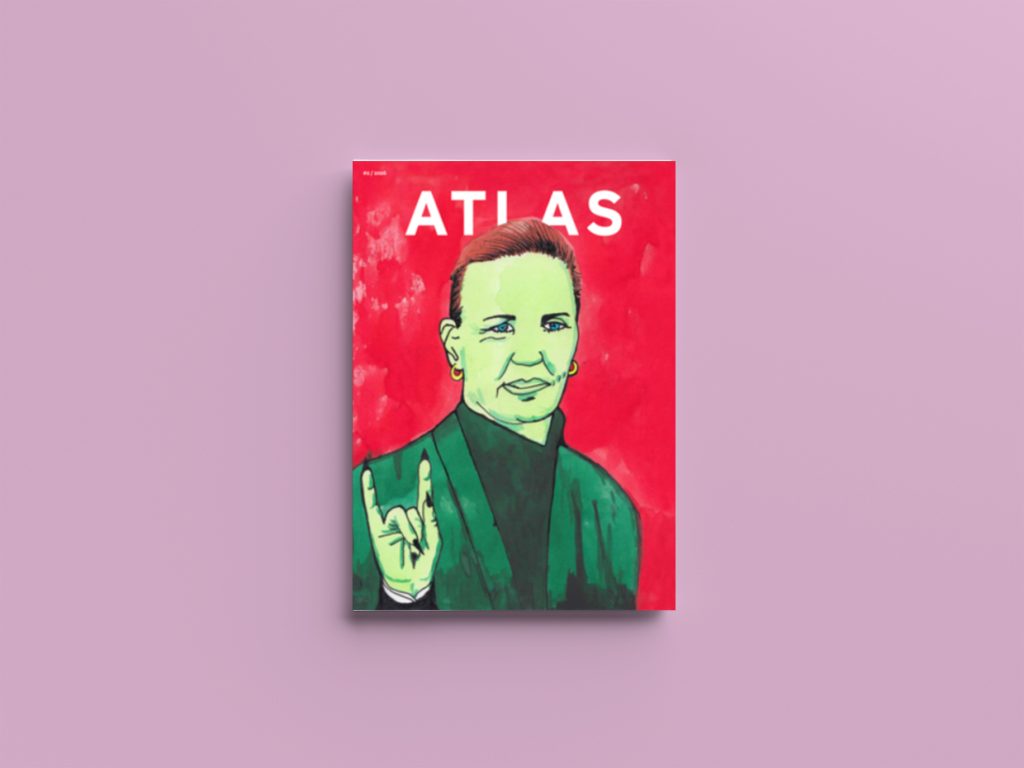
These are strange, dark times we are living in, writes Kristoffer Granov in his editorial to the fiftieth issue of Atlas (Denmark). As we become increasingly numb to modern horrors, our language seems deadened too: news stories looping the same events in lifeless, formulaic journalese, trite marketing copy, political slogans repeated until they mean almost nothing. Thinking itself is in its death throes, it would seem.
To mark its fiftieth issue, Atlas hopes to breathe some life back into prose, celebrating vivid, well-crafted, and reflective writing: ‘We need living people speaking a living language to other living people.’
Manosphere tales
The well-informed internet user is aware of the dangers of the digital manosphere – but awareness may not be enough, writes Alexander Rich Henningsen.
‘Training is non-negotiable,’ explains a fiftysomething on Henningsen’s feed, pectorals bulging. ‘Lifting weights is something every person on this planet should be doing,’ says American physician Peter Attia. And then there is cardio, a must for avoiding cognitive decline in middle age.
Not bad advice in itself – indeed, these health influencers often offer recommendations grounded in sound research. Yet taken together, such doses of useful advice can become toxic.
Henningsen describes how, as he fell deeper inside the rabbit hole of male health influencers, the relentless reminders of his supposed failings began to shape his thinking. He knew the images of perfect masculinity offered up on social media were impossible to attain. Yet found himself buying into these strange benchmarks: ‘Yes, perhaps hard, long-lasting erections really were a sign of a man’s status and worth.’
Taken aback by how easily his thinking had been infiltrated, Henningsen quickly realized he was not immune to the manosphere’s subtle powers of persuasion. In this cautionary tale, he shows how the route into far-right misogyny need not begin with extremism, but with seemingly sober discussions of exercise, health and discipline.
Copyright and creativity
What can – and should – be copyrighted? Creative works, certainly, but what about stories, characters, even character arcs? This is the question at the heart of Liv Helm’s essay, written in the aftermath of a lawsuit involving the Copenhagen theatre she directs.
In spring 2025, Husets Teater and playwright Nanna Cecilie Bang were sued by the rights agency Nordiska on behalf of the American rights holders to A Streetcar Named Desire. A settlement was eventually reached, but the theatre can never perform the play again. More lasting than the legal outcome, however, was its impact on Helm’s relationship to artistic creation itself.
‘If I become afraid of my own shadow in art, in the creation of theatre – which I love – then I am finished.’ The essay is less an attempt to settle scores than an effort to work through that fear and recover a sense of artistic freedom: ‘My fire must not go out entirely.’
As Helm explains, Notes on Blanche is not an adaptation of A Streetcar Named Desire, but a play about ‘a woman who sees herself reflected in a fictional character she has encountered in a film’. Yet the rights holders maintained that this was not Bang’s story to tell: ‘We own the character’s dramatic development.’
The startling claim prompts a broader reflection on artistic inheritance and intellectual property. From Shakespeare’s reworkings of familiar tales to sampling in hip-hop, all art develops through dialogue with what came before.
What began as a dispute over copyright gradually broadens into a meditation on authority, power and cultural ownership. Beneath the legal conflict lies a more troubling asymmetry: a small theatre confronted by a powerful rights regime capable of determining not only what may be performed, but who has the right to create and tell stories. ‘Who will pass on our shared stories over the coming millennia?’
Gentrification myths
Who is responsible for gentrification, asks Mikkel Borris in his essay on Copenhagen’s changing Nordvest district: property developers, politicians, investors – or the people who lament it most loudly?
While exalting the grit and character of the ‘authentic’ neighbourhood, the gentrifier also demands climate adaptation measures, waste sorting and fewer noise disturbances. Like Midas turning all he touches into gold, the gentrifier, in buying up an ‘authentic’ property, strips it of its raw charm.
Yet what exactly are Nordvest residents clinging to? As some of the district’s rougher edges are smoothed out, Borris finds it difficult to summon genuine outrage. The backlash against a proposed cycle path connecting the district’s wealthier and poorer quarters reveals the limits of urban romanticism: diversity is cherished as an aesthetic ideal, but less so when it threatens to become a lived reality.
‘One loves the idea of the socially diverse and ethnically mixed working-class neighbourhood … But in practice one does not particularly enjoy spending time with the “socially vulnerable.”’
Freedom despite
Kristian Husted’s poignant essay asks what freedom means once it can no longer be taken for granted. The question is prompted by the death of his friend Ivan, who was killed fighting in Ukraine. Before leaving for the front, Ivan told him: ‘We’re fighting for your freedom too – for the freedom of all Europeans.’
Husted probes the relationship between freedom, power and security against a backdrop of rearmament, geopolitical uncertainty and growing doubts about the American security guarantee on which Europe has relied for decades. Freedom, he suggests, is more than ‘freedom from’ constraints or ‘freedom to’ pursue one’s goals. It may also be a matter of ‘freedom despite’: the capacity to act freely in the face of danger, uncertainty and oppression.
Yet Husted is wary of turning freedom into a heroic individual achievement. The lesson he ultimately draws from Ivan’s death is not one of solitary courage but of mutual dependence. Freedom is neither a gift nor a given; it is something fragile that must be consciously maintained and defended. As Husted concludes, ‘freedom exists and unfolds within human communities, not in solitary majesty.’
Review by Cadenza Academic Translations