


One of the legacies of the Maidan in Kyiv is a subcultural revolution that retains its momentum to this day, albeit under increasingly precarious circumstances. Luigi Spinola talks to the DJs, entrepreneurs and politicians who know the scene best.
Live action role-playing in the Czech Republic: on the evolution of a not-so-niche cultural phenomenon; auto-drama and the thrill of borrowed life; military reenactments; the LARPization of politics.
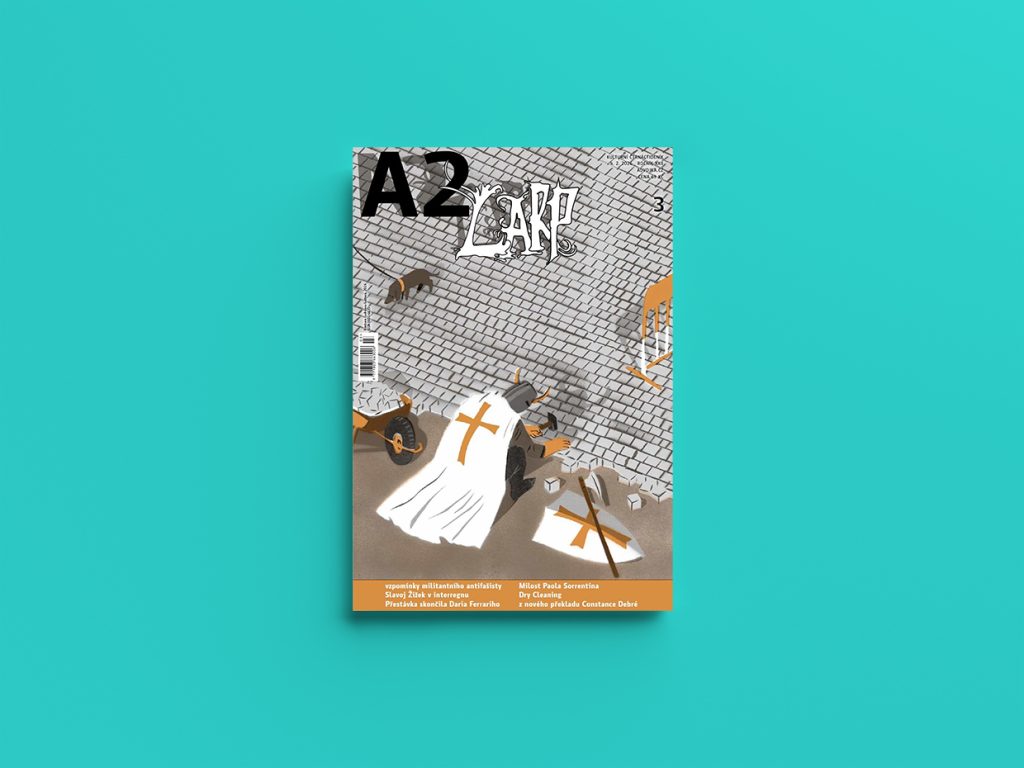
Czech biweekly A2 zooms in on ‘live action role-playing’, aka LARP. Inspired by tabletop role-playing games and genre fiction, LARP emerged in the West in the late 1970s and early 1980s, catching on in what was then Czechoslovakia after 1989. One of its early pioneers, writer Vilma Kadlečková, recounts how she and a group of friends founded the publishing house Altar in 1990, determined to catch up on things that under communism would not have passed the censors’ scrutiny:
‘The whole concept of “playing hero”, i.e. the idea of people playing the roles of fictitious figures, enacting and improvising their stories in their imagination, let alone dressed up and in real life, was completely alien to the regime. That is why even seemingly harmless things such as western fantasy or games were not in favour in Czechoslovakia under normalization.’
Altar’s first role-playing game, Dračí doupě (‘The dragon’s den’), was inspired by Dungeons & Dragons. A community slowly built up, with clubs springing up throughout the country, and gradually developed into fully-fledged LARP. Kadlečková has since moved on to literature, becoming one of the most celebrated fantasy and science-fiction writers, the Czech Ursula K. Le Guin. Mycelium, her highly acclaimed eight-part saga, has yet to be translated into English.
A2’s theatre critic Štěpán Truhlařík explores the similarities and differences between theatre and LARP. While both involve an audience and spectators, the theatre draws a clear line between actors and audience, whereas LARP merges these two categories into one:
‘All those present are, at the same time, those who act, watch and experience. This is the very essence of the LARP experience. Through everyone being involved in the playing, they jointly create the appearance of a fictional world that can exist only as long as everyone is taking it seriously. Theatrical devices such as costumes, acting and stage props are then used to help enhance the illusion.’
Truhlařík concludes: ‘While theatre remains a place of observation and interpretation, LARP places its participants in a situation where meaning arises directly from their decisions. Both forms thus respond to the same need to share a story. The difference is whether we want to follow the story or experience it first-hand.’
It was this first-hand experience that turned editor and PR professional Anna Urbanová from a LARP sceptic into a fan and, eventually, an organizer and member of a script-writing team. Prague boasts the largest LARP community in Czechia, with 400 to 500 people taking part on a regular basis – although some events have attracted thousands. In an interview with Matěj Metelec, Urbanová explains that her community focuses on storytelling and immersion, and that their games have little in common with the variety of LARP inspired by fantasy and featuring battles with wooden weapons:
‘Immersing yourself in character allows you to experience something akin to the adventures we dreamt of as children. Normally, in the space of three days you don’t get to experience the love of your life, a shoot-out with an enemy or to sacrifice your life heroically to save a brother-in-arms. I exaggerate, of course, but this kind of borrowed life stays with you in some way. And it imbues my “civilian” life with a more profound kind of emotion and experience.’
Admittedly, this can be quite unsettling, particularly if the script touches on sensitive chapters of recent history. This was the case with Zusammen, a 2021 LARP set in the Sudetenland between 1935 and 1945: ‘Half of the participants were Czech and half German and everyone played the role of the other nationality. This switching of perspective was quite chillingly effective.’
Matěj Metelec talks to historian Petr Wolmuth about what motivates people to take part in reenactments of military history. Wolmuth is the editor of the book on military reenactments in the Czech Lands, covering reenactments of historical events ranging from the Middle Ages to the colonization of America, through to World War II. Contrary to the researchers’ expectations, most of the people involved in the reenactment of Nazi military actions are not neo-Nazis or even people with rightwing views:
‘The general idea of military reenactors being mostly military fanatics proved to be completely wrong. We have found that historical reenactment relates primarily to unsettled accounts with history,’ states Wolmuth. He defines his method as post-positivist oral history, i.e. an approach that ‘does not regard recorded interviews as sources of reference to past events but rather as complex stories of the narrators’ own identity, ways in which the narrators understand themselves within history. Are they the winners? Are they somewhere on the margins? Is history developing in a way that speaks to them, or do they feel forgotten?”
Matěj Metelec notes that the boundary between games and real life is becoming increasingly blurred: for example, the images of the mob storming the US congress on 6th January 2021, in particular the QAnon shaman Jacob Chansley, may have looked like a major LARP event.
Czechoslovakia in the era of normalization could be regarded as a laboratory for political LARPing. ‘Not because of the melodramatic contrast between “living in the truth” and “living in the lie”, but because of the cynical slogan “they pretend to be paying us and we pretend to be working” … It would be nice to imagine that one could counter the LARPization of politics with a politicization of LARP. However, it has long been clear that “life imitates LARP much more than LARP imitates life.”’
A2 kicked off the year with an issue exploring folklore in present-day Czech and Slovak culture and mapping post-1989 efforts to find an authentic folk culture after decades of exploitation as an ideological tool of the communist regime. And in issue 4/2026, A2 draws on Jack Halberstam’s book ‘Female Masculinity’ to showcase Sapphic culture, the aesthetics of queer literature and ‘unhealthy’ forms of masculinity. Much of recent mainstream Czech literature featuring queer characters is an opportunistic gesture rather than genuine queer literature, A2 contends.
Review by Julia Sherwood
Published 10 March 2026
Original in English
First published by Eurozine
© Eurozine
PDF/PRINT
After over 20 years of publishing for free, Eurozine needs your support to get through an exceptionally lean year.
Become a Patron and get exciting perks for your help!


Want to hear a human voice?
Listen and subscribe wherever
you get your podcasts.
Subscribe to know what’s worth thinking about.

One of the legacies of the Maidan in Kyiv is a subcultural revolution that retains its momentum to this day, albeit under increasingly precarious circumstances. Luigi Spinola talks to the DJs, entrepreneurs and politicians who know the scene best.
By 1950, Poland’s postwar Stalinist regime was already near the height of its powers. Not that this stopped the emergence of a youth subculture during the ensuing decades. Tom Junes explains how associated movements evolved and even became useful to the Polish government.