


Against a backdrop of crime, corruption, inequality and sexual violence, Mexican novelists are returning to the tradition of the child narrator. Interviews with Fernanda Melchor, Luis Jorge Boone and Emiliano Monge.
Throughout history, Belarusians have turned to their rich folklore traditions in harsh times. What may appear as a period of cultural stagnation is often a moment of resilience and creative revival. And the current wave of Belarusian folk texts, music and dance is no exception.
In the history of Belarus throughout the nineteenth and twenty-first centuries, there is a pattern – after each failed uprising or short-term thaw, the society faces a crisis, resulting in culture retreating into folklore. During repressions, it becomes dangerous to speak about new meanings that emerged in the previous pre-crisis decades. Thus, folklore serves as the only acceptable and safe form of cultural existence and preservation. From it grows a new generation that leads to another uprising or ‘thaw’, and this cycle repeats.
This process manifested in the middle and second half of the nineteenth century. After the uprising of 1830-31, repressions occurred, including the ‘review of nobility’, the closure of Vilnius University, and the abolition of the Union of Brest. In 1844, Jan Barshcheuski published Nobleman Zavalnia, or Belarus in Fantastic Stories. This is an author’s expression wrapped in folklore form, where folklore serves an allegorical function and speaks through fairy tales and fantastic stories about events that occurred over the previous 50 years. These include the partitions of the Polish-Lithuanian Commonwealth and those other events up to the book’s publication. At the same time, Pavel Shpileuski began his ethnographic and myth-making activities, and his findings and works are still used in compiling encyclopaedias. His version of Belarusian mythology is taught in schools and penetrates modern literature (On the Other Side by Zaraslava Kaminskaya, Volnery by Valer Gapeev, or Ornaments by Alina Dlatouskaya).
After the 1863-64 uprising under the leadership of Kastuś Kalinoŭski, the region again faced strong repressions. The very name ‘Belarus’ was forbidden and uprising participants were punished or forced to emigrate. However, the uprising ultimately drew attention to the region. In the second half of the nineteenth century, Belarusian folklore began to be actively studied. During this time, important ethnographic and linguistic works were created by Yulian Krachkouski, Ivan Nasovich, Alexander Shymanouski, Mikhail Dzmitrieu, Nikolai Nikifarouski, Pavel Shein, Eudakim Ramanau and Yefim Karski. In 1894, Yefim Karski defended the first dissertation on Belarusian linguistics.
From folklore emerges one of the most important Belarusian poets of the nineteenth century – Francišak Bahuševič. A participant in the 1863-64 uprising, he published his books in Kraków (Belarusian Violin Bow, 1891) and Poznań (Belarusian Violin, 1892), and these two collections define the further development path of Belarusian literature. The rhythms of his poems are the rhythms of traditional Belarusian dances, while works saturated with folklore motifs reflect the problems of Belarusian peasants, their grievances, and the injustices occurring around them. From these two books the Belarusian literature of the Nasha Niva period flourishes.
The next crisis begins in the late 1920s. Around the same time, Vaclau Lastouski’s major ethnographic expedition of 1928 takes place. In the 1930s, during the time of large-scale repressions, the Republican Radio Festival of Folk Art is organized, with about 3,000 creators participating. The festival takes place in October 1937, during the most massive executions.
In the 1960s, the ‘philological generation’ emerged, whose representatives received consistent university education. For them, folklore was not an end in itself but a source of inspiration for creating new forms of expression. In the 1970s, which came after the ‘thaw’ of the previous decade, the era of stagnation began. In 1970, the Institute of Art Studies, Ethnography and Folklore of the Belarus Academy of Sciences begins a series of scientific publications on Belarusian folklore according to the genre principle of ‘Belarusian Folk Art’. The series has been published over 23 years and includes 40 volumes.
In cities, communities of Belarusian-speaking youth emerge, who separate themselves from village traditions but recognize their connection to them. During these times, movements alternative to official culture appeal to folklore. The association of young writers Tuteyshyia emerged in the early 1980s and existed in very close connection with the contemporary Belarusian national movement. Tuteyshyia played a major role in ensuring that nation-building processes of the late 1980s, which would lead to Belarus’s independence in the 1990s, also relied on folklore. For them, folk culture was returned heritage, and the return to authenticity became a strong argument in value and linguistic discussions.
The youth of the association organized Kupalle and Kaliady preserving rituals, and also performed Dziady, the classic play by Adam Mickiewicz. The first mass rally in modern Belarusian history is the Dziady march, which took place on 30 October 1988. The ritual pre-Christian feast of remembering the dead became an important political action that gathered tens of thousands of people. The organizers of the action included the poet Anatol Sys and future human rights defender and Nobel laureate Ales Bialiatski.
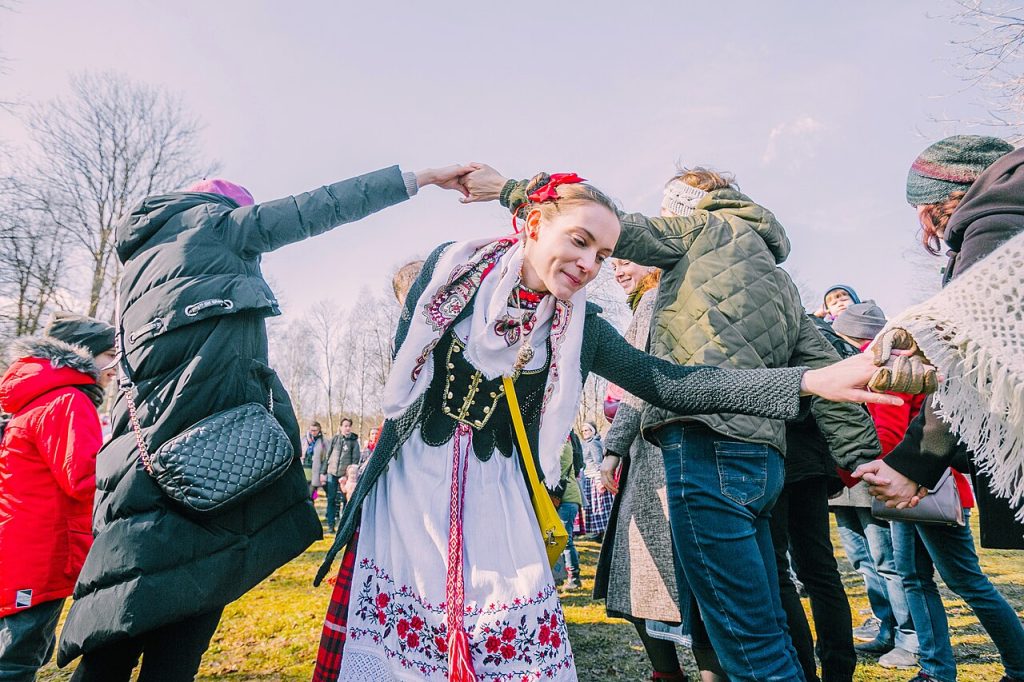
Ancient Slavic celebration of spring ‘Gukanne Viasny’, Vyazynka, Minskaya oblast, Belarus. Image by Mikhail Kapychka via Wikimedia Commons
After the fraudulent election and subsequent protests in 2020, repressions are now taking place constantly. Any open expression of discontent becomes dangerous and folklore again becomes the only space in which culture can exist. Folklore also plays an important role outside Belarus, serving as a tool for finding and preserving identity. The number of Belarusian dance communities in the diaspora is impressive. Initiatives in the field of Belarusian traditional dances that emerged after 2020 and organize regular events exist in Poznań, Gdańsk, Warsaw, Kraków, Wrocław and Białystok. In London in 2024, the album Vaclau Lastouski’s Expedition of 1928: Preserved Heritage was published. This was compiled by Volha Labacheuskaya and published by Czabor Publishing and Skaryna Press.
Regarding the situation inside Belarus, folk culture is now the only relatively safe place for cultural expression and preservation. Hundreds of people gathered for the celebration of Bahach (the autumn equinox festival, known since pre-Christian times) in September 2024. Participants in dance communities inside Belarus are also increasing, despite the emigration of a large number of active Belarusians. Folk crafts are in demand with studios of ceramics, weaving, straw weaving and paper cutting opening. In all this, folklore manifests as a de-colonial practice, a tool for finding and preserving identity within the country during times of repressions.
For state cultural institutions, folklore remains the only permitted way to talk about the national when it is dangerous to talk about the national. The National Art Museum organizes lectures about traditional culture and exhibitions of traditional costumes, with a similar exhibition being held at the National Academic Bolshoi Opera and Ballet Theatre.
The very concept of tradition contradicts change; tradition is directed at finding the lost and restoration, but not at creating and expressing other meanings not laid down by tradition. Therefore, works that use folklore as a tool, grounding and foundation, and then go beyond it, being full-fledged expressions of the author’s outlook, are especially valuable. Such cultural texts exist in modern Belarus. They have emerged over the last four years and are completely based on folklore but take the subject beyond static museum pieces, transforming it into a full-fledged dark and cathartic expression.
The techno-blues band Intelligency released their Malitva Belaruskaja video in August 2021. The action takes place in a batleika (a traditional puppet theatre) in the middle of an abandoned factory. The video’s characters – a devil and an angel – are also the main characters of batleika. The song’s text begins with the phrase ‘Oh in our paradise life is merry, life is merry, but for no one,’ which refers to the song Three Angels by Troitsa. This is a folk song that was recorded in the late 1970s in the village of Bartolomeevka in the Vetka district, which soon became a dead village after the Chernobyl disaster. The Belarusian Prayer itself ends with a pagan prayer to the sun, which is the culminating image in the video.
Three performances, each a ‘song in one act’, tell the most important events in human life: marriage, birth and death. The plot of all three performances fits into the plot of the folk song The Ox is Raging — Spring is Coming, a fragment of which is placed as an ‘epigraph’ in the annotation of Marriage with Wind:
The ox is raging –
Spring is coming,
The girl is crying –
Wants to marry.
Don’t rage, ox,
You’ll go to the field,
You’ll still plow plenty.
Don’t cry, girl,
You’ll get married,
You’ll still live plenty.
The raven caws –
Wants raw meat.
The girl cries –
Wants a son.
The raven caws,
Having eaten raw meat,
The girl cries,
Having had a son.
The raven caws,
Having flown away,
The girl cries,
Where to put him:
Whether to put him:
Whether to raise him,
Whether to send him
To the army,
Whether to drown him?
To send to the army –
Will be a pity,
To drown him –
Will be a sin.1
One of the main themes of the performances is the vulnerability of men who are captive to others’ decisions. While in the first performance there is a family story, in the final one men go to war and die. The subjects of the performances are women. There are no words in the performances, only folk songs arranged by Katsiaryna Averkava. All three performances are ‘ritual dramaturgy’. Specifically, Zabolotje begins with the Dziady ritual, in Pachupki there are 18 folk songs from the Birth ritual, and in Marriage with Wind there are songs performed during weddings.
Karniah and Averkava invented a metaphorical language for speaking about the terrible and dangerous, talking about trauma, war, violence, without saying a word – through folk songs, ceremony and ritual. The last performance of the trilogy, Zabolotje, at a certain point itself becomes a ritual in which the audience participates, making it an extremely intense experience.
Eva Viežnaviec’s book What is it you Seek, Wolf? was published in 2020 by the Pflaumbbaum publishing house and received the Jerzy Giedroyc Prize in 2021. It was translated into Czech, Swedish, German and Norwegian, and is now being prepared for Polish translation. The book has recently been adapted into a performance directed by Monika Dobrowlańska. The genre of the book, as defined in the annotation, is a swamp fairy tale, but it is a horrifying tale about a wild, dark world where it is uncomfortable and scary for humans to live.
The main character of the book – Ryna – returns to her native village to bury her grandmother Darafeia. Ryna’s grandmother is a whisperer, and her grandmother’s grandmother was too. Spells, rituals, superstitions and magical ways to remove a person from the world and heal them occupy an important part of the book. At the same time, the story is almost non-fiction, the stories told in it are documented either through documents or the oral history of the inhabitants of this area (the Luban region at the border of the Minsk, Homel and Mahilew regions). The central image of the story is also folkloric — it is the legendary White Pillar, a well with a holy spring, which must be found and dug up to restore the harmony of the world.
Each of these works, using folkloric forms, creates new narratives that make sense of the present. In current times, as two hundred years ago, folklore again serves as a space for culture’s existence and a tool that allows speaking about particularly painful topics in the current historical context. Does this mean that Belarus is now experiencing the next cycle?
This article first appeared in Eurozine partner journal New Eastern Europe.
BNT volume, Spring Songs, p. 84.
Published 1 December 2025
Original in English
First published by New Eastern Europe 5/2025
Contributed by New Eastern Europe © Maria Badzei / New Eastern Europe / Eurozine
PDF/PRINT
After over 20 years of publishing for free, Eurozine needs your support to get through an exceptionally lean year.
Become a Patron and get exciting perks for your help!


Want to hear a human voice?
Listen and subscribe wherever
you get your podcasts.
Subscribe to know what’s worth thinking about.
Against a backdrop of crime, corruption, inequality and sexual violence, Mexican novelists are returning to the tradition of the child narrator. Interviews with Fernanda Melchor, Luis Jorge Boone and Emiliano Monge.

Contemporary Moldovan novelists continue to thematize the struggle for linguistic, social and ethnic identity within the Soviet system. Taken together, their work forms a literature of post-totalitarian recovery.