

Despite a semblance of calm, Maduro’s removal has unsettled the Venezuelan regime. Will Chavismo’s tried and tested combination of coercion and expectation management continue to delay the long-awaited rupture?
Viktor Orbán’s Fidesz was defeated by a grassroots movement that faced down systematic intimidation in an extraordinary act of popular mobilization. The attempt to restart democracy in Hungary stands a better chance of success than at any time since 1989. Caveats apply, however.
The events in Budapest on the night of Viktor Orbán’s election defeat on 12 April were pivotal and unforgettable. Hundreds of thousands of people flooded the streets in a carnival-style fiesta. Such a level of popular enthusiasm was evident neither in October 1989, when the new republic was proclaimed, nor in May 1990, when the first democratically elected government was formed. ‘It was like winning the World Cup’, witnesses said.
Younger generations, who have spent all their adult lives under Orbán’s rule, campaigned hardest for change and feel that they are the main winners. Generation Z’s overwhelming support for Péter Magyar’s Tisza Party spread to older age groups, too, and was a game-changer across the country.
According to political scientists Andrea Szabó and Zoltán Gábor Szűcs-Zágoni, what happened on 12 April 2026 was ‘not just a critical election, a landslide or a change of government. It can truly be described as an electoral revolution: a bloodless constitutional political shift marking the beginning of a new era driven by the collective power of society.’
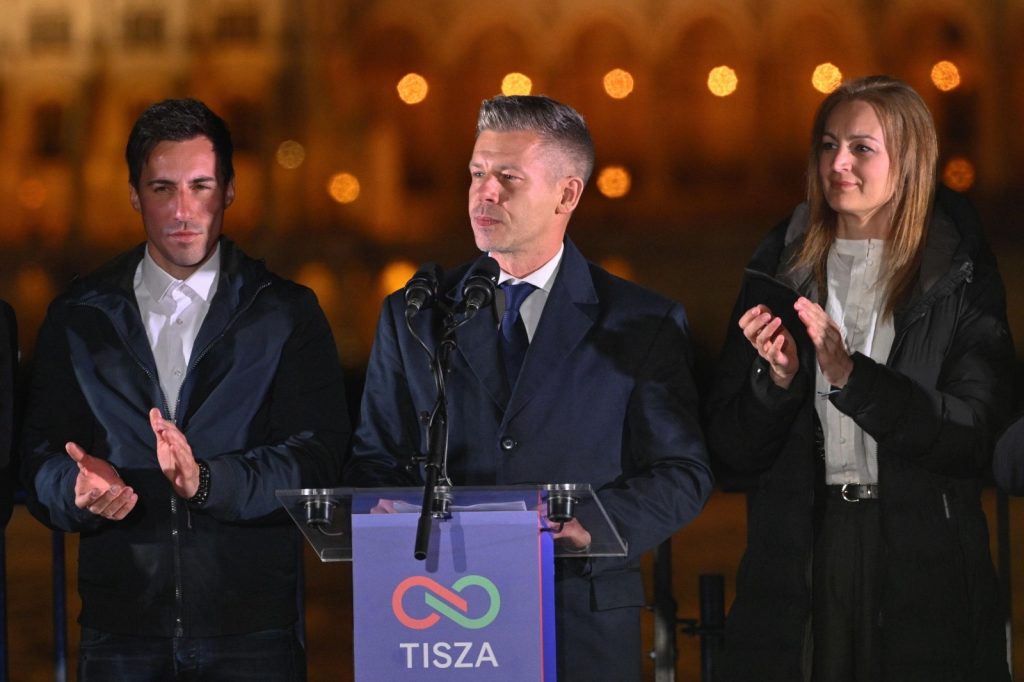
Petér Magyar, 12 April 2026. Image copyright Stefano Bottoni
What made this ‘electoral revolution’ possible? What consequences is Viktor Orbán’s downfall likely to have in Hungary, Europe and beyond? And how easy will it be to restore democracy to a country in which the division of powers has effectively collapsed?
The Hungarian constitutional system is modelled on Germany’s Kanzlerdemokratie and gives the prime minister a particularly strong position vis-a-vis the other parts of government. However, after 2010, Orbán effectively turned Hungary into an ‘absolute republic’, a term coined by political scientists Gábor Török and Péter Farkas Zárug to describe a system combining electoral democracy with the unrestrained use of state resources and a personality cult surrounding the leader.1
János Széky wrote in Élet és Irodalom that Magyar’s victory in fact ends Viktor Orbán’s 28-year reign, which began during his first term in office between 1998 and 2002. But significance of the 12 April vote embraces an even larger period of recent Hungarian history. These elections also mark nearly four decades since the transformation from a one-party system to a western-type liberal democracy in 1989.
A former frontrunner of westernization in the east-central European context, Hungary began to lose ground in the 2000s. The overwhelming vote for change can be interpreted as a call for another push towards the West after the previous attempt in 1989–90, which started promisingly but ultimately failed.
The 12 April also marks the end of decades of fruitless and detrimental political rivalry between a triumphant radical right and an increasingly frustrated and powerless left. The ‘cold civil war’ that Orbán has been waging since 2004 with his leftwing counterpart, the former prime minister Ferenc Gyurcsány, has finally ended in mutual destruction. Gyurcsány’s Democratic Coalition received just one per cent of the popular vote and will not be represented in parliament. Orbán also failed to secure a seat, after thirty-six continuous years as an MP.
For the first time since 1920, there will be no leftwing or liberal parties in the Hungarian parliament. The political landscape now comprises three different shades of right: EU-compatible, moderate conservatism (Tisza); anti-EU radical illiberalism (Fidesz); and neofascism (Mi Hazánk, or ‘Our Motherland’).
The absence of left-liberal opposition in the Hungarian parliament sends a grim message to the rest of Europe. If leftwing political parties cannot connect with voters, those voters will have to look elsewhere for political representation. Almost two thirds of the 3.4 million Hungarians who voted for the Tisza Party came from liberal, leftwing or green backgrounds. There are several new MPs in the 141-strong Tisza group with leftwing and/or liberal leanings. Despite its conservative profile, represented by Magyar himself, Tisza is a surprisingly diverse party, where leaders and rank-and-file activists from different backgrounds coexist.
Political scientist Balázs Jarábik has argued that the elections demonstrated Hungary’s ongoing democratic potential. But if Péter Magyar truly intends to effect change, he must address the long-standing illiberal tendency to grant the government almost unlimited power. Will Magyar make wise use of the complex network of legal instruments that could easily transform a democratically elected prime minister into a plebiscitarian leader and potential autocrat? Will Magyar resist the temptation to use his supermajority to consolidate his personal power?
These are the real questions awaiting answers. Viktor Orbán’s authoritarian path was not an anomaly or a bug in the system, but the extreme consequence of a constitutional mindset anchored in the idea of a dominant party and ‘stable’ governance.
Following the vote, Fidesz pundits began arguing that Orbán’s swift acceptance of the results showed that the system was far less authoritarian than his opponents claimed. However, this is contradicted by the evidence. For almost two years, Fidesz had employed a variety of tactics, legal and illegal, to suppress the dissent voiced by Tisza. Since 2024, the Hungarian government had exploited the powers of the security agencies and received covert support from Russia and, to a lesser extent, the United States, to destroy the only genuine contender and secure Orbán’s fifth consecutive term in office.
Orbán’s ultimate decision not to crack down on the opposition was motivated not by respect for the democratic will of the Hungarian people but because of an unprecedented display of force from Europe. It is tempting here to draw a parallel with the changes of 1989. However, in 1989, the peaceful transformation of communist Hungary into a multi-party democracy was supported by all the major powers and took place at the end of the East–West ideological divide. During this election campaign, by contrast, both Putin’s Russia and Trump’s United States openly backed Orbán’s regime.
Since late February, Orbán had been plagued by damaging press leaks. These originated from an entity of which Hungary was still a part, but which Orbán had started to label as his ‘main enemy’: the European Union. Several European security agencies cooperating on the Hungarian file had intercepted phone conversations between Orbán’s foreign minister, Péter Szijjártó, and his Russian counterpart, Sergei Lavrov, as well as between Orbán and the Russian president, Vladimir Putin. They revealed a pattern of strategic cooperation and moral collusion that made Orbán’s presence in Brussels undesirable.
The exposure of the public misconduct of senior Hungarian officials went far beyond the well-known issue of systemic corruption. All the Orbán system’s failed geopolitical ventures were exposed, including the attempted armed rescue of former Bosnian–Serb leader Milorad Dodik in 2025, which was thwarted by decisive American intervention, and the scandal surrounding the planned Hungarian military mission to Chad. While rumours could be heard in diplomatic and military circles about Hungarian involvement in the African operations of the infamous Wagner Group, the truth appears to be more straightforward. The deployment of 200 military personnel to a high-risk combat zone of little strategic importance to Hungary may have been driven by the glory-seeking ambitions of Gáspár Orbán, the son of the outgoing prime minister and at the time army captain, who wanted to save local Christians, regardless of potential losses among his fellow soldiers.
According to analysts in both the West and Russia, Orbán’s departure represents a significant strategic setback for Putin. Although Hungary is not a major military or economic power, it has played a crucial political role in advancing Russian interests. Moscow has lost its most valuable and long-cultivated ‘insider’ within the European Union and NATO. As a legitimate European leader rather than a puppet, Orbán was the Kremlin’s most effective tool within the West.
Moscow secures loyalty by offering cash, business opportunities and political attention. Amplifying fears of migration, war and loss of national identity has helped to translate pro-Kremlin sentiments into local politics across the region. Now, with the collapse of the invincibility myth, other pillars of Russian influence in East-Central Europe may also be under threat.
Péter Magyar has said his government will seek pragmatic cooperation with Russia, particularly on energy, and an immediate ‘crusade’ against Moscow is not in sight. Nevertheless, Hungary will cease to be a ‘spanner in the works’ in the EU, enabling more coherent decision-making. Putin loss of his only real foothold in Europe is a significant setback for Russian foreign policy.
Much has been said and written about Péter Magyar, the mole within the system who more than anyone else has exposed its moral decay and corruption. Gábor Bruck, one of Hungary’s leading election campaign strategists, has said that in his many decades in the field, he has never witnessed a performance of such calibre. For around two years, Magyar travelled the length and breadth of the country – literally on foot for weeks at a time – visiting no fewer than 700 locations and reaching millions of citizens in person. Many Hungarians living outside Budapest had never had the opportunity to shake hands with or speak to a national politician.
Counting on the support of Budapest – a long-standing stronghold of the anti-Fidesz liberal left – Magyar instead focused on the hidden, invisible Hungary of 2,500 villages and hundreds of small towns with populations of just a few thousand. The election results show that support for Tisza was spread across the whole country and not limited to the cities. Orbán’s electoral and cultural stronghold, ‘deep Hungary’, turned its back on him and embraced the vision of radical change promoted by Magyar.
However, it would be reductive to focus solely on the top level of the Tisza Party. Magyar deserves historic credit for daring to issue an existential challenge to Orbán’s power within the unfair electoral system Orbán had established. Nevertheless, he had something that Orbán’s power machine lacked: a genuine grassroots movement with widespread support. In the years to come, the Tisza Party will likely be studied as the model of a ‘popular front’ democratic mobilisation, capable of uniting right, left and centre behind a common cause.
The Tisza Party’s structure was organised into three distinct yet loosely connected tiers. The first was Péter Magyar, a political animal with innate charisma, a huge capacity for work and exceptional strategic instincts. András Körösényi, the doyen of Hungarian political scientists, pointed out that Magyar’s extraordinary success highlights not only the fragility of an autocratic system, but also an increasingly widespread and pronounced trend towards plebiscitary democracy.
The second tier, which has so far been almost imperceptible, concerns the party as a formal political structure. With only a few dozen members, the party could easily be described as an electoral committee centred around its founder and natural leader.
The third tier is perhaps the most intriguing. Since 2024, over two thousand ‘Tisza islands’ have spontaneously formed in hundreds of Hungarian localities, including villages where there has probably been no political activity since 1945–46 or the turbulent days of the 1956 uprising.
Although it is impossible to estimate the exact number, it is safe to say that hundreds of thousands of people have been actively involved in opposition politics over the past two years. This is in a country with barely eight million potential voters. The Tisza Islands have no legal status and are not formally affiliated with the small party headquarters. The members form a grassroots civic community of equals and have become a powerful example of informal, bottom-up democracy in a country that has lost its institutional democracy. After long complaining about the lack of civic commitment and interclass solidarity in Hungarian society, social scientists have finally found a topic of great interest: the emergence of a politically oriented social force outside the traditionally progressive capital city of Budapest.
The best example of grassroots action came on election day, when Tisza mobilised 50,000 unpaid volunteers. Despite the personal risks, they dedicated themselves to political change – the first time this has happened in recent Hungarian history. Almost 5,000 civilians patrolled the polling stations most affected by Fidesz’s well-established vote-buying scheme. As the documentary film A szavazat ára (‘The price of the vote’) revealed, this ranged from bussing voters to polling stations to handing out alcohol and drugs to addicts. Fidesz even threatened people’s jobs or child custody. Vote-buying gained the ruling party more than 200,000 votes in 2022; its campaign strategists hoped it would secure up to twice that number in 2026.
Travelling around by car or motorcycle, the presence of these volunteers managed to curb the phenomenon. In areas where ‘electoral tourism’ had been most heavily monitored, observers prevented tens of thousands of people from voting fraudulently.
The Tisza Party is also leading a quiet gender revolution in a country where politics has always been heavily male dominated. Women make up one third of the parliamentary group. By contrast, only 17 of Fidesz’s 135 MPs during the previous parliamentary term were women. Successful businesswoman Ágnes Forsthoffer will become president of the National Assembly; the former diplomat and energy expert Anita Orbán has been appointed foreign minister.
The greater presence of women in the Tisza party is not the result of compliance with ‘gender quotas’, however, but a sociological reality and cultural breakthrough. Female activism has played a decisive role in establishing and operating the Tisza Party. These women are primarily middle-aged and active in the private sector. Dissatisfied with the state of the country, they have the time and practical experience of managing daily life to contribute to the community.
All this said, the damage inflicted on representative democracy in Hungary between 2010 and 2026 will be long-lasting. Orbán’s System of National Cooperation found fertile ground due to the established pattern of patronage-based autocracy and the lack of functioning democratic models.
The largely spontaneous social mobilisation that brought about the downfall of the Orbán regime is not enough to overcome the longstanding weakness of Hungary’s democratic culture. Magyar’s parliamentary supermajority enables him to dismantle the former power system brick by brick without putting the legal system under strain, as happened in Poland after the defeat of PiS in 2023. The question is whether he will be able to restrain his own almost unlimited power, or whether his charismatic leadership of the party will backfire when serious issues concerning democratic standards arise.
Perhaps even more importantly, the new government will need to democratise the education system and political discourse. Mutual hate, grievances and scapegoating must be replaced by a new collaborative spirit. The hundreds of thousands of young people who voted for democracy and integration with the West should be given the opportunity to learn about democracy while attempting to implement it.
The support received by the new elite on 12 April bring great historical responsibility. Magyar and his government will need to study the errors made during the 20-year experiment that began in 1989–90 in order to avoid repeating them. For example, the political reintegration of the former authoritarian elite should be preceded by a process of lustration; crimes should be prosecuted and publicly exposed.
Above all, however, the new government must abandon the anti-democratic practices deeply rooted in the past century – from Miklós Horthy to Viktor Orbán and János Kádár – and establish a democratic state capable of addressing the numerous challenges of the current one.
Péter Zárug Farkas, Gábor Török: Orbán kora. Vázlat egy abszolút köztársaság felemelkedéséről, Budapest, L’Harmattan, 2026.
Published 29 April 2026
Original in English
First published by Eurozine
© Stefano Bottoni / Eurozine
PDF/PRINT
After over 20 years of publishing for free, Eurozine needs your support to get through an exceptionally lean year.
Become a Patron and get exciting perks for your help!


Want to hear a human voice?
Listen and subscribe wherever
you get your podcasts.
Subscribe to know what’s worth thinking about.


Despite a semblance of calm, Maduro’s removal has unsettled the Venezuelan regime. Will Chavismo’s tried and tested combination of coercion and expectation management continue to delay the long-awaited rupture?

While lasting peace between the Turkish state and the Kurds now seems a genuine possibility, Ankara’s assault on democracy continues. Sırrı Süreyya Önder, the longtime dissident who died last year, remains a symbol of hope.