On the rituals of prisoner exchange; a village priest who became an adoptive father of six; a wedding costume to be worn into the grave; the field hospital as a place between life and death.
Reporters, the long-form reportage magazine published by The Ukrainians Media, devotes its fifteenth issue to ‘beauty’, under a masthead that promises to search for meaning between facts. Editor-in-chief Marichka Paplauskaite opens with a photograph from a front-line ‘stabilisation point’ or field hospital: six pairs of hands holding a barely conscious body, faces lit red so the darkness hides them from the enemy, bent so close they form a circle, in a composition that recalls a Rembrandt painting.
Beauty of form can serve evil as readily as good, Paplauskaite writes; what survives is ‘the great beauty in the choice to remain human’.
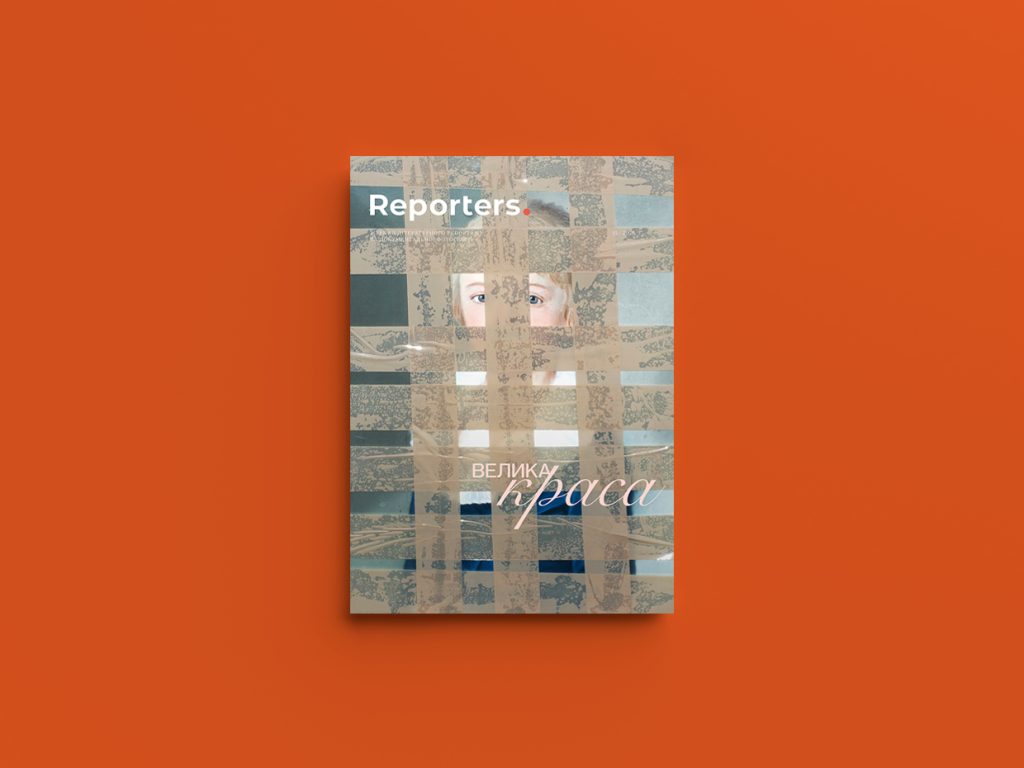
The flag of hope
Natalia Nahorna, a journalist who has followed prisoner-of-war exchanges for years, opens with a dream: buses between tall pines, pale close-cropped men in faded prison clothes, lying face up on emerald grass, weeping. She wakes on a pillow soaked through.
For the past eighteen months the exchanges have been held in Chernihiv region. Journalists learn of the date the day before. There is a petrol station on the way where everyone stops for coffee and the same sentences circulate – ‘ours’ have certainly been brought, perhaps the blindfolds are off by now. Families wait for a notification in the state Diia app. Nahorna photographs a woman and wishes her the most valuable thing possible on such a day: that she receives the message.
Ten minutes later she hears her scream. ‘Happiness can be deafening’ – often relatives faint from the excess of it. Many of the released feel guilty and have waited months to apologise to the people who waited for them. One woman embraces another family’s daughters, following a local superstition: hold the relatives of the released ‘so that the exchange passes on’.
Nahorna has her own relic: a wand in a box and a ticket from platform nine and three-quarters, carried to fifteen exchanges, the corners worn soft. They belong to her friend Sasha Ivanov, a marine of the 36th Brigade, who last called from the Illich plant in Mariupol at four in the morning, the wounded groaning behind him, when it was already clear that captivity lay ahead. Four years have passed.
Ivanov knows the Harry Potter books by heart, so his friends write to tell him which of the film actors have died: Hagrid, Professor McGonagall, Dumbledore. When someone dies in that world, the rest raise their wands: ‘We know that if he reads our letters, he raises his wand in his mind.’ Beside the wand lies a pair of socks reading ‘Dobby is free’, kept for the moment he steps off a bus and gets the joke. Relatives at the roadside carry blessed crosses, bracelets woven by children, and a white and black flag – white for the hope of return, black for those who vanished or were tortured to death. ‘Last June I promised that when he returns I will tie the flag of hope around his shoulders.’
On 15 May 2026, after this issue went to press, Oleksandr Ivanov came home in a prisoner exchange, after 1,494 days in Russian captivity. In a colony in Mordovia, where prisoners stood in silence from reveille to lights out, while propaganda radio played without pause, he retold all seven Harry Potter books to his cellmates from memory, whispering so the guards would not hear, and breaking off at the most interesting moment so that they would ask him to go on. ‘We felt like prisoners of Azkaban, with dementors behind the door. And how is it best to fight dementors? With a patronus. When a person in captivity starts to believe that he is expected at home, that creates a patronus so strong that no dementor can get through it.’
The yard opposite the church
Artur Dron talks his way into the house of Father Oleksii Filiuk, who lives near a friend he is visiting. He was among the first Ukrainian priests to see what online preaching could do; more than one and a half million people follow him on Facebook alone. He greets them with ‘Thanks be to God and to the defender of Ukraine that we woke up happy.’ He settles questions of superstition – yes, you may sleep in a bed where a grandmother once died – and films the ordinary business of village life: building work, a son’s birthday, his rabbits. He speaks openly about his own family history: his wife left him for another man, and he was able to move on, though he admits with a smile, ‘I love her anyway!’
Living alone, with his yard filling up with silence, he decided to adopt a boy from a children’s home. Then another, and another; he became a father to five, the eldest married with a child of his own. A nineteen-year-old called Mykhailo, who grew up in an orphanage and now studies at college, wrote to him in December 2025 after following him online: ‘May I come to you for Christmas Eve?’ Mykhailo communicates only in sign language or in writing. He became Filiuk’s sixth child.
The women of this family
‘There is faith in God, and there is faith in your kin’, runs the line above Olena Livitska’s reportage. The latter sometimes makes a person begin what they never planned. Valentyna Zusko saw the wedding costume of her grandmother, Nastia Hnatkova, and decided to make an exact replica. In Volyn Polissia, women bequeath their wedding clothes, often called vinchalni, to be buried in – dressed for the grave as they were dressed on the day they married. Death is not an end: ‘I must be beautiful, because they will meet me there.’ When Nastechka died, the children dressed her in the girlhood shirt embroidered with broad flowers and set a candle in a jar of grain. The women of that family quietly did what had to be done.
Nastechka came from Lobna, a village absorbed by Novovolynsk, a Soviet mining town built at speed for the people who dug its pits. Zusko carried the shirt, apron, headscarf and skirt to Kyiv to be digitised with the Vidkryta Skrynia project, which documents historic dress, at a time when she was afraid of not finding a shelter during the shelling. Researching Liubeshiv embroidery, she found how much has gone: one Etsy shop that opened around 2022 has sold eight hundred items from the district. These are dealers, not collectors, she insists. Beauty leaves for the other world less often in coffins than through indifference – rushnyky used to wipe shoes, shirt sleeves on rubbish tips, the clothes and goods from a dowry chest burned in the middle of the yard when their owner dies.
In September 2025, on Nastia’s anniversary, Zusko entered a competition for the most exact reconstruction of an authentic costume, sewing to the millimetre in double-sided satin stitch and reproducing even her grandmother’s mistakes. The costume won. ‘I believe in my kin. I believe that in a hard time for our country the souls of our dead awaken and act so that Ukraine may live.’
A place in between
For nine months the photographer Liza Bukreieva documented the medics of the Third Army Corps in stabilisation points, where there are minutes to stabilise the wounded before evacuating them or returning them to duty. It is a place ‘in between’: the battlefield and the rear hospitals, light and darkness, life and death, writes Daria Svystukha. Nothing prepares a person for a field hospital; sometimes tears come as a physical reaction to the disinfectant. Bukreieva photographed as though every wounded man were someone she knew.
After assaults the wounded arrive in dozens, most often in the middle of the night, and the medics work shifts of four days at least. They take a long time to recover from those who arrive in a terminal state; once they stood outside for ten minutes and nobody dared to move first. The rooms hold other detail: lilac on a table in spring, garlands in winter, children’s drawings on the walls all year.
‘To feel joy during the war we have to make a great effort – and soldiers twice as much. What is needed is the ability to make joy out of nothing.’ Sweets for an evacuation driver, an energy drink for a medic: joy made by hand, which cannot be had for free. Closer to the line the world narrows – from political news, petrol prices and blackouts down to brotherhood and support.
Review by Kseniya Kharchenko
Published 5 August 2026
Original in English
First published by Eurozine
© Eurozine
PDF/PRINT
Invest in insight!
After over 20 years of publishing for free, Eurozine needs your support to get through an exceptionally lean year.
Become a Patron and get exciting perks for your help!


Want to hear a human voice?
Listen and subscribe wherever
you get your podcasts.
Newsletter
Subscribe to know what’s worth thinking about.