I meet Hana in the Artfórum bookshop in Kozia Street in Bratislava. It is one of her favourite haunts and also one of the few which, in the early days of this millennium, stocked Atribút, the first cultural and social monthly for queer people. The only other place you could buy it was Marta Šáteková’s legendary Ex Libris in Michalská Street and a handful of newsagents across the country. ‘We want to step into legality,’ said a slogan on the front page of Atribút in 2001. Well, we know what that legality looks like today.
Born in 1963, Hana Fábry missed out on the euphoria of Prague Spring. But although too young to take in all its implications, she was aware that the grey era of normalisation had begun and clearly remembers those days.
‘Not only was it not possible to be in a gay relationship, we didn’t even know that such a thing existed,’ she tells me over a cup of herbal tea. ‘We had no one to talk to – because of course, a socialist person could not possibly be homosexual! “Do you know what a faggot and a tractor at a collective farm have in common? Shitty rubbers!” Queer people were only ever publicly mentioned as the butt of crude jokes.’
Forbidden queering
Where does a teenager in socialist Czechoslovakia look for information if she has a secret crush on a female friend? Or needs to figure out what’s going on? She picks up the dictionary of foreign words. ‘It included the word lesbian. I even seem to remember that it was there in the diminutive form lesbička, and its definition went: “an unhealthy, unnatural attraction of one woman for another”. Surely that’s not something you want to be like?’ recalls Hana Fábry.
Hana and many others like her have come to regard the word lesbička as offensive, a stigmatising slur. Lesbians subverted people’s idea of the role of a woman in socialist society as well as that of a mother and wife in communism. ‘I still dislike the word and avoid it,’ Hana admits. She prefers the word teplá (gay – trans).
Anyone who has ever been in love knows how it feels. But having to suppress your feelings, hide them and have no one to talk to about it is painful. ‘As it was forbidden but at the same time, irresistible, I tried to become best friends with the girl I was in love with. Or at least be accepted into her inner circle,’ says Hana, looking back on her 17-year-old self. The days of hardline normalisation may have been over by then but the regime still had a firm grip.
Steady relationships went hand in hand with secrecy. ‘Under the commies I had only one or two girlfriends. But to be on the safe side, I told each of them that she was my first and only one. I was scared that they might let something slip if they had a drink too many,’ Hana confesses. The memory of her past anxieties and loneliness makes her frown. ‘Having no one to talk to when you’re happily in love is one thing. But being unhappy and having no one to tell – that’s painful. It was hard to bear.’
All alone in the world
I pluck up the courage to ask about her family: ‘Were you not able to confide in them?’ Her father had barely managed to get a taste of family life before he died when Hana was only four months old. Her mum was left to shoulder all the responsibility. ‘She loved us very much,’ Hana stresses. She worked twice as hard, even going on business trips when necessary. School holidays where the only time she was able to travel with her children. The memories of the holidays with her mum still conjure up a smile on Hana’s face.
The next blow came when she was twelve – her mother died. ‘Growing up, I felt all alone. My sister wasn’t quite twenty-two yet, she was studying to be a doctor. She would take night shifts at the hospital in order to make ends meet. She threw her own life away to take care of us – myself and my brother. There was no time to talk about anything apart from homework or whether we’d eaten our school snack.’
It was activism that taught Hana to speak up for herself and about her own needs and ideas. When students first took to the streets of Bratislava on 16 November 1989, she was among the three hundred or so young people who gathered in what is now Hodža Square. She knew she had to be there. She was twenty-six, had embraced her identity, and wanted to live it to the full. Now she was discovering a new, civic dimension to her life.
At first, it never even occurred to Hana that the regime could actually fall. When it actually happened, it came as a shock. It only began to sink in properly when she heard about the mass protests in Prague. The crowds of protesters in the streets began to swell in Bratislava and other Slovak cities after 20 November, and the push for change grew stronger.
After 1989 Hana gradually evolved into an activist, political commentator, photographer, manager and tour guide around her native Bratislava. In the first decade after the revolution, she was involved in every event that was a milestone for the queer community in Slovakia.
In May 1992 she joined Ganymedes, the first Slovak organisation defending the human and civil rights of gay and lesbian people. Two years later she founded the first independent lesbian association, Museion. More letters, identities and individuals were gradually added to the letters L and G.
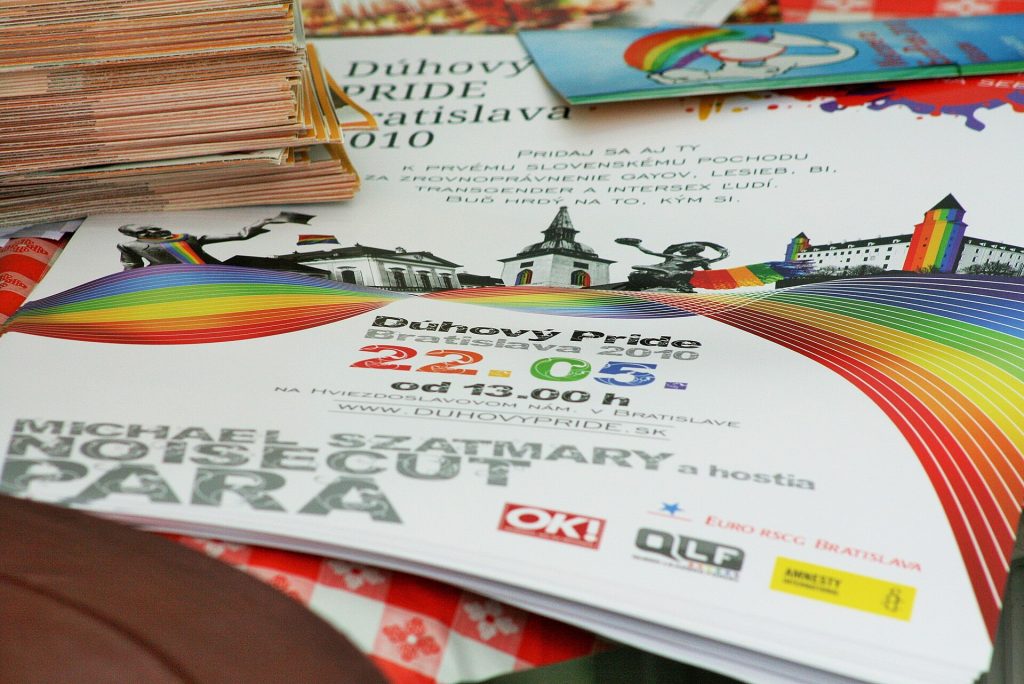
Hana was a contributor to the journal Atribút, mentioned earlier. In 2000 she helped found the initiative Inakosť [Otherness], which started life as an informal group. As a member of the Queer Leaders’ Forum she mentored a new generation of activists. And in 2010 she went on stage to address the crowd at the first Bratislava Pride. Incidentally, our city was the last capital in the European Union to organise a Pride event.
Why do you hate us?
The question remains: how is it possible that, despite the enormous efforts over the past thirty-five years, we haven’t seen any improvement in terms of equal rights for queer people in Slovakia? In fact, we have even regressed. All over Europe LGBTQI+ people are in the crosshairs of assorted populists, extremists and neo-Nazis, but Slovakia went one step further, enshrining two sexes in the country’s constitution. This happened over three decades after the fall of the dictatorship and more than two decades after we joined the European Union.
Hana puts this down to a variety of factors. ‘The [political party] Christian Democratic Movement (KDH) has always been and will always be reactionary. Under communism they suffered oppression. But after coming to power after the revolution, they started playing God and oppressing us. In his capacity as minister of justice, Ján Čarnogurský [former dissident, first KDH chairman, former prime minister and latterly pro-Russian activist –ed.] launched the deliberate politicisation of the gay issue, which continues unabated. But this has only made us stronger. We have moved from community-building activism to civic activism. However, we haven’t achieved enough,’ Hana concludes, wearily and sceptically, sinking into the sofa.
Under socialism, Fabry feared she might be forced to undergo medical treatment for loving a woman. ‘Nowadays, what I must fear is that just because of the most beautiful thing there is – love – I might be shot dead in the street, like Matúš and Juraj [two young men shot dead outside a gay club in Bratislava in October 2022 – ed.]. I feel worse now than ever before. In the old days, they didn’t want me to exist, now they hate me. But why?’
Rather than prejudice or fear of otherness, Hana believes this is an evil which people imbibe with their mother’s milk. ‘Don’t touch that dog, it will bite you. Don’t go up to that man, he’s smelly. Ha-ha, you’re sitting next to the fatty in class! This evil has been inculcated in people and fostered by the establishment. We don’t know how to live in a democracy, how to live in freedom,’ Fabry concludes.
A little more rainbow in politics
Many had hoped that the advent of democracy would mean that queer people would no longer be criminalised, stigmatised and regarded as sick. However, the optimism that followed the fall of communism, the defeat of the regime of Vladimír Mečiar (1990 to 1998) and the joining of the EU, which required our country to provide legislative protection to all citizens including queer people, proved to be short-lived.
The anti-discrimination legislation adopted in 2004 was just window-dressing and we have yet to see comprehensive protections for the rights of queer people. Mikuláš Dzurinda’s government between 1998 and 2006 continued to pursue a conservative political agenda. It has become too deeply entrenched in this country.
Although more than two decades of activism have left Hana exhausted, she does see a ray of hope in the Association of Parents and Friends of LGBT+ people, founded in 2020, as well as the community that has formed around it. It reminds her of the 1990s and the ideas she used to come up with Jaro Gyurik or two other friends who are no longer with us, Ivan Požgaj and Marián Vojtek: regular meetups, weekend events and outings, networking, some of it online. ‘I would like them to become a little more political though, at least a tiny little bit, particularly seeing as our rights are being trampled upon again. We are being driven back into isolation,’ adds Hana Fábry as she takes the final sip of her tea.
No one is going to respect you for who you are if no one knows who you are
‘Do you know that this place used to be a brothel?’ Jaro Gyurik asks me as we walk into Bistro Ferdinand in Janko Kráľ Park in Bratislava. I met him through Hana. We take our coffee in paper cups to a bench outside so we can enjoy the sunshine. ‘Some people used to frequent erotic salons, others underground toilets,’ says Jaro with a laugh, referring to a network of public toilets across Bratislava that served as gay meeting places. They included the ones next to the St Andrew Cemetery, the old Avion, in front of the Reduta concert hall, the City Savings Bank, in Kollár Square as well as one by the park in Šafárikovo Square.
If there is anyone in Slovakia’s queer minority today – apart from Hana – who has something valuable to say about the transformation of people’s attitudes from socialist to post-socialist, it is Jaro. ‘The problem is that we didn’t really have to fight for our freedom. That is why freedom doesn’t carry a profound meaning for our society. We rattled keys in the squares but is that enough?’ ask Jaro, shrugging his shoulders. ‘Some have taken a larger bite of freedom than others. And while I have to put up with a bloodied Jesus Christ on almost every corner, even thirty-six years after the revolution I don’t have the freedom to hold my husband’s hand in public.’
Jaro was a founding member of Ganymedes. He was introduced to Vojtek, Požgaj and later Hana by the sexologist Božena Castiglione, to whom many queer people who felt lonely in those days would turn with their personal and health problems. She connected them to each other and helped to spark their activism. But what really mattered was that she did not treat them as if they were sick, recalls Jaro.
Under the old regime, well into the 1960s, homosexuality was regarded as a mental disorder – its diagnosis had the number 302. Even though medical opinion around the world as well as at home has been changing, the idea that queer people are sick still holds sway among many in Slovakia. Not just lay people but also within a small but particularly vocal, group of medical professionals.
The 1990s saw the emergence of the first self-help support groups – gay, lesbian and bisexual. People who lived too far away were able to make use of crisis telephone helplines or write to P.O. boxes, including one administered by Ganymedes. By then Jaro had left the group as his and Marián Vojtek’s views on the ways of achieving their shared goal – equal rights for same-sex couples – had diverged.
Freedom is coming out
‘Freedom is coming. Freedom is coming out’, proclaims the cover of an issue of the Ganymendes community magazine from 1993. ‘No one is going to respect you for who you really are if no one knows who you are. This was a key point on which Maroš (Marián Vojtek – ed.) and I disagreed,’ says Jaro.
Marián favoured a slow and cautious approach and felt that Jaro was putting too much pressure on people to come out. ‘I think this is one of the reasons why we are still second-class citizens in this country and why we have not yet won our rights. My first coming out, at work, was a huge relief, even though it happened by accident. Up until then I had been living two separate lives, two identities, but I had had enough of it,’ Jaro explains.
After parting ways with Ganymedes, Jaro decided to mobilise LGBTI+ people by means of entertainment. On 7 February 1992, he organised the First Gay Gala Ball in Czechoslovakia in Bratislava’s Park of Culture and Leisure (PKO). He brought a couple of ballroom dancers from Interclub, where he enjoyed ballroom dancing; organised a DJ from FunRadio and found volunteers among members of the gay community to take part in a drag show. Tickets cost a hundred crowns. There remain only two pieces of evidence that the ball took place: a flyer and a photo which shows a tall, thin, red-haired diva in a tight red gown. My guess is that her singing voice was closer to a baritone’s than a soprano’s.
‘The staff at PKO found the idea of a gay ball inconceivable and threatened to go on strike, but later they told us that ours was the best event ever held at the venue. Nothing had been broken and there had been no fights,’ he recalls with glee. Although it was a big success, the event left him 4,000 crowns in the red, a debt that took him years to repay. It makes us both laugh.
Apart from the ball, Jaro and his friends also organised Friday discos at the Camel Club, swimming in the lake in Rusovce, and nudist beach gatherings, as well as disco cruises on the Danube and community trips. ‘Of course, we had to have security as well. If skinheads had turned up, we would fight them with anything we had, including our hats. The club used to be packed solid, and they wouldn’t have stood a chance’, explains Jaro.
He participated in protest rallies and pride marches in Slovakia and abroad before moving with his husband to England, where he stayed for twelve years. He returned to Slovakia three years ago – on his own. He had enough of the constant rain as well as all the smiling faces.
Caring for lonely gay and lesbian people
He is no longer in touch with what is left of the former queer community, which changed while he was away. He has sold his flat in Bratislava and bought an orchard in Žitný ostrov, where he tends to trees neglected by the previous owners. He spends most of his time outdoors and on his own. Lately, however, his old organising drive has been reawakened.
‘In the UK there are non-profit organisations that provide care for ageing lonely gay men and lesbians. Their work is supported by the National Health Service, which understands that it makes sense to invest in programmes of this kind: it makes people happier, enables them to enjoy greater physical and mental health and be more empathetic,’ says Jaro, introducing one of his latest ideas.
His other idea is to set up a safe refuge for men who are free in both body and soul. I don’t need to close my eyes to visualise both his ideas taking shape in an avenue of trees in his orchard, far from the madding crowd. The first idea makes me smile, the other, blush.